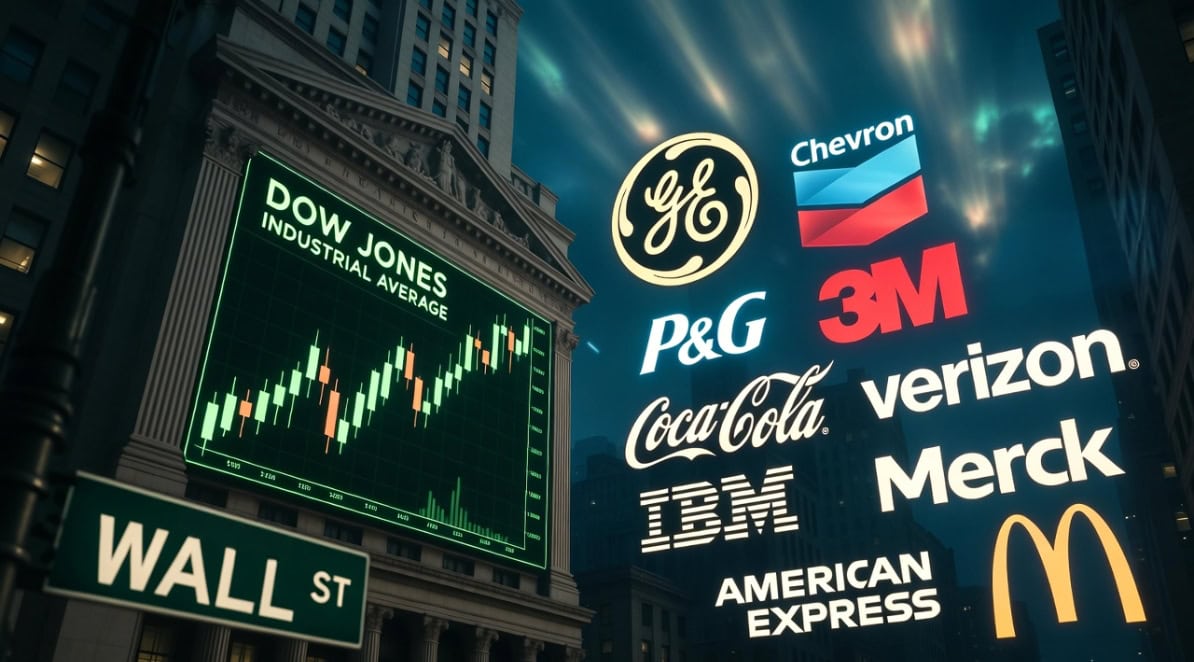
The Dow Jones Industrial Average (DJIA) has changed its 30 components 59 times since 1896. Most stocks that enter the index do not stay long. However, a small handful have remained through the Great Depression, World War II, multiple recessions, pandemics, and major technological shifts, proving themselves as the true long-term survivors of the Dow.
General Electric: The Dow’s Longest-Serving Stock with 122 Combined Years
Nobody has logged more total time in the Dow than General Electric (GE). The conglomerate was one of the original 12 companies when Charles Henry Dow first published the DJIA in 1896. GE was dropped and re-added twice around the turn of the 20th century.
Yet it still spent more combined years inside the index than any other company in history, before being removed for the final time in June 2018, replaced by Walgreens Boots Alliance. Its roughly 122-year association with the Dow will almost certainly never be beaten.
GE no longer sits inside the DJIA. But its legacy still defines what analysts mean when they say “blue-chip.”
Procter & Gamble: Longest Continuous Member of the Dow Since 1932
Among today’s 30 current DJIA components, which Disruption Banking has dutifully covered here, none has held its seat longer than Procter & Gamble (PG). P&G joined in 1932, 94 years ago, and has never been removed. Tide, Gillette, Pampers, and Bounty, are some of P&G’s brands so embedded in daily American life that removing P&G from the Dow would feel as absurd as removing it from the grocery aisle.
P&G beat analyst estimates on April 24, 2026, reporting $1.59 in earnings per share against a consensus of $1.563. It is also a Dividend King, with 69 consecutive years of dividend increases, one of the most reliable income generators on any major index.
As Disruption Banking has previously reported, even in a strong 2025 for the broader Dow, P&G slid 13.8%, but that is not the measure of its longevity. It is still here. That’s enough.
Chevron: Earliest Current Member of the Dow (With a 9-Year Gap)
Chevron (CVX) first entered the Dow in July 1930. If you count only from that original date, no current member joined earlier. But Chevron left the index in 1999 and only rejoined in 2008, a nine-year absence that disqualifies it from the “unbroken tenure” title.
Chevron is now the Dow’s only remaining oil major, and considered a big winner of the US-Iran war. Its significance in the index reflects energy sector representation as much as it does raw seniority.
3M, IBM, and Merck: Which Stocks Have Lasted Over 40 Years in the Dow?
Three other current DJIA members have held their seats for more than four decades. 3M (MMM) was added in 1976, making 2026 its 50th anniversary inside the index. International Business Machine (IBM) rejoined in 1979 after a four-decade absence and has remained continuously for 47 years. Merck (MRK) also entered in 1979, clocking another 47 unbroken years.
American Express (AXP) followed in 1982. McDonald’s (MCD) in 1985. And Coca-Cola (KO), which was an early Dow member in the 1930s but was dropped in 1935 alongside DuPont’s entry, only returned to the DJIA in 1987.
What 90+ Years in the Dow Jones Signals for Investors in 2026
Staying power in the Dow Jones is not just a badge. It is a signal. And rightly so because the companies that have remained in the index for the longest periods tend to share a few consistent traits: global brand dominance, reliable dividends, and the kind of earnings consistency that outlasts political cycles and geopolitical crises alike.
Albeit, expect more churn. The Motley Fool already predicts Verizon (VZ) could be booted in 2026 for Alphabet (GOOGL/GOOG); price-weighting again punishes low-priced laggards. But do not bet against the survivors. Procter & Gamble has lived through 15 recessions, World War II, and 13 presidents. It will likely outlive the next AI hype cycle too.
The Dow crossed 50,000 for the first time on February 6, 2026. As the index hit that milestone, one that seemed unthinkable a decade ago, P&G was still anchoring the consumer staples corner of the index, exactly as it has done since Franklin D. Roosevelt’s first term.
That is what real tenure looks like. As we continue tracking the DJIA’s turbulent 2026 performance, including the market shock triggered by Operation Epic Fury, the question of which stocks earn their long-term place in the index has never been more relevant. Membership in the Dow is not guaranteed. History proves that. But for stocks that have held firm since the 1930s and 1970s, the handwriting on the wall is: durability compounds.
Author: Richardson Chinonyerem
See Also:
Are Dow Jones Components Targets for Activist Hedge Funds? | Disruption Banking
How Did Chevron Crush Q1 2026 Earnings Estimates? | Disruption Banking