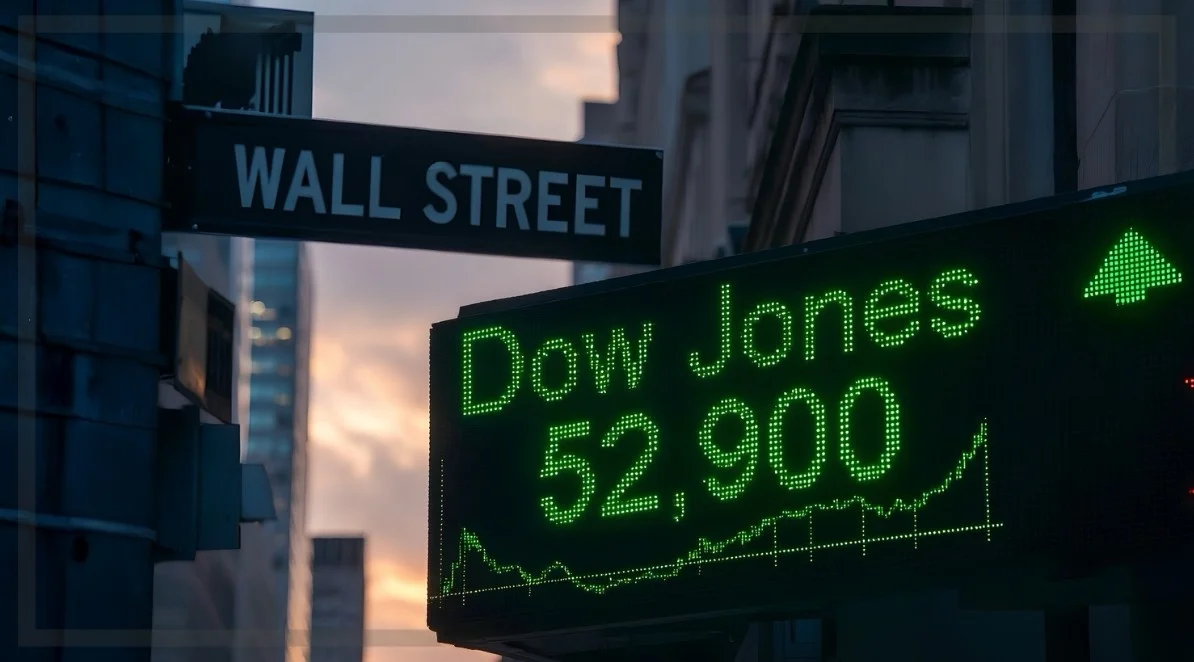
The Dow Jones Industrial Average (DJIA) closed at a record 52,900.07 on Thursday, 2 July, its 20th record close of 2026. That is the least interesting number in this story.
The blue-chip index surged 594.83 points (1.14%) to an intraday high of 52,903.85, logging its longest winning streak since October 2024. Yet Nasdaq fell 0.80% while the S&P 500 finished flat.
One jobs report, three outcomes, the gap between them is the real rotation the market priced in over the last week.
Why a Soft Jobs Report Was Good News for Blue Chips
U.S. employers added just 57,000 jobs in June (half the roughly 115,000 expected; May revised lower). Unemployment eased to 4.2% from 4.3% as more than 700,000 people left the labor force, lowering participation to 61.5%, per Bureau of Labor Statistics data.
After the June meeting, the first under new Fed Chair Kevin Warsh following the June FOMC meeting, markets braced for possible rate hikes rather than cuts, with post-war inflation still above the 2% target. The soft payrolls cooled those hawkish bets; by Friday, CME FedWatch priced a July hold at about 76%. Lower tightening odds favor rotation toward dividend-paying value stocks that fill the price-weighted Dow Jones.
The Nasdaq slide was separate: chip equipment names (Teradyne −13.6%, KLA −11.5%, Lam −10.2%) fell on AI capex-peak fears, unrelated to the job-driven rotation.
The Breadth Numbers That Matter More Than the Headline
Breadth gave the record its meaning. On the New York Stock Exchange (NYSE), advancers beat decliners 1.42-to-1, with 318 new highs against just 111 new lows. Nine of the S&P 500’s eleven sectors closed higher, led by utilities, consumer staples, materials and financials. Technology was the clear laggard.
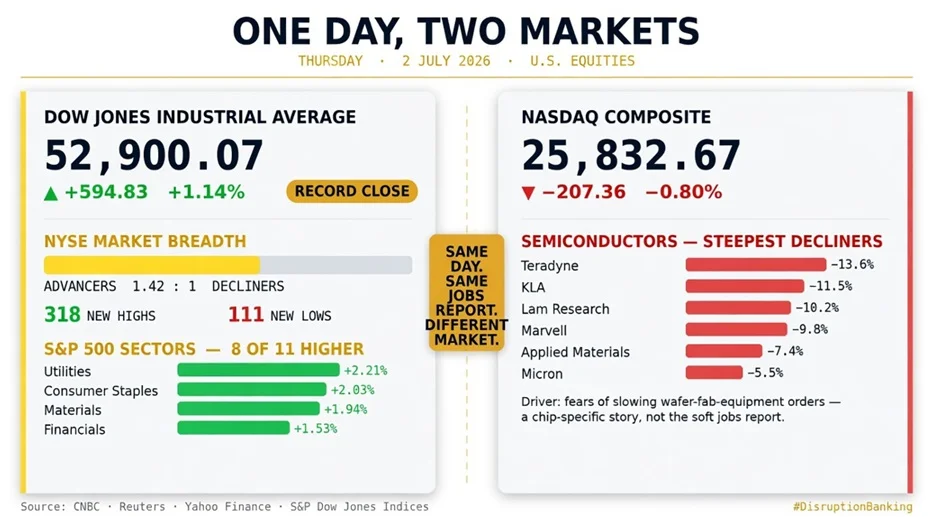
The Nasdaq contrast is the tell: decliners edged advancers there. A price-weighted 30-stock benchmark and cap-weighted tech index splitting on the same news shows how narrow the AI rally had become. And why breadth, not the level, signals market health.
The Dow Rises for a Fourth Straight Week
The rotation has momentum. The Dow Jones rose 8.9% in the first half (H1) of 2026, its best H1 since 2021, yet trailed the S&P 500 at 9.6%, and the Nasdaq at 12.8%. KKM Financial’s Jeff Kilburg called the trade “extremely healthy,” saying the rotation “persists into Q3 as blue-chip Dow names attract tech profit-taking inflows” and underscoring broadening breadth.
Whether it lasts remains open. Quarter-end flows and chip wobble may fade. A calm VIX (CBOE Volatility Index) around 15.8 suggested an orderly reshuffle rather than panic.
The Tech-Contagion Question Yet Unanswered
The risk bulls cannot dismiss this: if chip weakness deepens into broad risk-off, value names lifting the Dow could be dragged down too. Charles Schwab’s Joe Mazzola asked whether tech-winner pullbacks “portend the market pulling back overall.”
The counter remains that broadening leadership defines a maturing bull market. Both readings fit the data; neither is settled.
What Disruption Banking’s Dow Coverage Has Already Shown
This latest Dow record caps an eventful year. The same Dow crossed 50,000 in February and May, absorbed a roughly 2,440-point drawdown during March’s Iran-war selloff, and swapped Alphabet in for Verizon on 29 June, deepening its tech tilt even though price-weighting still lets a high-priced gainer like Apple do the heavy lifting. Tellingly, the new member Alphabet slipped Thursday while “boring” blue chips set the record.
Each milestone had different drivers: a threshold, a shock, a composition change, now a rotation. The next tests are Wednesday’s June Fed minutes, where Manulife John Hancock Investments’ Matthew Miskin wants to see “how incrementally hawkish are they [policymakers] leaning,” and the opening of Q2 earnings, with Delta and PepsiCo first, and the S&P 500 profits forecast to climb more than 24%.
As U.S. markets reopened Monday, July 6, after the holiday, futures pointed to the rotation holding, with the Nasdaq 100 surging more than 1% early as investors favored a broader set of sectors. Those will decide whether breadth endures or tech reclaims the lead.
Author: Richardson Chinonyerem
The editorial team at #DisruptionBanking has taken all precautions to ensure that no persons or organizations have been adversely affected or offered any sort of financial advice in this article. This article is most definitely not financial advice.
See Also:
How the Dow Jones Performs During Wars: Lessons from Iraq, Gulf War & Iran | Disruption Banking