
The Dow Jones Industrial Average (DJIA) ended its record run with a modest weekly loss last week. It closed at 52,146.42 on July 17, down 0.93% from the prior week. DisruptionBanking reported that the index had crossed 53,000 for the first time on July 6 and reached an intraday peak of 53,289.30 on July 7. By July 10, it stood at 52,637.01. The following week erased most of those gains.
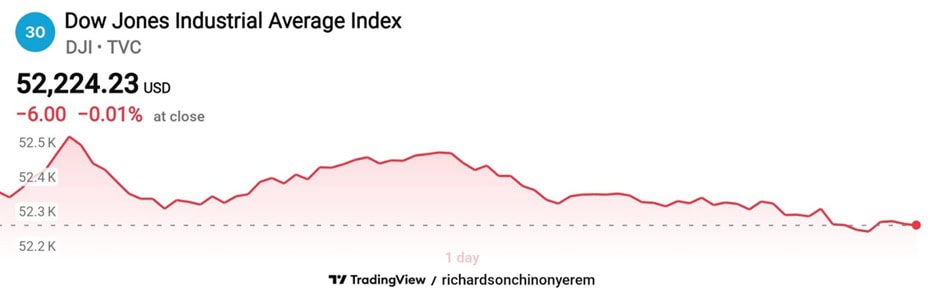
Three sessions later, the picture is less one-sided. The Dow fell 0.59% on Monday, recovered 0.74% on Tuesday and slipped 0.01% on Wednesday to close at 52,218.58 (Reuters). Softer June Consumer Price Index (CPI) and Producer Price Index (PPI) data helped. But oil and the U.S.-Iran war escalation leading to closure of the Strait of Hormuz once again rebuilt the inflation risk, as a semiconductor selloff spread through global markets. Brent settled slightly above $94 on July 22, up 6.8% from Friday.
The same pressures hit both sides of the Pacific, China precisely. The results did not match.
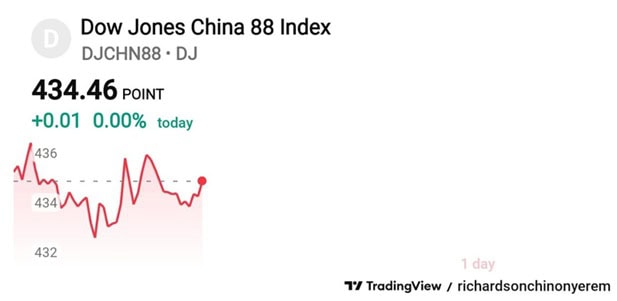
China Has an Actual Dow, and It Recovered 4.5%
The Dow Jones China 88 tracks 88 of the largest and most liquid mainland A-shares listed in Shanghai and Shenzhen. S&P Dow Jones Indices’ June methodology says the index is float-adjusted market-cap weighted.
After falling 5.37% to 415.82 in the week to July 17, the China 88 rose 1.82% on Monday and 3.39% on Tuesday before easing 0.75% on Wednesday to 434.45. It has regained 4.48% from Friday but remains 1.13% below its July 10 close. The index is down 5.66% in July and up 4.52% for 2026.
CSI 300 Recovered 4.2%. Then State Money Entered
The broader CSI 300 followed almost exactly. After closing at 4,529.10 on July 17, it gained 1.53% on Monday and 3.06% on Tuesday, then slipped 0.46% on Wednesday to 4,717.24. That is a 4.15% recovery from Friday but still 1.33% below July 10 and roughly 5.27% lower for the month.
This was not a clean, organic reversal. Two Chinese-owned state capital operators, China Reform Holdings and China Chengtong, announced more than 60 billion yuan ($8.9 billion) of stock purchases and buyback support after the selloff. State money helped establish a floor. Tuesday’s semiconductor rebound amplified it.
China’s “Volatility Hedge” Is Still Conditional
Some investors had viewed Chinese equities as a diversifier because of their low correlation with U.S. markets. That hedge failed during the global chip rout. It appeared to return this week, but government buying makes the signal less clean. Low correlation and official support are not the same thing.
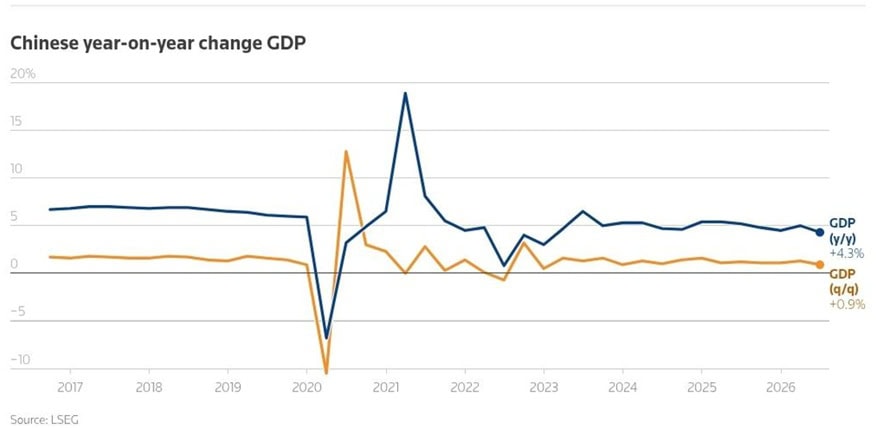
Domestic data still warns against reading three sessions as a macro turn. China reported second-quarter GDP growth of 4.3%, below the 4.5% consensus and down from 5% in the first quarter. June retail sales rose 1%, while property investment contracted 18% and fixed-asset investment fell 5.7% in the first half. Exports jumped 27% in U.S. dollar terms. On July 22, the finance ministry reported fiscal revenue up 4.7% and spending up 1.5%, but land-sale revenue fell 31.5%. Manufacturing and external demand remain robust. Household consumption, property and land-dependent local-government finances do not.
Two Index Designs, Two Different Chinas
The Dow Jones China 88 captures onshore A-shares. It does not fully reflect the offshore technology platforms, Tencent, Alibaba, and others, that dominate many global China portfolios. An investor can hold a bullish view on “China” through those names while the China 88 moves on an entirely different set of exposures.
As of June 30, industrials represented 28.7% of the index, technology 27.9% and financials 18.8%. These past trading sessions updated the earlier distinction we reported between “Old China” and “New China” benchmarks.
The U.S. Dow Jones drew partial protection from its financial, healthcare, industrial and energy components. China’s onshore benchmark faced the global tech reversal on top of weak domestic demand, then benefited disproportionately when chips rebounded and state buyers entered. The construction difference between the two indices is not a footnote. It explains part of both the selloff and the recovery.
Brent at $94 Leaves the Divergence Open
As of July 22, China’s Dow has recovered faster, but the monthly gap remains wide: the China 88 is down 5.66% in July against a 0.19% decline for the DJIA. The late-July Politburo meeting remains the key Chinese catalyst after Premier Li Qiang called for stronger counter-cyclical adjustment and preparation of incremental policies.
In the U.S., Big Tech earnings and next week’s Federal Reserve decision will test whether the Dow can absorb oil near $100. The divergence narrowed in three sessions. It did not close.
Author: Richardson Chinonyerem
The editorial team at #DisruptionBanking has taken all precautions to ensure that no persons or organisations have been adversely affected or offered any sort of financial advice in this article. This article is most definitely not financial advice.
See Also:

Richardson Chinonyerem
Contributing author at Disruption Banking, covering capital markets.