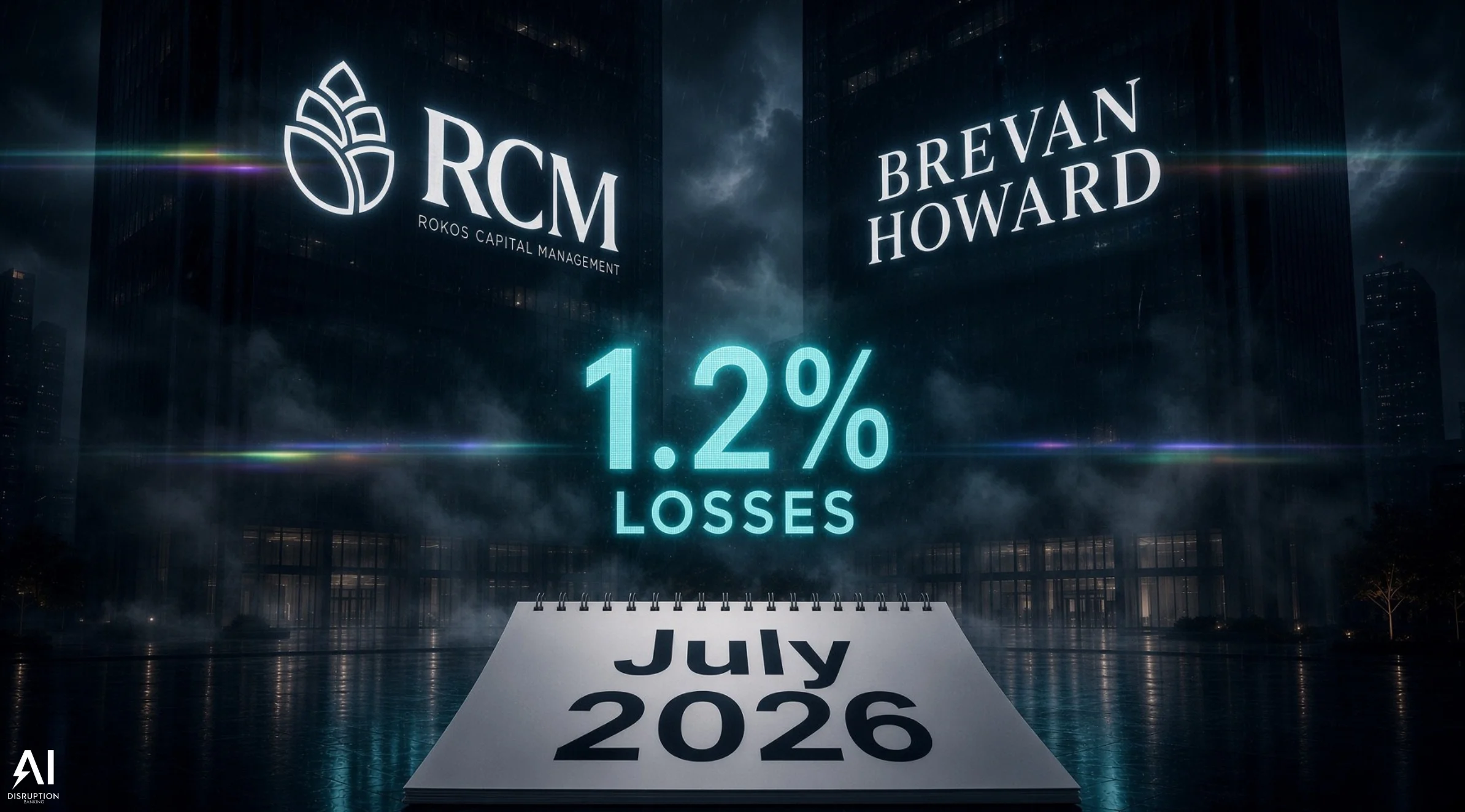
Rokos Capital Management and Brevan Howard Asset Management both posted 1.2% losses in July, joining a wider group of hedge funds caught in the month’s sharp AI-led sell-off and subsequent rebound. Chris Rokos’s firm extended its June decline and saw year-to-date (YTD) gains trimmed to 8.1%. Brevan Howard’s Master Fund pared its YTD return to roughly 0.9%, according to people familiar with the figures.
These modest drawdowns sit against a volatile backdrop that tested even experienced macro managers. The month’s turbulence followed heavy selling in AI names before a sharp rebound, creating difficult conditions for directional and relative-value strategies alike. While neither firm is known for large directional AI equity books, the velocity of the reversal still left marks.
How Does This Fit Brevan’s Recent Trajectory?
Brevan Howard’s Master Fund has already been under scrutiny for lagging peers during the strong macro environment of 2025. Disruption Banking reported that the flagship eked out only a +0.8% gain that year, while rivals such as Bridgewater’s Pure Alpha and Discovery Capital posted far stronger double-digit results. Alpha Strategies managed a more respectable +8.0%, but the overall picture pointed to challenges in capitalising on rates, currency and volatility opportunities.
The July setback fits a longer pattern in which the flagship has struggled to convert strong macro backdrops into outsized gains, even as the firm has concentrated talent in the Master Fund and expanded its digital-assets effort. Investors who have followed Brevan’s evolution will recognise these efforts, yet the core macro book remains sensitive to sharp, short-lived reversals of the kind seen last month.
What Does Rokos’s Performance Signal for Macro Allocators?
Rokos Capital Management entered July with stronger YTD momentum. Bloomberg reported that July’s decline followed a loss in June and cut Rokos’s YTD gain to 8.1%. That was a sharp step down from May, when a 3.7% monthly gain had lifted returns for the first five months of the year to 14.2%.
For allocators evaluating pure-play macro exposure, the contrast is instructive. Rokos has historically tended to run with higher volatility than Brevan’s more conservative profile, delivering outsized gains in favourable regimes but absorbing larger drawdowns when markets reverse quickly. July showed how quickly even large, experienced macro funds can be caught by a sudden reversal in an equity theme such as AI.
Where Does This Leave Macro Investors Heading into Late 2026?
Both firms are large, well-capitalised, and institutionally relevant. Brevan continues to benefit from its Abu Dhabi partnership and digital initiatives. Rokos retains its reputation for concentrated, founder-led macro trading.
What changed in July is the demonstration that even pure macro strategies can still be temporarily wrong-footed by equity-led volatility. Sharp moves in the AI complex can transmit through rates, currencies and correlation shifts even when managers hold little or no direct equity exposure.
For allocators evaluating these two houses, July offers only a partial read on performance. Both demonstrated disciplined risk management that limited the damage; both also showed that the current environment can still surprise managers who have spent years navigating rates and currencies more successfully than most.
Author: Richardson Chinonyerem
The editorial team at #DisruptionBanking has taken all precautions to ensure that no persons or organisations have been adversely affected or offered any sort of financial advice in this article. This article is most definitely not financial advice.
See Also:
How Brevan Howard Fell Behind in the Macro Surge of 2025 | Disruption Banking
How Brevan Howard’s Flagship Fund Stopped Making Big Returns | Disruption Banking