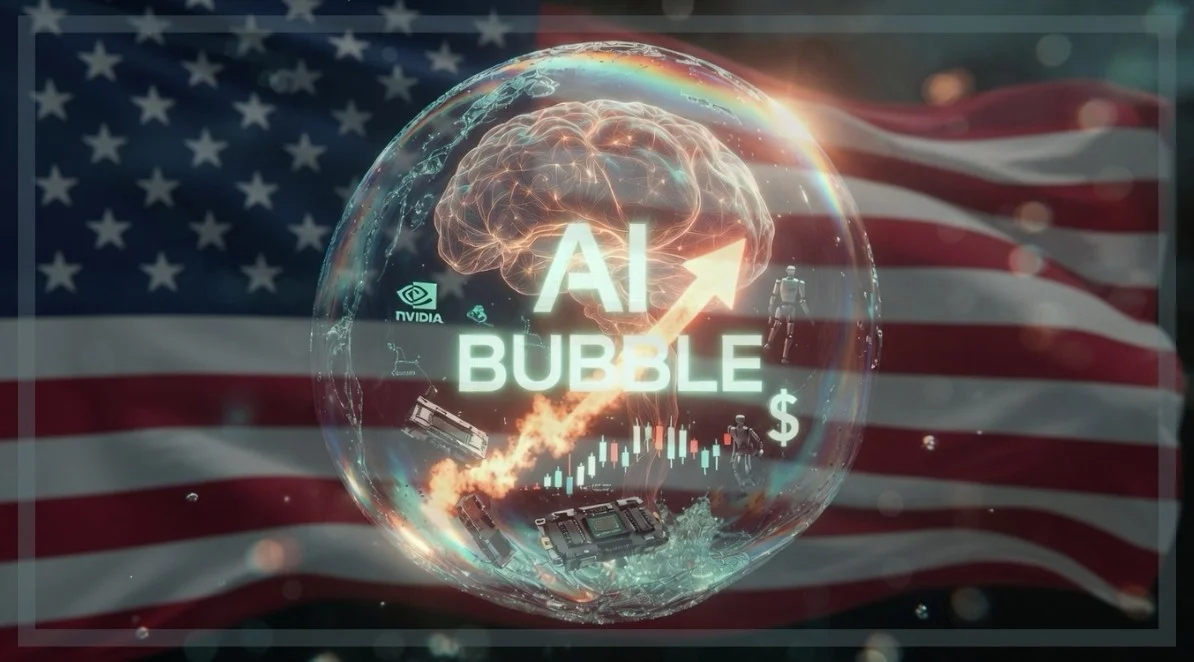
Economist Steve Hanke has issued a stark warning that the US stock market has entered dangerous AI stock bubble territory once again. This time, it is not the internet stocks of the 2000 dot-com bubble, but the explosive growth in artificial intelligence (AI) and Big Tech that is powering a staggering $10 trillion rally in equities. This rapid rise is raising serious concerns that the AI stock bubble could trigger the next major market crash.
Bubble concerns gained momentum last July when Apollo Global Management’s Chief Economist, Torsten Slok, shared a striking analysis. Slok, a highly respected voice on Wall Street, stopped short of officially declaring a bubble but delivered a sobering comparison.
“The difference between the IT bubble in the 1990s and the AI bubble today is that the top 10 companies in the S&P 500 today are more overvalued than they were in the 1990s,” he wrote. Slok warned that the forward price-to-earnings ratios and enormous market capitalisations of companies such as Nvidia, Microsoft, Apple, and Meta have become detached from their actual earnings.
The US stock market is once again in BUBBLE TERRITORY.
— Steve Hanke (@steve_hanke) May 11, 2026
In 2000, it was the internet. In 2026, it’s AI.
Don't forget the old line: If it looks like a duck, swims like a duck, and quacks like a duck, then it probably is a duck. pic.twitter.com/SoUWHuzZS6
What Is Steve Hanke Warning About the AI Stock Bubble?
Hanke, a professor of applied economics at Johns Hopkins University and former Reagan advisor, relies on proprietary models. These include his bubble detector and bond-stock yield spreads to flag overvaluation.
As Big Tech companies pour billions into AI infrastructure and data centers, the market has seen rapid gains. Yet the rally feels fragile. It is driven by a narrow group of AI leaders and semiconductor stocks while the broader economy shows cracks.
The US stock market is displaying multiple classic warning signs of bubble territory according to Crypto Banter host Ran Neuner’s (Cryptomanran) recent detailed analysis which supports Hanke’s observations. These technical and fundamental indicators have historically preceded major market corrections and crashes.
A significant warning sign is the extreme concentration risk. The top 10 stocks currently account for more than 40 percent of the total market capitalisation. This specific concentration level has preceded major crashes throughout nearly 200 years of market history.
Today, the market is being carried almost entirely by a handful of AI and semiconductor stocks. This creates a massive disconnect from the rest of the market, where the majority of stocks are lagging far behind the headline indices.
Overextension: NASDAQ and S&P 500 at Extreme Levels
The NASDAQ is trading approximately 15 percent above its 15-day moving average. This rare level of overextension has only occurred twice in the last 30 years: right before the dot-com crisis and during the 2009 financial crisis.
At the same time, the S&P 500’s Relative Strength Index (RSI) has reached 75. This signals that the market is extremely overbought and overextended.
There is also a clear and unhealthy divergence in market breadth. While the S&P 500 index continues to hit new highs, the number of individual stocks trading above their own 200-day moving averages is actually declining. This lack of broad participation shows that the rally is narrow and fragile, relying on just a few mega-cap names rather than genuine widespread strength.
Historical Parallels to the 2000 Dotcom Bubble
Analysts like Michael Burry have drawn direct comparisons between the current environment and the final months of the 2000 dot-com bubble. While Burry is known for issuing frequent crash warnings that do not always materialise, the technical and structural similarities, including technological hype, extreme valuations, and narrow leadership, cannot be entirely ignored according to Neuner.
Several fundamental pressures are adding to the risk. The latest Producer Price Index (PPI) data showed a 6 percent year-on-year increase, well above the expected 4.9 percent. Since producer price rises typically pass through to consumers within three to four months, this points to sticky high inflation ahead.
The high inflation data also creates major constraints for the Federal Reserve. Markets are pricing in interest rate cuts, but the Fed may be unable to deliver them without a significant market decline or economic breakdown.
Finally, a widening wealth disconnect is visible. Asset inflation continues to enrich stock owners, while many ordinary households face doubled costs for rent and fuel. This disparity has preceded nearly every major crash in modern history.
What This Means for Investors
Despite these clear alarm bells, Neuner notes that markets can remain irrational and overheated for extended periods. The rally could potentially climb another 50 percent before a meaningful correction occurs. However, with these warning signs flashing, the current risk-to-reward ratio is considered unfavourable for new investments.
The editorial team at #DisruptionBanking has taken all precautions to ensure that no persons or organizations have been adversely affected or offered any sort of financial advice in this article. This article is most definitely not financial advice.
Author: Ruben McCarthy
See Also:
Is SanDisk Still Worth Buying After a 3,700% Rally? | Disruption Banking
How Is Oil Futures Complacency Risking Global Supply Chains? | Disruption Banking