
The Dow Jones Industrial Average (DJIA), which only recently crossed 50,000 points for the first time in February 2026, remains one of the world’s most recognised financial benchmarks today. But joining it is not simply about being one of America’s biggest companies. S&P Dow Jones Indices, the company that oversees the index methodology and operations, describes the DJIA as “a price-weighted measure of 30 U.S. blue-chip companies,” covering “all industries except transportation and utilities.”
For readers following Disruption Banking’s broader coverage of the Dow, its breakdown of Dow Jones components adds useful context. The key point is this: Dow membership is a curated signal of corporate importance, not a mechanical ranking of market value.
Who Decides Dow Membership?
The Averages Committee maintains the Dow. S&P Dow Jones Indices reports that the committee includes three representatives from S&P Dow Jones Indices and two from The Wall Street Journal. It reviews corporate actions, market developments, and candidate companies, and assesses whether the index continues to accurately reflect the market it is intended to measure.
That makes Dow inclusion partly technical and partly judgment-based. The methodology states that changes are made “in the sole judgment and discretion” of the Averages Committee to keep the index aligned with its objective.
What Makes a Company Dow Material?
S&P Dow Jones Indices explains that Dow selection is not governed by quantitative rules. A company is typically considered only if it has an excellent reputation, sustained growth, broad investor interest, and helps maintain sector representation. The company should also be incorporated and headquartered in the U.S., with a plurality of revenue from the U.S.
That explains why the Dow is not just a list of the largest American companies. Otherwise, the likes of BlackRock, Meta Platforms, Eli Lilly, and Tesla, could have made the cut. The Dow Jones is meant to be a compact representation of the U.S. economy.
Disruption Banking’s recent piece on the longest-serving Dow members shows how much continuity matters: Procter & Gamble (P&G) has remained in the index since 1932.
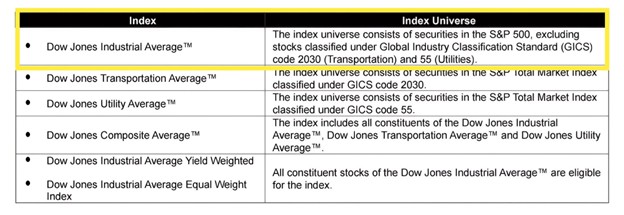
Dow Jones Industrial Average DJIA Index Eligibility Criteria. Source: S&P Global
Dow Jones vs S&P 500: The Big Difference
The S&P 500 is broader and more rules-based. S&P Dow Jones Indices sets out eligibility criteria covering U.S. company status, market capitalization, liquidity, public float, financial viability, and sector balance. The S&P 500 also measures the large-cap segment of the U.S. market and is weighted by float-adjusted market capitalization.
The Dow has only 30 companies. S&P’s own comparison explains that Dow selection focuses on reputation, sustained growth, investor interest, and sector representation, while the S&P 500 uses quantitative eligibility criteria before the committee selects among eligible stocks.
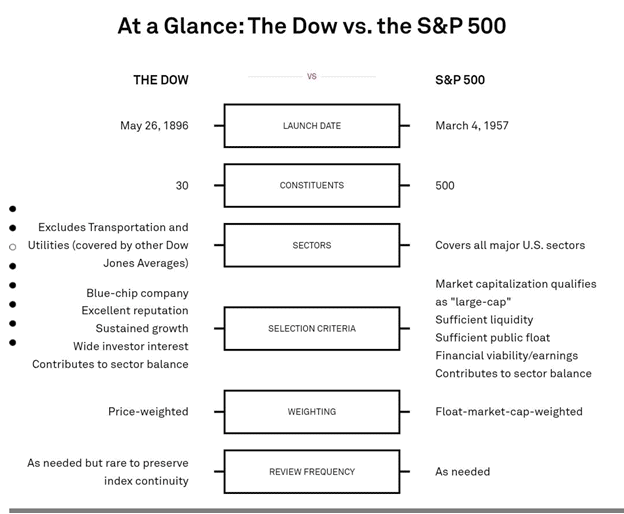
The Dow Jones vs. the S&P 500. Source: S&P Global
Why Share Price Matters in the Dow Jones
The Dow is a price-weighted index. In simple terms, a company with a higher share price has more impact on the Dow’s movement than a company with a lower share price. S&P Dow Jones Indices explains that the S&P 500 is different: bigger companies by float-adjusted market value carry more weight.
This is why stock price can affect suitability for Dow inclusion. The Dow methodology says the committee evaluates share price when considering additions and monitors whether the highest-priced stock is more than 10 times the lowest-priced stock.
What Happens When a New Company Joins?
Because the Dow has only 30 slots, a new entrant usually means another company leaves. In November 2024, S&P Dow Jones Indices announced that Nvidia (NVDA) would replace Intel, while Sherwin-Williams (SHW) would replace Dow Inc. It said the changes improved semiconductor and materials-sector representation, and noted that low-priced stocks have limited impact in a price-weighted index.
There can also be trading consequences. Reuters quoted the head of money and markets at Hargreaves Lansdown, Susannah Streeter, as saying that losing Dow status meant “…that Intel is not included in exchange-traded funds (ETFs) which track the index, which could impact the share price further.”
What Dow Inclusion Really Means
Dow inclusion does not improve a company’s revenue, margins, balance sheet, or competitive position by itself. It can raise visibility, bring prestige, and create demand from funds that track the DJIA. But the business still has to perform.
The Dow’s relevance remains partly cultural. When the index crossed 50,000 for the first time, Reuters quoted Horizon Investment Services CEO Chuck Carlson calling it “the people’s index.”
Final Takeaway: The Dow Rewards Relevance, Not Just Size
A company joins the Dow Jones by becoming large, established, widely followed, economically representative, and suitable for a price-weighted 30-stock index. But Dow inclusion is not a reward for size alone, and it is not a guarantee of future performance. It is a mark of corporate importance. Investors should still judge the company, not just the badge.
Author: Richardson Chinonyerem
The editorial team at #DisruptionBanking has taken all precautions to ensure that no persons or organizations have been adversely affected or offered any sort of financial advice in this article. This article is most definitely not financial advice.
See Also:
Are Dow Jones Components Targets for Activist Hedge Funds? | Disruption Banking