Alphabet is joining the Dow Jones Industrial Average (DJIA), and Verizon is leaving. On paper, it is one index change. In reality, it is a clean signal of how far America’s most famous stock-market benchmark has moved from telecom wires and industrial balance sheets toward cloud computing, AI infrastructure and platform economics.
Alphabet Joins the Dow as Verizon Leaves the Blue-Chip Club
S&P Dow Jones Indices announced on 23 June 2026 that Google’s parent company, Alphabet Inc. (GOOGL), will replace Verizon Communications Inc. (VZ) in the DJIA, effective before the opening of trading on Monday, 29 June. As of the time of writing, the change has now taken effect, with Alphabet officially in the Dow and Verizon out.
The move marks the first Dow Jones change since November 2024, when Nvidia and Sherwin-Williams replaced Intel and Dow Inc., respectively.
Alongside the swap, Honeywell International is completing the spin-off of Honeywell Aerospace on 29 June. The parent company remains in the index under its new name, Honeywell Technologies Inc, trading under HON. At the same time, Honeywell Aerospace began regular-way Nasdaq trading under HONA and is not included in the DJIA.
Verizon’s $45 Share Price Made It Nearly Invisible Inside the Dow
Verizon was not removed because telecoms became irrelevant. The company still operates one of the largest U.S. wireless businesses, with 146.8 million total wireless retail connections as of 31 March 2026.. It did not fail. It became structurally invisible inside the Dow’s methodology.
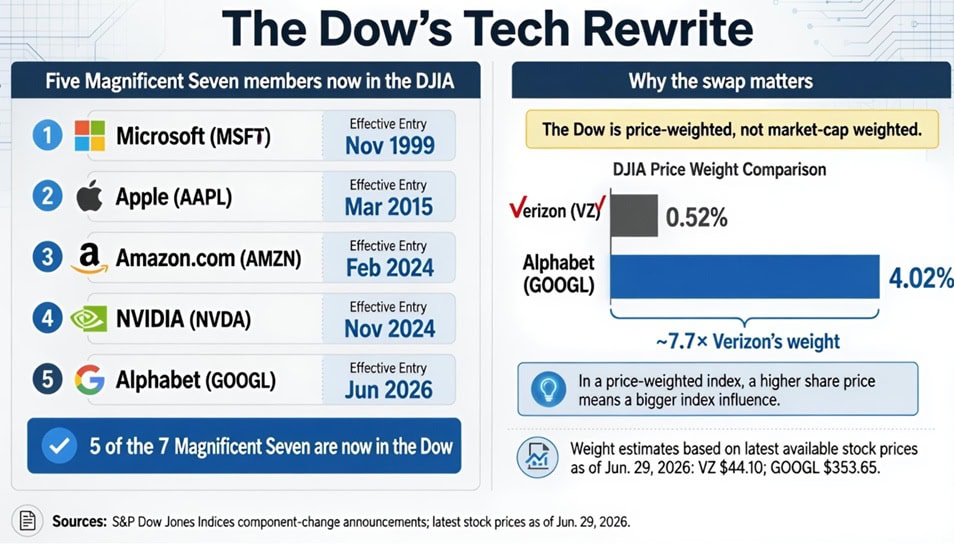
The Dow Jones is price-weighted: each constituent’s influence depends on its share price, not its total market value. A $300 stock moves the index more than a $40 stock, regardless of company size. With Verizon trading around $44 and Alphabet around $345 at announcement, the gap was stark. S&P Dow Jones Indices stated that Verizon’s low share price had reduced it to only around 0.5% of the DJIA. They noted that “persistently lower-priced stocks have an immaterial impact on the index.” Alphabet, by contrast, was expected to carry roughly 4% of the Dow after joining, making it about eight times as influential as Verizon had become.
Verizon joined the Dow in April 2004, replacing legacy carrier AT&T. Over just 22+ years, it tracked telecom’s evolution from copper to fiber to 5G. Its exit reflects not business failure, but a weighting structure that makes low-priced names structurally marginal, regardless of their commercial significance.
From Search Engine to AI Infrastructure Giant: Why Alphabet Belongs in the Dow Jones
S&P Dow Jones Indices cited Alphabet’s business breadth as central to its case for inclusion. The official press release listed advertising, cloud infrastructure, artificial intelligence, hardware, autonomous mobility through Waymo, healthcare technology, and media distribution as the key pillars of Alphabet’s portfolio. Google Cloud reported $20 billion in revenue in the first quarter of 2026, up 63% year-on-year (YoY), with operating income of $6.6 billion, implying a 32.9% operating margin.
Alphabet now touches nearly every major pillar of the digital economy.
Microsoft, Apple, Amazon, Nvidia, Alphabet: The Dow’s New Tech Core
With Alphabet’s entry, five of the seven Magnificent Seven companies, Microsoft, Apple, Amazon, Nvidia and now Alphabet, will sit inside the 30-stock index. That is a striking concentration for a benchmark once synonymous with steelmakers, oilmen and consumer brands. The Dow Jones now increasingly reflects platform economics, cloud infrastructure, AI semiconductors and digital advertising.
Meta Platforms and Tesla remain outside the index. Meta’s exclusion reflects ongoing committee judgment about sector concentration. Tesla, classified by S&P as consumer discretionary rather than technology, also faces questions about share price suitability and earnings volatility in the context of Dow selection. As Disruption Banking has previously examined, Dow membership is curated by committee, not determined by market capitalization alone. The index is not simply becoming a Magnificent Seven basket. But it is moving in that direction.
What This Means for Investors: Alphabet’s Dow Debut Matters More for Narrative Than Fund Flows
Alphabet gains meaningful symbolic legitimacy among blue-chip investors. The primary Dow-tracking vehicle, the SPDR Dow Jones Industrial Average ETF (DIA), manages approximately $45 billion in assets as of June 26, 2026, significant but modest beside the passive funds anchored to the S&P 500 and Nasdaq 100.
When Nvidia and Amazon joined the Dow in 2024, both stocks saw muted immediate price reactions, underscoring the limited forced-buying effect from Dow Jones inclusion alone. Nvidia fell 0.8% on the day it entered the Dow, while Amazon slipped 0.1%, according to Dow Jones Market Data cited by Disruption Banking.
The bigger impact is narrative: the DJIA is formally acknowledging an economic reality that equity markets had already priced in. That narrative played out immediately. Alphabet shares rose 3.7% to $350.24 in early trading on its first day as a Dow component. Verizon, meanwhile, dropped as much as 7–8% intraday, briefly hitting lows near $42.96 on TradingView amid a telecom selloff and the same-day announcement of its major international enterprise joint venture with BT Group, before closing down approximately 5.2% at $44.10.
Is the Dow Still America’s Benchmark?
The DJIA remains one of the most quoted market indicators on earth. Its psychological weight far exceeds its institutional footprint. But its structure is old-fashioned: 30 companies, committee-selected and price-weighted, covering a fraction of the listed U.S. equity universe. The S&P 500, by market-cap weighting across 500 companies, is the broader and more institutionally relevant measure.
What Alphabet’s entry confirms is that the Dow must keep replacing pieces of yesterday’s economy to avoid becoming a museum exhibit. Adding a company whose businesses span search, cloud, AI and autonomous mobility is one way to stay current. The deeper challenge, a 30-stock, price-weighted structure born in 1896, will not be resolved by any single swap, however significant.
The Dow Jones Industrial Average is not broken. It is showing its age. And the world’s most famous market scoreboard is patching itself, one blue-chip rotation at a time.
Author: Richardson Chinonyerem
The editorial team at #DisruptionBanking has taken all precautions to ensure that no persons or organizations have been adversely affected or offered any sort of financial advice in this article. This article is most definitely not financial advice.
See Also:
How Can a Company Join the Dow Jones? | Disruption Banking
Verizon: 21 Years Connecting the Dow Jones | Disruption Banking