





The short answer: stuck. As of late July 2026, the Digital Asset Market Clarity Act (H.R. 3633) has cleared the House and a Senate committee, but it still has no floor vote, no cloture motion, and no date on the calendar.
Senate Majority Leader John Thune told reporters he does not expect the bill to reach the floor before the summer recess begins around August 7. His reasoning, per CoinDesk, is that the chamber is first working through federal nominations, then a Russia sanctions bill, legislation now tied to the memory of Senator Lindsey Graham, who died in July.
How Far the Bill Has Come Since July 2025
The CLARITY Act is the most advanced crypto market structure bill in US history. The House passed it on July 17, 2025, by a 294-to-134 margin, with more than 70 Democrats crossing the aisle. The Senate Banking Committee advanced it 15-to-9 on May 14, 2026. On June 1, it landed on the Senate Legislative Calendar as Calendar No. 423, making it eligible for a full floor vote without further committee work.
That’s where the momentum ended. Calendar placement is not a vote. Four procedural steps remain: floor debate, a 60-vote cloture threshold, House-Senate reconciliation between differing Banking and Agriculture Committee texts, and a presidential signature.
The Math Problem: Why 53 Seats Isn’t Enough
Republicans hold 53 seats. Passing cloture requires 60 votes, so roughly 7 to 10 Democrats have to sign on. Committee support suggests two: Ruben Gallego and Angela Alsobrooks are already there. The rest are holding out. In mid-July, Senators Chris Murphy, Chris Van Hollen, and Jeff Merkley formally opposed the bill after a merged draft dropped an ethics provision that Democrats had made a condition.
Prediction Markets Have Turned Sour
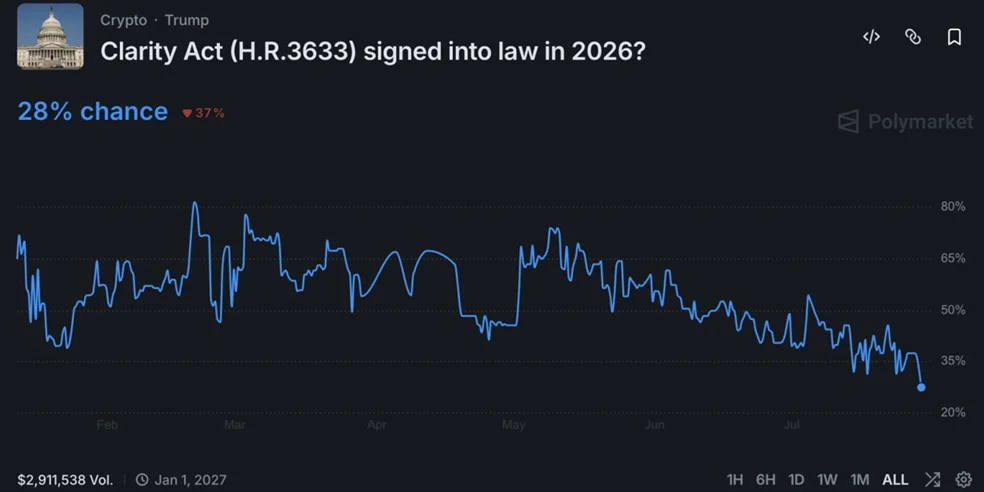
The betting reflects the drift. Polymarket priced 2026 passage at 28% on July 30, down from a peak of 82% in February. Galaxy Digital cut its own estimate to 30% as talks slid deeper into the Senate calendar. Brian Gardner, chief Washington policy strategist at Stifel, said, “The bill probably needs to get through the Senate by the end of July,” and missing recess would cause prospects to “deteriorate materially.”
What a September Delay Actually Costs
Missing the window doesn’t kill the bill. It pushes it into a September session crowded by appropriations fights and the November midterms, thin territory for floor time. The cost is real for builders. Dozens of crypto projects have shut down in 2026, with the industry pointing to regulatory uncertainty as a key driver: firms can’t plan custody or product roadmaps without knowing which agency holds jurisdiction.
For now, the only guardrail is administrative. The March 17, 2026 joint SEC-CFTC guidance classifying 16 digital assets can be rescinded by any future administration without a vote. Only a statute survives that. Watch one thing above all: whether Thune files cloture at all. No filing, no summer vote.
Author: Ayanfe Fakunle
The editorial team at #DisruptionBanking has taken all precautions to ensure that no persons or organizations have been adversely affected or offered any sort of financial advice in this article. This article is most definitely not financial advice.
See Also:
CLARITY Act: Trump Signs Off on Ethics Language, Now Comes the Hard Part | Disruption Banking











One Response
I support the bill