For three years, artificial intelligence was Wall Street’s favourite growth story. Investors poured money into anything remotely connected to AI (chipmakers, hyperscalers, cloud infrastructure), and stocks surged. Now the mood has flipped.
Enter Wall Street’s infamous newest coinage, the “AI scare trade.”
Why is the AI Scare Trade Spooking the Stock Market
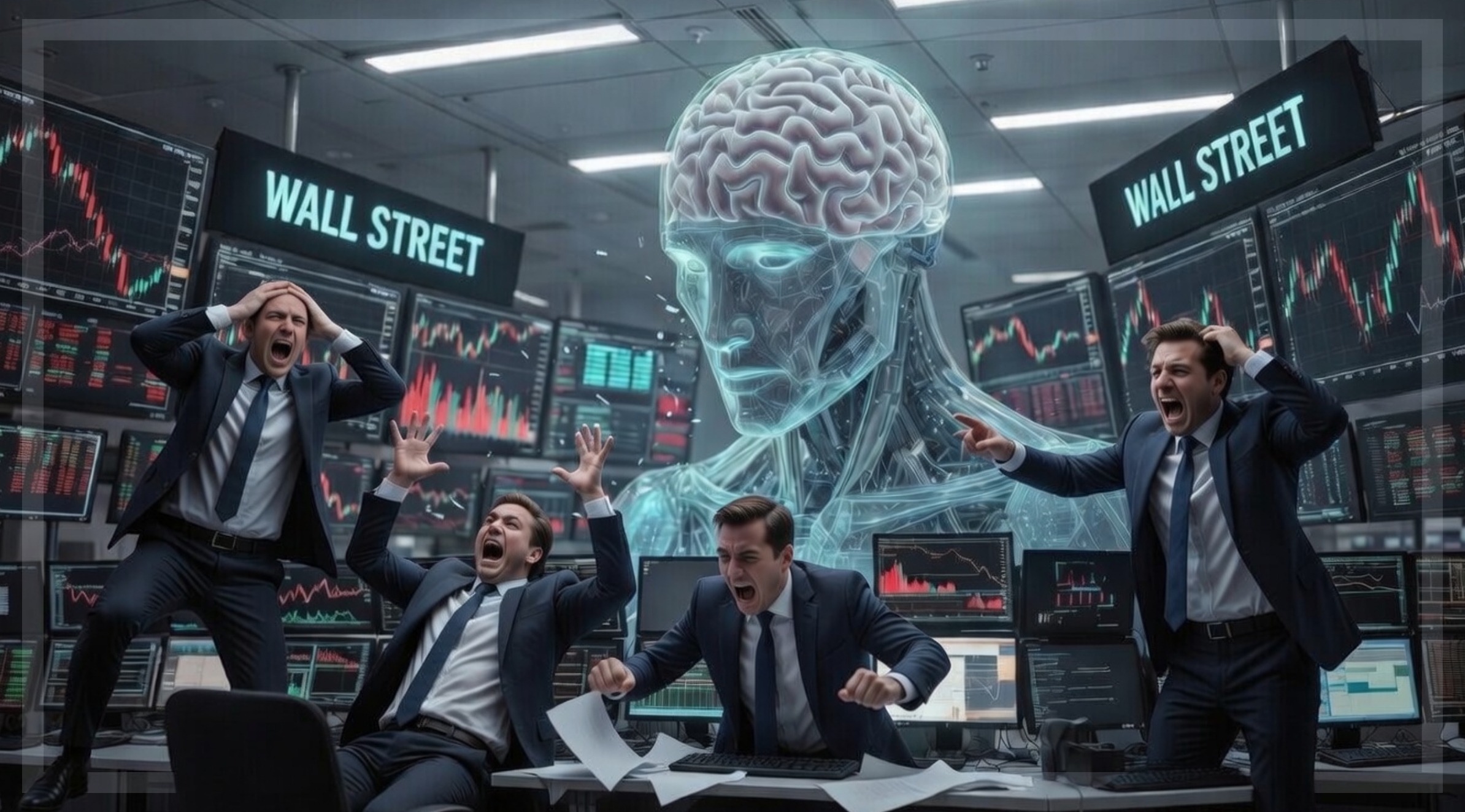
Wall Street woke up to a new fear in early 2026. Investors no longer chase AI winners. They now dump anything AI might replace. This flip created what Wall Street now calls the “AI scare trade,” panic selling in sectors that could lose jobs, revenue, or entire business models to smarter machines.
At the time of writing, market jitters linger. Stocks in software, real estate services, and logistics still feel the heat even after February’s brutal sell-off.
The shift stunned traders. For three years, AI powered a bull run. Now its success spooks everyone. The same force that drove one of the most powerful bull runs in a generation is now sending sectors into freefall.
The Simple Trigger That Lit the Fuse
The term “AI scare trade” entered Wall Street talk in early February thanks to Keefe, Bruyette & Woods analyst Jade Rahmani. One gloomy memo was all it took.
It had been building for weeks, traders quietly selling out of sectors they feared AI would make obsolete.
It started with one research note and one AI tool. On February 22, 2026, Citrini Research published a Substack post titled “The 2028 Global Intelligence Crisis,” a stark warning about a “global intelligence crisis” by 2028. Analyst James van Geelen described AI agents replacing software engineers, advisors, and managers. He called it a “human intelligence displacement spiral” that could create “ghost GDP,” growth that skips human paychecks and tanks consumer spending. Written as a fictional retrospective from June 2028, it was explicit: this was a scenario, not a forecast.
The market listened but did not care about the disclaimer. Software shares plunged. Days later, Anthropic’s Claude Code and Claude Cowork tools, AI agents that write code and review contracts, poured fuel on the fire.
Jack Dorsey’s 40% Layoff: From Fiction to Fact
On February 26, the theoretical became concrete. Block, the company behind Square, Cash App, and Afterpay, announced it was cutting 40% of its workforce, shedding more than 4,000 employees to bring its headcount below 6,000. Co-founder Jack Dorsey cited “intelligence tools” as the reason. He went further: “Most companies are late,” he wrote to shareholders, “and I think the majority of companies will reach the same conclusion.”
Block’s stock rose nearly 14% the next day. Markets rewarded the efficiency. That is the paradox at the core of the AI scare trade: what is good for shareholders may be devastating for workers and, ultimately, for consumption-driven economies like the US.
Alap Shah, co-author of the Citrini report, warned on Bloomberg TV that 5% of white-collar workers could be cut within 18 months. He is now calling for an AI tax on windfall gains to cushion the blow.
we're making @blocks smaller today. here's my note to the company.
— jack (@jack) February 26, 2026
####
today we're making one of the hardest decisions in the history of our company: we're reducing our organization by nearly half, from over 10,000 people to just under 6,000. that means over 4,000 of you are…
$611 Billion Wiped Out in Weeks: Which Sectors Are Getting Crushed
Software and services stocks lost $611 billion in market value in just one week after the Citrini report, according to March 2026 market commentary from James Investment Research.
Salesforce dropped 30%. Adobe slid 25%. IBM fell 13% in a single day, its worst in 25 years. The S&P 500 software index lost another 10% in February alone and now sits 30% below its September 2025 peak.
The speed of contagion was striking. Mohit Kumar, a strategist at Jefferies, put it plainly: “Market is in shoot first, ask questions later mode, with any names/sectors that could be impacted by AI disruption taking a hit.”
On February 9, per a CNN report, shares of major insurance brokers fell after Madrid-based startup Tuio unveiled an insurance app built with ChatGPT. Marsh shares tumbled 7.5%. Arthur J. Gallagher dropped 9.85%. Commercial real estate took a hit on February 11. CBRE Group, Jones Lang LaSalle, and Cushman & Wakefield tanked on February 11. Logistics stalwarts like C.H. Robinson fell 24% intraday. Even wealth managers, insurance brokers, and cybersecurity firms took hits.
In February, Charles Schwab dropped over 7%, while Raymond James and LPL Financial both fell more than 8%, after fintech firm Altruist launched an autonomous AI platform capable of generating complex tax and estate strategies without a human advisor. In London, wealth manager St. James’s Place cratered 20%.
The underlying businesses had not changed. Earnings at most of these firms remained solid. The selloffs were, as Mona Mahajan of Edward Jones noted, almost entirely speculative, markets pricing in hypothetical futures, not current deterioration.
Broader indexes felt it. The S&P 500 posted its worst monthly performance since March 2025, finishing February down just shy of 1%. The Nasdaq dropped harder. Short interest in software stocks hit record highs.
Overblown Fear or the First Wave of Real Disruption?
Not everyone is panicking. Lori Calvasina of RBC Capital Markets wrote in a client note that “existential concerns for industries other than software like wealth management and transportation/logistics have seemed overblown.” Citadel Securities published a direct rebuttal to the Citrini memo, citing an 11% year-on-year increase in demand for software engineers as evidence that the job displacement thesis does not yet hold in the data.
Brian Meredith at UBS said the selloff in insurance brokers was “meaningfully overdone,” noting these firms remain essential intermediaries for household financial decisions. Jonathan Krinsky, chief market technician at BTIG, took a harder line: “Single-stock moves based on AI nerves are getting more and more extreme,” he wrote, warning that sustained weakness could drag down the broader market.
The S&P 500 remains roughly flat for the year. But beneath the surface, a violent rotation is underway, and it is reshaping where global capital is going.
NVIDIA CEO Fires Back: “The Market Got It Wrong”
NVIDIA reported blowout Q4 2025 results, $68 billion in revenue, up 73%. Guidance beat estimates. Yet shares fell over 5% on February 27, the worst day since April 2025. Investors worried hyperscalers like Microsoft and Amazon might slow massive data-center spending.
CEO Jensen Huang pushed back hard. “I think the markets got it wrong,” he told CNBC. He argued that AI agents will actually boost the companies they seem to threaten.
Goldman Sachs raised the odds of another sharp pullback to 28%. Morgan Stanley called the sell-off a chance to buy quality names. The panic exposed bubble fears after years of sky-high valuations.
Why This Panic Is Actually Healthy: But What Should Investors Do?
The AI scare trade is not going away. Laks Ganapathi of investment research firm Unicus is forecasting high unemployment and stubborn inflation into the second half of 2026, according to a Fortune report. Her thesis: “Companies will lean as much as they can, as fast as they can with AI. And that is going to cut a lot of jobs.”
The honest answer is that no one knows the speed or the scale of disruption. What is clear is that markets are no longer treating AI purely as upside. It is now a two-sided risk, a force that creates winners and destroys incumbents at the same time.
For investors, the question is no longer whether AI will reshape industries. That debate is settled. The question is timing, and which businesses can genuinely hybridise, combining human judgment with AI efficiency, versus those that will be hollowed out entirely.
Dorsey’s bet at Block is early evidence that the latter group is larger than Wall Street assumed. And if he is right, that most companies will reach the same conclusion, the scare trade may just be getting started.
Author: Richardson Chinonyerem
The editorial team at #DisruptionBanking has taken all precautions to ensure that no persons or organizations have been adversely affected or offered any sort of financial advice in this article. This article is most definitely not financial advice.
See Also:
Should the Magnificent Seven Form Part of Your Portfolio in 2025? | Disruption Banking
The AI5: The New Powerhouse Redefining the AI Era | Disruption Banking