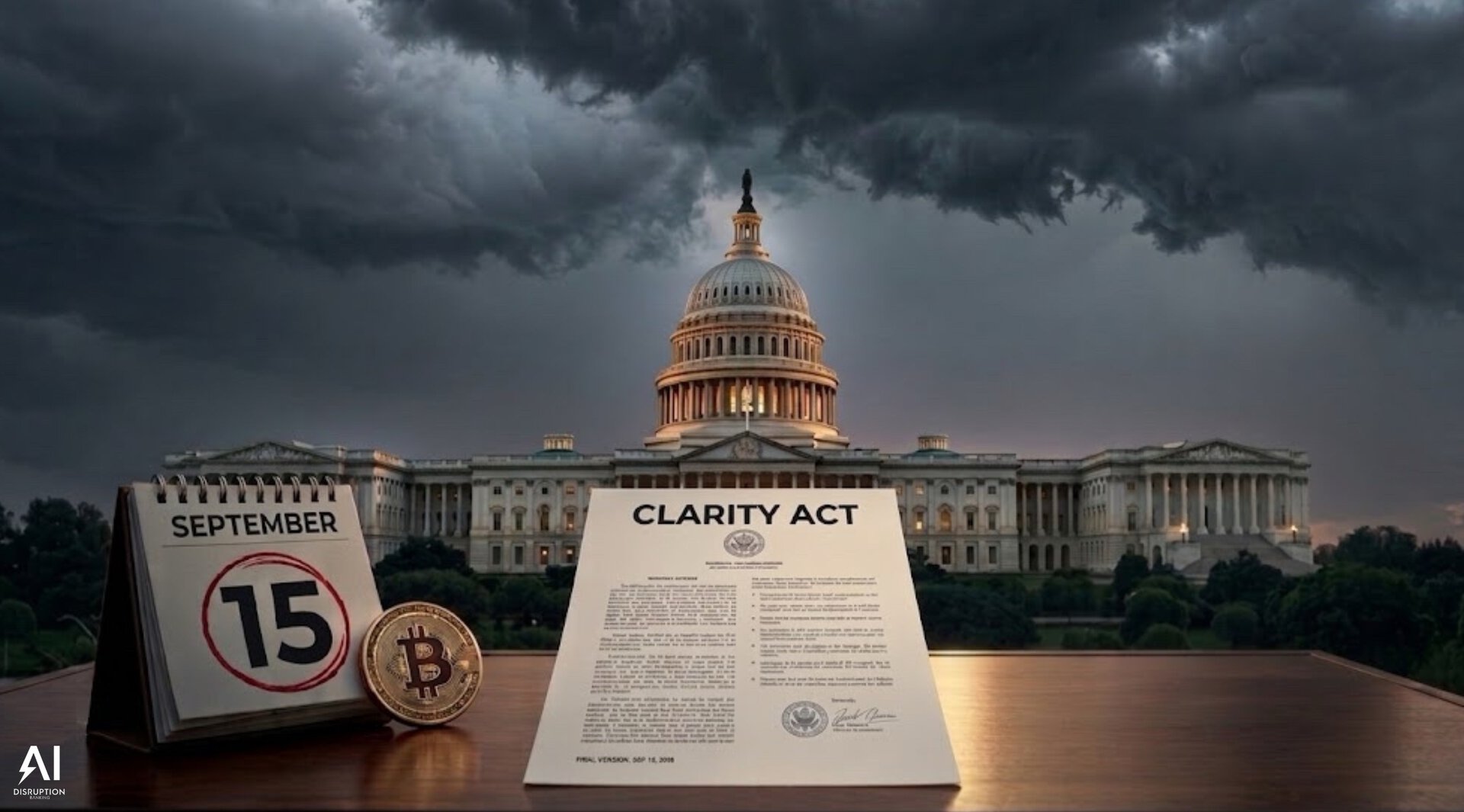
The CLARITY Act cannot get out of its own way, and the Senate now has a fixed date to prove that wrong. Majority Leader John Thune filed cloture on August 8, setting up a procedural vote for September 15, the day the Senate returns from recess. That single date now carries the bill’s remaining momentum for the year.
Thune’s September 15 Vote and the Seven-Vote Math
The Digital Asset Market Clarity Act needs 60 votes to clear the Senate, and Republicans hold 53 seats. That leaves the bill needing at least seven Democratic votes. Thune told reporters Democrats “insisted on no vote” before the break, though he pointed to progress on ethics language with Senator Cynthia Lummis, calling her work “great” and promising it would be “queued up first thing when we come back.”
Prediction markets have turned less confident. Galaxy Research cut its passage odds, most recently to 10% in mid-August, while Polymarket traders priced the bill’s chances at around 17%. Senator Elizabeth Warren has kept up her opposition, describing the bill as “written by the crypto industry to protect and advance the crypto industry.”
Alex Thorn of Galaxy Research laid out the firm’s revised outlook here:
— Alex Thorn (@intangiblecoins) August 14, 2026
Trump Calls the Bill ‘Powerful’ at a White House Event
President Trump used an August 19 White House crypto event to press lawmakers directly, calling for “a fair version” of the CLARITY Act and describing it as “very, very powerful structured legislation” that would help the US stay ahead of China. His remarks came a day after a separate regulatory move made the bill’s urgency harder to argue.
SEC Opens a $75 Million Path Without Waiting on Congress
On August 18, the SEC proposed Regulation Crypto Assets, a rulemaking that gives token issuers two exemptions without an act of Congress. A startup exemption caps raises at $5 million over four years, with only narrative disclosure. A larger fundraising exemption allows up to $75 million in a 12-month period, provided the issuer files audited financials and ongoing reports. A safe harbor would allow a token to exit “investment contract” status once the issuer completes the managerial work it promised investors, and the rule would preempt conflicting state registration requirements.
Chair Paul Atkins said Congress “designed our securities laws to amplify opportunities for entrepreneurs to innovate” within existing guardrails. Commissioner Hester Peirce, usually one of the agency’s more crypto-friendly voices, was more measured, calling the proposal “one step on a long road toward a clear regulatory framework for crypto.” Public comments remain open for 60 days after the rule’s Federal Register publication.
Two Deadlines Now Running in Parallel
Congress and the SEC are working on separate clocks. The Senate’s September 15 vote will test whether the ethics and illicit-finance disputes covered in our earlier reporting can still be resolved. The SEC’s comment window will show how many issuers are willing to build under an agency rule rather than wait for a statute. Both deadlines fall before Congress’s attention fully shifts to the midterms.
Author: Ayanfe Fakunle
The editorial team at #DisruptionBanking has taken all precautions to ensure that no persons or organizations have been adversely affected or offered any sort of financial advice in this article. This article is most definitely not financial advice.
See Also:
SEC Moves on Crypto Rules Without Waiting for the Clarity Act | Disruption Banking