

Gilbert Verdian, CEO of Quant, is not easily summed up in a sentence. A security veteran turned blockchain visionary, he has been quietly (and relentlessly) helping the financial services industry shift from pilots to production.
Importantly, Verdian is not just a stalwart at Innovate Finance’s Global Summit (IFGS2026), he was recently invited to speak at the GFTN Forum in Japan too. He joined a panel to discuss stablecoins and tokenised assets in practice – global infrastructure, regulation, and real-world adoption.
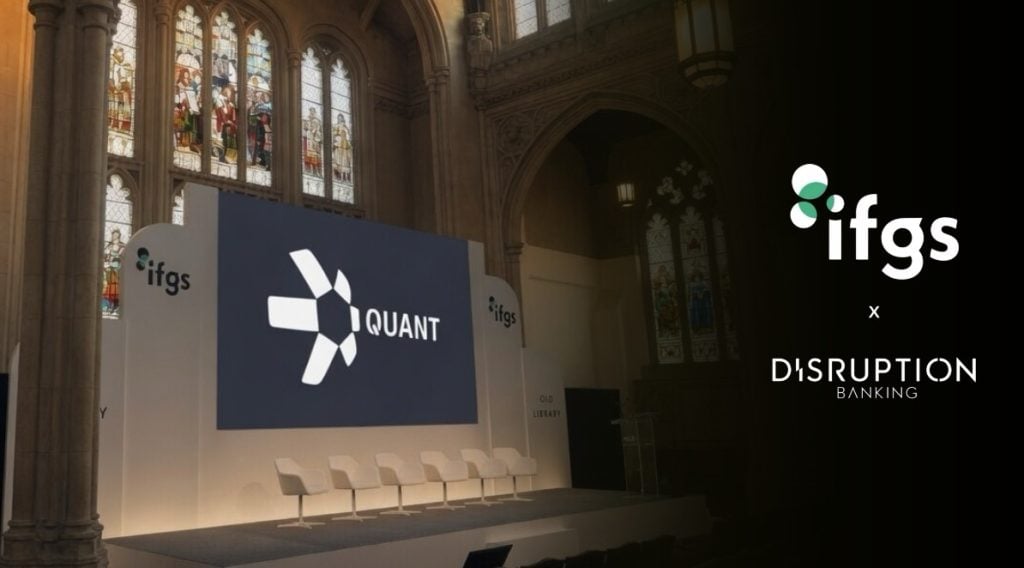
This week Verdian was back in London. He joined a panel to discuss “Building A “Multi-Moneyverse”, Are We There Yet?” which included industry leaders from the Bank of England, Link, Modulr, and Euroclear.
Verdian was joined by John Howells, CEO of Link, Victoria Cleland, Chief Cashier and Senior Advisor to the Governors, Bank of England, Kate Lowe, Deputy Chief Business Officer at Euroclear, and Myles Stephenson, CEO and Founder of Modulr. Kunal Jhanji, Managing Director and Partner at BCG moderated the panel on the Old Library Stage.
What is a Multi-Moneyverse?
It is an unusual concept, a Multi-Moneyverse. But what does it mean? It centres on a new world of money. Not one where traditional bank deposits, physical cash, and a few emerging digital alternatives dominate the landscape. Instead, it refers to a vibrant, mixed “universe” of money that includes:
Tokenised commercial bank deposits (programmable bank money on distributed ledgers)
Central bank digital currencies (CBDCs) – wholesale or retail
Regulated stablecoins (private sector issued, fully backed digital money)
Traditional fiat / reserves
Potentially even tokenised real-world assets or other regulated forms of value
The term was popularized by Bank of England Deputy Governor Sarah Breeden in a September 2025 speech. She described it as a system characterized by choice, where each form of money can play to its strengths (speed, programmability, settlement finality, privacy, etc.), while the whole ecosystem remains anchored in trust and stability.
Verdian has been one of the strongest advocates for this concept. His firm, Quant, has explicitly designed tools to help build the rails and the “operating system” for this Multi-Moneyverse.
How is the “Multi-Moneyverse” progressing?
Kunal Jhanji opened the panel by explaining to delegates how “we’re going to be discussing this new and emerging world of Multi-Moneyverse.” He started by asking Cleland from the Bank of England to share how she sees the evolution of these new forms of money, and what opportunity it brings to the UK.
Cleland pointed to the national payments vision which the Bank of England launched in 2025. She explained how this vision is about building a world leading trusted payment system and ecosystem.
“How do we give the right choice to people?” she asked. “We know that this next generation infrastructure needs to have at least the same levels of functionality as we currently have. There are lots of things that will be built into this new infrastructure, and when we talk about the Multi-Moneyverse it’s not just about using traditional bank money. It’s a world in which you can use commercial bank money, stablecoins, tokenized money, potentially central bank digital currency and use them in a seamless way.”
Interoperability will be Key in a Multi-Moneyverse
Kate Lowe from Euroclear joined the conversation by explaining how multiple incidents have affected the DeFi ecosystem of late. Specifically, where bridges connecting to blockchains have been hacked. These hacks have resulted in substantial losses, she added.
Looking back over the years, she shared with delegates how many of the losses incurred by the blockchain ecosystem have been due to problems with interoperability and bridges. This led her back to the question: “What do consumers want?”
Lowe answered: “They want trust. They want liquidity, but they want acceptance.”
“I think you can only really get those things in a wholesale market with a regulated infrastructure,” Lowe added.
Lowe continued by explaining how, at Euroclear “the way that we’re thinking about the world is, how do you provide the interoperability so that it’s seamless to the consumer? I think that’s really where interoperability can be a success, where it’s regulated, it’s got standards that everyone understands and can trust.”
A Future Where Money Works for YOU
Verdian of Quant joined the debate by using the shift from cash to card payments as an example. He highlighted the amount of friction from people who were against paying by ‘plastic’. And then, suddenly, cards became the norm. He added how people were then against sharing their bank details online, and how that is normal today as well.
“Now we’re moving to the next generation of money,” Verdian continued. He highlighted how today we still need to do reconciliation, batch payments, and a whole host of complex processes. How this shouldn’t necessarily be the case.
“I think it should be the other way around,” Verdian shared. “I think money should be working for us. We need to automate money. We need to say: just sort my bills out, make my payments, etc. and it does it. I think in a few years we’re going to be there, and the UK has the opportunity to build this. This is the next generation of money, where money can work for us.”
The Great British Tokenised Deposits or #GBTD being discussed by @gverdian of @quantnetwork at #IFGS2026. Could this be the future of money? #DisruptionBanking #Quant pic.twitter.com/yCGk6ZkCNw
— Digital Startup (@digitalstartup5) April 21, 2026
The UK seems to have the appetite to continue to be a financial powerhouse. The central bank alongside an open regulator is engaging with high-tech firms to bring about this future, and events like the Innovate Finance Global Summit is where you can see this future evolve.
Author: Andy Samu
#IFGS2026
See Also:
Quant’s Verdian Champions Programmable Money at IFGS2025 | Disruption Banking
Is Regulation a Barrier or Growth Engine for UK Fintech? | Disruption Banking

Andrew Samu
Andrew Samu, Editor-at-Large at Disruption Banking, shapes the publication’s global coverage of banking, capital markets and digital assets. Based at London’s Level39, he combines market analysis with a strong commercial perspective, informed in part by his role as Commercial Director at Verita HR.