

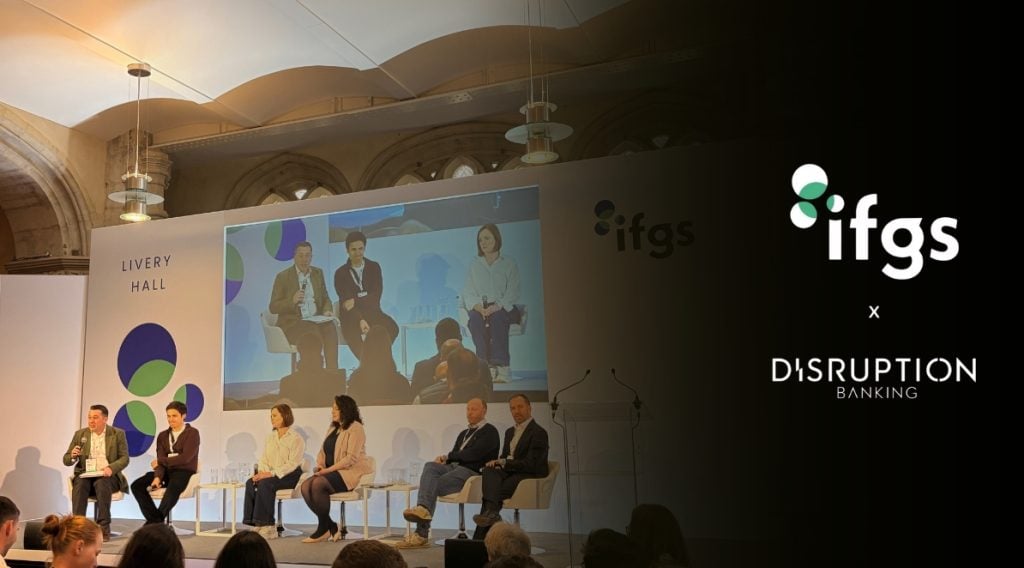
Is regulation a barrier or a growth engine for UK fintech in 2026? At IFGS 2026, leading voices tackled this question head-on in the panel “From Tech Neutral To Tech Positive: Regulating For Growth, Innovation, And Better Outcomes”. The discussion explored how smarter, faster regulation can support fintech growth, AI adoption and UK competitiveness.
Featuring Victoria Collins MP (Liberal Democrats Spokesperson for Science, Innovation and Technology), Charles Delingpole (Founder and Executive Chairman, ComplyAdvantage), Colin Payne (Head of Innovation, Financial Conduct Authority (FCA)), Kirsty Rutter (Fintech Investment Director, Lloyds Banking Group), and James Jackson (CEO, Bumper), the discussion examined how regulation can actively unlock growth while maintaining trust.
The timing is critical. With fintech investment regaining momentum and AI transforming payments, lending, fraud detection and customer experience, the industry needs a framework that keeps pace.
Regulation Should Unlock Innovation
Victoria Collins MP, opened the discussion by calling for a fundamental shift in how regulation is viewed in the UK’s innovation ecosystem.
“Regulation shouldn’t be this trauma word,” she said. “Doing it right should absolutely be about unlocking that.”
Collins emphasised that effective regulation must set the right incentives for scaling up, investing, and upskilling while maintaining the UK’s strong foundation of trust and quality. She highlighted the country’s respected legal system and leading position in fintech as assets that regulation should reinforce rather than undermine.
“We have this leading place of being trustworthy, about quality. UK law is respected around the world. We should really embrace that, especially when it comes to fintech,” Collins noted. “Helping set that foundation of trust is something regulation can do.”
She advocated for adaptable standards that allow innovation to flourish while keeping consumer trust at the core. Collins also stressed the importance of government action to support the skills needed for an AI-driven economy, including skills tax credits and a lifelong training grant similar to models used in France.
These measures, she argued, would empower individuals to retrain and help the UK embrace long-term technological change.
Victoria Collins MP, Liberal Democrats Spokesperson for Science, Innovation and Technology, tells delegates to "Embrace the change” at the panel – From Tech Neutral To Tech Positive: Regulating For Growth, Innovation, And Better Outcomes. #IFGS2026 pic.twitter.com/D7cW7NOaOQ
— #DisruptionBanking (@DisruptionBank) April 21, 2026
How Is the FCA Making Tech-Positive Regulation a Reality?
Payne described the shift from tech-neutral to tech-positive regulation. The FCA pioneered the world’s first regulatory sandbox, digital sandbox and AI initiatives and its 2025-2030 strategy embeds this approach.
“We were the first talking about tech positive,” Payne said. “Our role is to clarify that. The idea is to unlock the opportunity.”
The FCA’s AI Lab (now expanding to agentic AI) and sandboxes provide free tools for firms to test innovations safely. Regulators worldwide watch the UK, he added, crediting cross-party government support and collaboration with ecosystems in Singapore and Saudi Arabia. Success is measured by investment, unicorns and fintech scale, not zero-sum competition.
Building Capabilities: What Firms and the Ecosystem Must Do
As banks and fintechs navigate rapid change, firms must build capabilities through community, experimentation (for example, quantum computing trials with IBM) and education reform, moving beyond rote learning to critical thinking. Regulation itself must adapt.
“We have to look at it systematically,” Kirsty Rutter said. “The whole system is going to have to adapt. You’ve got to be in it.“
Charles Delingpole focused on AI’s practical impact on compliance. ComplyAdvantage works with thousands of banks and fintechs on AML, sanctions and fraud. Agentic AI now outperforms humans in speed, accuracy and cost, processing billions in labour equivalents.
The challenge for regulators (FCA and global peers) is responding to this profound shift responsibly, testing carefully to avoid future harmful outcomes.
Proportionate Regulation: Moat Against Bad Players Without Blocking New Entrants
James Jackson, whose Bumper processes billions in automotive payments and holds an FCA consumer credit licence, called for proportionate rules. He warned against overly burdensome regimes like the EU AI Act, which could cost high-risk SMEs hundreds of thousands of euros annually in compliance, funds diverted from innovation. Europe’s slower growth versus the US illustrates the risk.
The UK’s faster BNPL regulation (versus upcoming EU rules) shows leadership, though some smaller EU markets impose disproportionate licensing costs.
“A good regulator is a moat against bad players, but at the same time, not a barrier to entry,” Jackson said, urging agility to protect consumers without stifling innovation.
Quick-fire ideas for keeping the UK competitive included safe harbours for agentic AI, thinking like entrepreneurs with growth incentives and standards, systemic education reform and data-agent integration, and regulatory discipline via sunset clauses to prevent rule layering. Embedding policy as “code” could make rules machine-executable for faster, safer deployment.
View Global Regulators as Partners, Not Competitors
Payne addressed the question of international competition directly when asked about leadership and potential rivals and he emphasised collaboration over rivalry.
“We don’t really think of this as a competition per se,” he said. “Of course, we want the UK to be the best by quality, and we can measure that through investment, support, and numbers of unicorns and fintechs.”
Payne explained that the FCA works closely with leading regulators including those in Singapore and Saudi Arabia. Rather than viewing them as competitors, the UK regulator shares best practices and focuses on interoperability and global standards.
“If we don’t think about interoperability, and we don’t think about global standards, then we’re missing the trick completely. We have to work with them. It’s not a competition,” Payne stressed.
He highlighted practical examples of UK leadership, such as being the first regulator in the world to create a dedicated Scale Unit to help fintechs grow. The overall approach, he argued, is about optimising the UK ecosystem while contributing to a stronger global community of regulators.
Colin Payne, Head of Innovation, Financial Conduct Authority said, “When we look at other regulators, let’s not call them competition… we have to work with them” at #IFGS2026 pic.twitter.com/KDtxy8OE5J
— #DisruptionBanking (@DisruptionBank) April 21, 2026
Can Regulation Become a True Growth Engine for UK Fintech?
The panel signals a broader cultural shift. Regulators are not just permitting innovation but deploying technology themselves, via enhanced sandboxes, AI monitoring and real-time testing, to reduce friction, identify risks early and reinforce the UK as a global fintech hub. 2026 milestones (enhanced payment safeguarding in May, BNPL perimeter in July, crypto regime preparation for 2027) test this balance, creating both compliance demands and opportunities for trust-building and investment.
“It’s creating safe spaces for the ecosystem to come in and play. That’s what we’re doing. So I think that’s the key on policy. It’s just unlocking and if that means policy is code in the future, that’s what I’d like to try it against“, said Payne.
“If we get policy embedded into the coding that we’re doing on the product side… it becomes a machine executable habit which is much faster,” Payne concluded, turning regulation into a true growth engine.
Reported live from IFGS 2026, Guildhall, London. 21 April 2026.
Author: Ruben McCarthy
See Also:
Tube Strike or Not, UK Fintech Is Unstoppable: What IFGS 2026 Revealed | Disruption Banking
UK fintech backed to embrace future payments technology | Disruption Banking