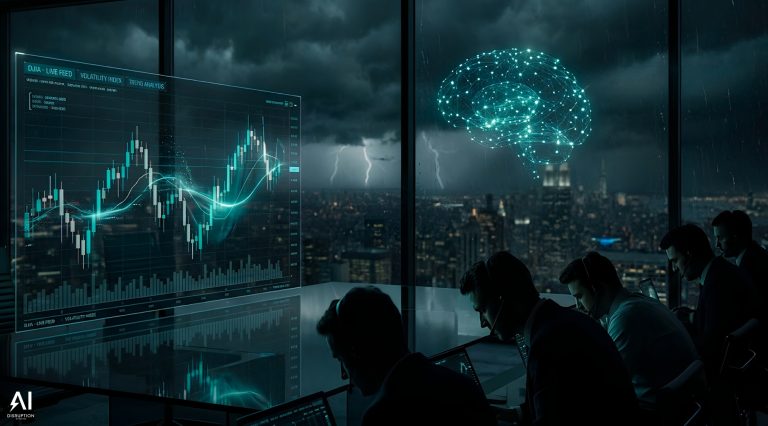

The KOSPI (Korea Composite Stock Price Index) has lost 33% of its value since June. It lost another 7.3% in the 24 hours between July 27 and 28, triggering a halt in trading, referred to as a “circuit breaker,” the 8th one already this year.
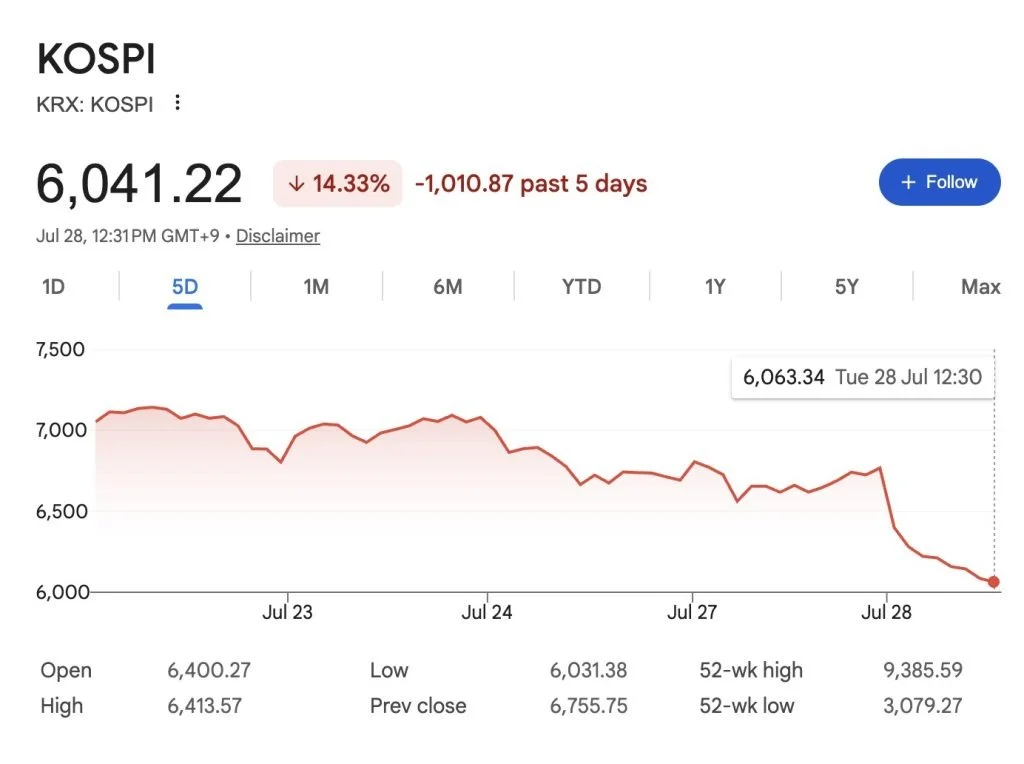
Despite the decline, South Korea’s stock index is still up a staggering 49% since the beginning of the year. This explosive growth, and subsequent correction, are largely powered by leveraged investments in two companies.
South Korea’s retail investors piled record leverage into Samsung and SK Hynix, two stocks that make up over half the KOSPI, which are down 11% and 12%, respectively. When AI capex fears hit in late June, the index cratered, triggering margin calls on 1.2 million accounts and forcing liquidations that dragged Tokyo and Taiwan down with it.
The Kopsi tracks nearly 900 companies on the Korea Exchange (KRX), and functions as the primary economic indicator for South Korea. In that regard, some have noted that the index is fluctuating more like a meme stock than an index. Multiple percentage-point leaps and drops have become common over the past two months.
The volatility can be explained by a few contributing factors. First and foremost, over 50% of the Kopsi’s market cap is made up of just two companies: Samsung and SK Hynix. Second, both of those companies have become increasingly focused on AI, which has driven international markets for the past few years. Third, South Korea is heavily leveraged, which leads to bigger swings in the market.
The Uninvited Guest
ChangXin Memory Technologies opened for trading on Shanghai’s STAR Market on July 27 at 8.66 yuan a share. By the close, it had gained 466%, valuing China’s largest DRAM maker at roughly $489 billion and making it, for one day, the most valuable listed company in the country.
Analysts can’t agree on what any of that is worth. Nomura’s Donnie Teng set a price target of 116 yuan, more than 1,200% above the IPO price. Morningstar’s Wei Jingjie put fair value at 14.90 yuan, a fraction of where the stock opened. Between those two numbers sits $489 billion in market cap and a great deal of investor imagination.
CXMT doesn’t need to catch Samsung Electronics or SK hynix in high-bandwidth memory to hurt them. It just needs to keep flooding the market with ordinary DRAM, the kind that sets the prices the Korean giants depend on. The company controlled about 7.7% of global DRAM revenue and 11% of wafer capacity in the first quarter of 2026, figures that grow every time a new fab comes online.
Seoul found out what that pressure looks like on July 28, when the KOSPI tripped its eighth circuit breaker of the year. Samsung and SK hynix carry more than half the index’s weight. When memory prices caught the CXMT scare, the whole market caught the seizure.
Same Playbook, Bigger Stage
While the KRX is small compared to the U.S. stock market, the factors driving its dramatic price moves bear some striking similarities. While the NYSE and Nasdaq are not dominated by two mega-corporations like South Korea, they are increasingly dominated by a handful of tech stocks.
The S&P 500 is composed of 500 companies, but a mere 14 of them make up 45% of the index. The top nine companies all exist in the AI space. The Nasdaq 100 is even more lopsided. The top ten companies, all AI-driven, account for 67% of the index’s weighting.
Without these handful of AI and AI-adjacent companies, the market would be flat or down on the year. Given investors’ growing concern over rampant spending on AI infrastructure, any number of catalysts could trigger a selloff, which, given the companies’ outsized position in the Nasdaq 100, could trigger a broader correction.
Two for One
American investors are more leveraged than they’ve been in quite some time. The US margin debt recently hit a record at $1.53 trillion. The margin debt percentage relative to GDP is 4.71%, which places the current number in the company of the years 2000 and 2007, both of which were followed by steep corrections.
The ETF market is exploding with more and more leveraged vehicles for anything AI.
According to Morningstar, “leveraged and inverse ETFs made up 31% of all U.S.-listed ETF launches in the first half of 2026, up from 22% in all of 2025.”
U.S. investors, by the numbers, are increasingly being drawn to riskier investments, such as leveraged ETFs that focus on single stocks. Market volatility, however, has not been seen in the U.S. like in South Korea. However, there is another bug that could eventually weigh on American markets.
Circular Financing is Still a Thing
While not occupying as outsized a presence as Samsung on the Korea exchange, Alphabet is one of the major players on the Nasdaq 100. Its stock performance can sway broader market sentiment. That being said, Alphabet recently reported its most profitable financial quarter in the company’s history.
Investors rewarded the company with a major selloff that saw the stock drop 7% in a single day. $112.1 billion in net income for a single quarter, it seems, just doesn’t buy investor confidence like it used to.
Instead, investors focused on Alphabet reporting negative free cash flow of $5.9 billion for the quarter, its first negative cash flow since going public 22 years ago. The 2026 capital expenditures forecast raised to $205 billion also didn’t calm anyone’s nerves.
But what’s $5.9 billion when you’re making $112 billion in a single quarter? That might be true if the second number wasn’t more a product of accounting tricks and circular financing than actual profit.
The Cloud Kickback
Alphabet is a sizable investor in SpaceX and Anthropic, the valuations of each having exploded in the past year. Two-thirds of Alphabet’s second quarter profits are attributed to unrealized gains from these equity investments. However, Alphabet didn’t sell anything. They are paper profits, which could disappear, but have been counted as income.
Additionally, much of Alphabet’s remaining profit comes from its cloud division. However, one of their main cloud customers is Anthropic. So, in essence, Alphabet invested billions in Anthropic for Anthropic to then pay Alphabet billions for access to its data centers.
Alphabet isn’t alone in these kinds of circular deals. Amazon, Nvidia, and others all are essentially paying for corporate customers to use their products. While in the long run this tactic might win out, it adds another layer of risk to the tech sector and the overall market.
The Next Domino?
Given the changing priorities of American investors regarding AI expenditures, increased scrutiny of tech companies’ earnings reports is to be expected.
South Korea’s market correction was triggered by a tech sell-off, heavy single-stock concentration, and leveraged investors. The U.S. markets exhibit these conditions, along with opaque circular financing and concerns over rampant AI spending.
None of this means a crash is imminent. Markets can stay concentrated and leveraged for a long stretch before something breaks. But South Korea just handed Wall Street a live demonstration of what happens when an index props itself up on a handful of stocks and retail money leverages into that narrow bet with borrowed cash.
The U.S. has the concentration. The U.S. has the leverage. And now it has the circular financing, tech giants investing billions into companies that turn around and pay those same giants billions for cloud access, dressing up paper gains as record profits. Alphabet’s stock didn’t fall 7% because the quarter was bad. It fell because investors are starting to ask whether the numbers still mean what they used to.
A market correction sometime in 2026 wouldn’t be surprising.
Author: Tim Tolka, Senior Reporter
The editorial team at #DisruptionBanking has taken all precautions to ensure that no persons or organizations have been adversely affected or offered any sort of financial advice in this article. This article is most definitely not financial advice.

Tim Tolka
Tim Tolka, Senior Reporter at Disruption Banking, covers digital assets, monetary policy and the politics of global finance. Based in Mexico City, he brings an investigative edge to his reporting, informed by a Master's in International Affairs and his work as an author and screenwriter.