
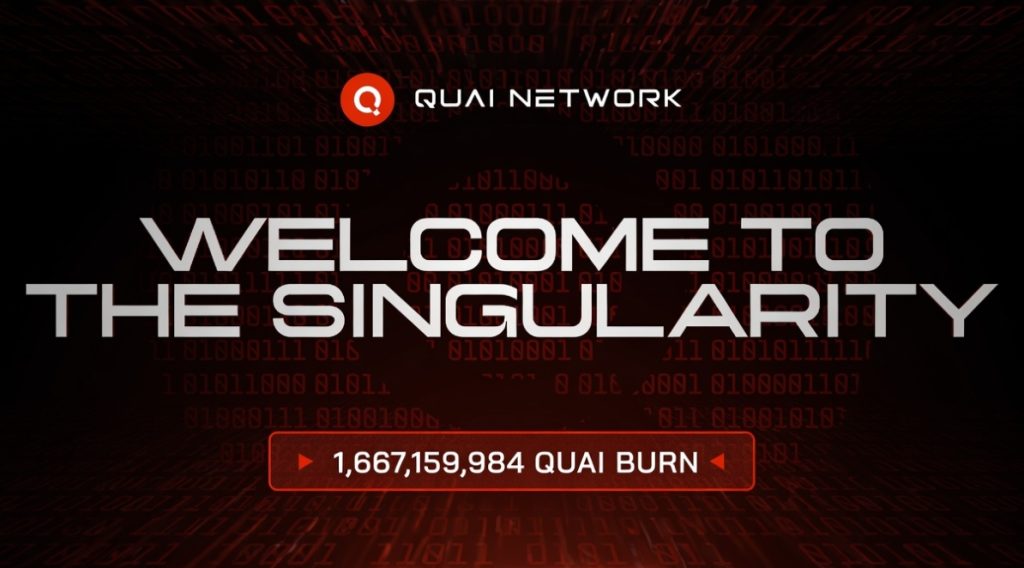
At Prime Block 1,530,500, Quai Network activated the Singularity Fork. The upgrade permanently removed approximately 1.67 billion QUAI from future genesis unlocks. Through a multilateral agreement between investors, Dominant Strategies, and the Quai Foundation, the network eliminated 81.1 percent of all remaining future genesis unlocks. This action lowered the vested baseline from 3 billion QUAI to roughly 1.33 billion.
For financial readers who follow proof-of-work monetary systems, the fork represents more than a large token reduction. It marks a deliberate shift toward a more disciplined and institutionally legible supply framework. Many Layer-1 networks still carry substantial forward dilution risk. Quai has now reduced one of the largest sources of that risk at the protocol level.
Why Future Token Overhang Matters
Large scheduled unlocks create uncertainty in crypto markets. Investors and analysts must model potential selling pressure from future emissions. This modeling can affect price discovery and capital allocation. Projects that carry significant unvested allocations often face repeated questions about whether early participants will eventually sell into the market.
Before the fork, Quai’s structure included a substantial genesis unlock schedule. By removing the majority of those future releases directly in the protocol, the network reduced a common source of overhang. Market participants now have a clearer baseline from which to assess Quai’s forward supply trajectory.
Many other Layer-1 networks continue to carry large unvested allocations for early investors and founding teams that extend several years into the future, which often creates ongoing uncertainty around future supply.
What Changed at the Protocol Level
Many token reductions in crypto rely on discretionary treasury decisions or community votes. The Singularity Fork was implemented differently. After block 1,530,500, the network’s monthly emission schedule simply skips the designated addresses that previously held the removed unlocks. No further QUAI will be released to those addresses.
This approach is enforced by the protocol itself rather than by an off-chain promise. The change was activated through the release of go-quai version 0.51.0. Node operators were required to update before the activation block. Because the rule is coded into the protocol, it offers greater predictability than discretionary actions.
The New Supply Equation
After the fork, Quai describes its supply dynamics through a clear equation. Total supply equals genesis unlocks plus mining emissions minus SOAP burns. The network now operates with a soft supply cap of approximately 1.4 billion tokens. The impact of the fork on Quai’s supply composition is shown below:
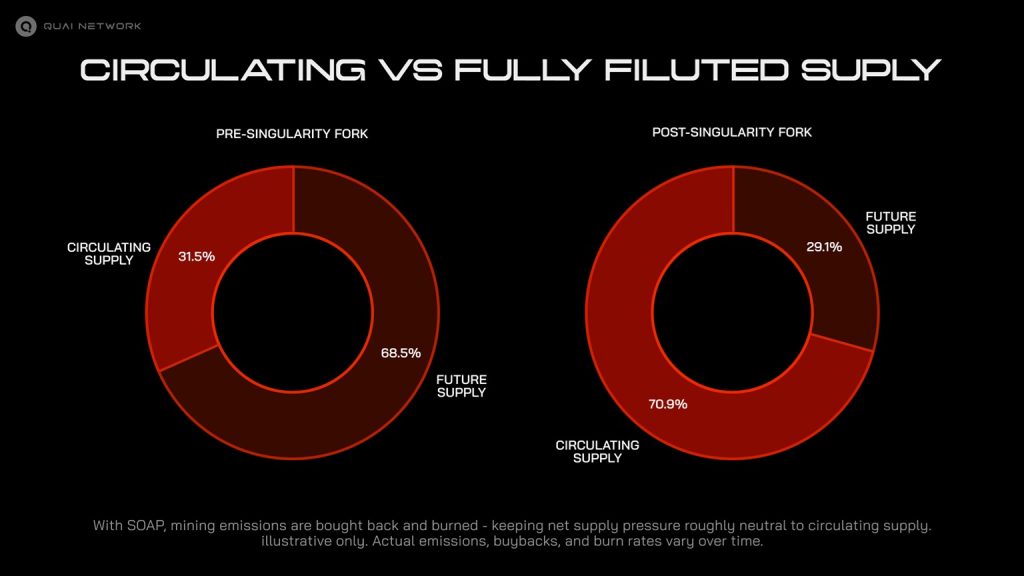
Mining emissions continue as the core incentive for proof-of-work security. At the same time, Project SOAP routes a portion of network revenue into QUAI buybacks and permanent burns. This mechanism creates an observable offset to ongoing emissions. The result is a monetary design that can be evaluated through measurable on-chain activity rather than static distribution schedules.
Mining Infrastructure Improvements
The fork also doubled workshare inclusion limits, increasing total workshares per block from 16 to 32. Both SHA and Scrypt shares rose from 8 to 16 per block. This change increases base-layer throughput capacity and improves the economics for miners submitting valid workshares.
In addition, the upgrade delivered several node and infrastructure improvements. These include better RPC subscription support, more accurate gas estimation, and optimizations to the peer-to-peer layer. The changes support both miner participation and broader network usability as transaction volume grows.
A More Legible Monetary Framework
For institutions and analysts who evaluate proof-of-work networks, the Singularity Fork provides a clearer set of variables to monitor. These include remaining genesis unlocks, mining emissions, and the rate at which SOAP converts network revenue into permanent burns. The fork does not remove all future emissions. It does, however, materially reduce the size of the predetermined unlock overhang that has historically complicated supply forecasting.
Quai presents the change as part of a broader effort to build monetary infrastructure where supply dynamics follow observable protocol rules and on-chain revenue activity.
Looking Ahead
The Singularity Fork leaves Quai with a smaller forward unlock schedule and an active mechanism to offset mining emissions through revenue-driven burns. Whether this combination produces sustained network growth and measurable adoption remains to be seen. What the fork has already delivered is a more defined starting point for that evaluation.
Financial observers can now track Quai’s progress against a cleaner supply baseline and an explicit link between network revenue and token burns. Both data points were less visible before the protocol-level reset.
See Also:
Quainance Launches: The New Central Hub for DeFi on Quai Network | Disruption Banking
Should Bitcoin HODLers Take a Closer Look at Quai Network? | Disruption Banking

Andrew Samu
Andrew Samu, Editor-at-Large at Disruption Banking, shapes the publication’s global coverage of banking, capital markets and digital assets. Based at London’s Level39, he combines market analysis with a strong commercial perspective, informed in part by his role as Commercial Director at Verita HR.