

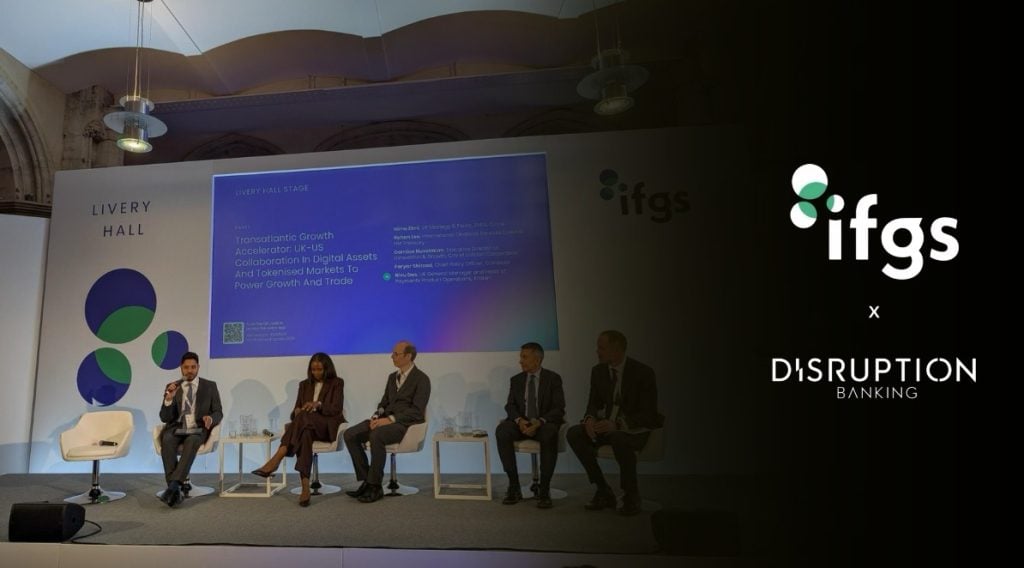
This year’s Innovate Finance Global Summit has seen many panels discuss digital assets. AI hasn’t quite taken the crown away from crypto, especially with the backdrop of the Transatlantic Taskforce for Markets of the Future which includes digital assets.
Known as TTMF for short, the topic was big enough to justify its own panel called “Transatlantic Growth Accelerator: UK-US Collaboration in Digital Assets and Tokenised Markets to Power Growth and Trade.” Speakers included Nima Elmi, VP Strategy & Policy, EMEA, Circle, Rohan Lee, International Financial Services Director, HM Treasury, Damian Nussbaum, Executive Director of Innovation & Growth, City of London Corporation and Faryar Shirzad, Chief Policy Officer at Coinbase. The panel was moderated by Bivu Das, UK General Manager at Kraken.
In the packed Livery Hall at London’s historic Guildhall, Bivu Das introduced the audience to the topic of the conversation. A debate about the world’s two most powerful financial centres teaming up to rewrite the rules for the digital age.
What is the Transatlantic Taskforce?
The Taskforce, launched in September 2025 during a historic UK state visit by the US Treasury Secretary, is no ordinary diplomatic exercise. It’s a deliberate push to align regulations on digital assets, create pathways for firms to operate seamlessly on both sides of the Atlantic (including passporting-like arrangements), and accelerate progress on stablecoins and tokenisation.
London’s Ambition to Lead
Rohan Lee, the government official on the panel, admitted with a self-aware chuckle that his notes gave him away as the civil servant in the room. But his message was clear and optimistic. Despite minor delays caused by US government shutdowns, real momentum had built up. UK and US teams had swapped visits. First hosting American counterparts in London for industry discussions, then crossing the Atlantic for meetings in Washington. Industry voices, especially from innovative and dynamic firms, were being actively heard.
“The outcomes of the Taskforce should really be determined by engagement with the sector,” Lee emphasised. Just days earlier, the Chancellor and Economic Secretary had used the Spring Meetings in Washington to check progress. An update was expected by summer. The goal? Strengthen the “special relationship” at a moment when digital technology is poised to transform finance forever.
When asked where the strongest will to act lay, Lee pointed to the UK’s clear ambition to lead on digital assets. That very morning, the government had announced Chris Woolard as the new Wholesale Digital Markets Champion, in a signal of intent. Yet he was quick to add that true leadership couldn’t happen in isolation. The UK’s financial services strategy depends on strong international partnerships, and this Taskforce was the perfect example.
From the City of London’s perspective, Damian Nussbaum framed the stakes in dramatic terms. This wasn’t just another regulatory tweak. Instead, it was potentially a “big bang” moment on the scale of the 1980s reforms that reshaped global finance.
“Unless you can join these innovations up and achieve real interoperability,” he warned, “all the exciting developments in places like Singapore, Switzerland, the UK, or the US risk hitting a wall. It’s like racing down a fast track only to find the rails suddenly end.”
Get it right, and London and New York could set the standards and culture for a new era of finance that becomes the global default. Get it wrong, and fragmentation wins. The opportunity, and the risk, is enormous.
Not the Time for Caution
Faryar Shirzad of Coinbase brought the private-sector urgency into sharp focus. Blockchain technology, he argued, is fundamentally changing how value moves around the world. This isn’t the time for cautious, incremental national rules. It demands high-level dialogue between sophisticated financial centres.
On the US side, he noted, two big debates had already been settled: stablecoins are accepted as the payment system of the future, and tokenisation of real financial assets (bonds, derivatives, and more) is moving full steam ahead. The harder question looming is intermediation itself. Traditional finance relies on layers of third-party intermediaries. Blockchain can remove much of that need, a disruption that touches the core business models of incumbents.
“This is exactly the kind of thing that secretaries of the Treasury and Chancellors need to discuss at the highest level,” Shirzad said. All speakers expressed strong support for the Taskforce and hoped its summer outcome would deliver not just an ambitious political statement, but a concrete work programme to turn vision into reality.
Coinbase Chief Policy Officer Faryar Shirzad takes the stage at #IFGS2026
— Digital Startup (@digitalstartup5) April 21, 2026
The hard question is what happens to intermediation, he shares.#DisruptionBanking #Coinbase #TTMF pic.twitter.com/dz0i3A6XFs
Why This Matters for Operators
Operationally, for companies operating across borders, clarity matters deeply. Treating software and smart contracts as market infrastructure rather than traditional intermediated activity is crucial. So too are practical mechanisms like equivalence determinations and recognition regimes. Both areas where the UK’s FCA has shown leadership, and where the US may soon follow with legislation like the Clarity Act.
The conversation turned hopeful when stablecoins were highlighted as the accepted future of digital payments, welcome news for the Circle team. Shirzad expanded on the broader opportunity: the upcoming US SEC innovation exemption could commit America to building tokenised capital markets on smart contracts, DeFi platforms, and decentralized exchanges. The question for the UK and the Taskforce is whether it will match that vision, and go further by enabling true cross-border capital flows.
“Unlocking access to capital and investment opportunities is one of the biggest policy challenges right now,” he argued. Drawing from Coinbase Institute’s report From the Unbanked to the Unbrokered, Shirzad pointed out how wealth creation through labour has been dramatically outpaced by returns to capital, and how most people remain locked out of meaningful investment opportunities. Tokenisation, fractional ownership, and reduced barriers could change that, helping everyday people, builders, and entire economies participate in wealth creation with powerful social and political implications.
Rohan Lee acknowledged the loud industry call for international interoperability, both in rules and in how firms actually operate. He highlighted the UK’s balanced approach: government and regulators setting sensible guardrails while giving industry room to innovate through initiatives like the DIGIT Pilot and the digital securities sandbox. Post-Brexit overseas recognition regimes will be key in applying these principles to new areas of finance.
Ambition and Disruption
As the session drew to a close, the moderator turned to Shirzad for his final words.
“Ambition and disruption,” he replied without hesitation.
In that simple answer lay the spirit of the entire discussion: a recognition that the transatlantic partnership has a rare chance to shape the next era of global finance. It can do this not through caution, but through bold, coordinated action that embraces technology’s transformative power while keeping markets open, competitive, and inclusive.
The summer update from the Taskforce will reveal how far that ambition will reach.
Author: Andy Samu
See Also:
Clarity Act: Ripple Says Yes, Coinbase Walks Away | Disruption Banking
Why did Coinbase join the S&P 500? | Disruption Banking
Coinbase blocks trading for users in the UK. Why? | Disruption Banking

Andrew Samu
Andrew Samu, Editor-at-Large at Disruption Banking, shapes the publication’s global coverage of banking, capital markets and digital assets. Based at London’s Level39, he combines market analysis with a strong commercial perspective, informed in part by his role as Commercial Director at Verita HR.