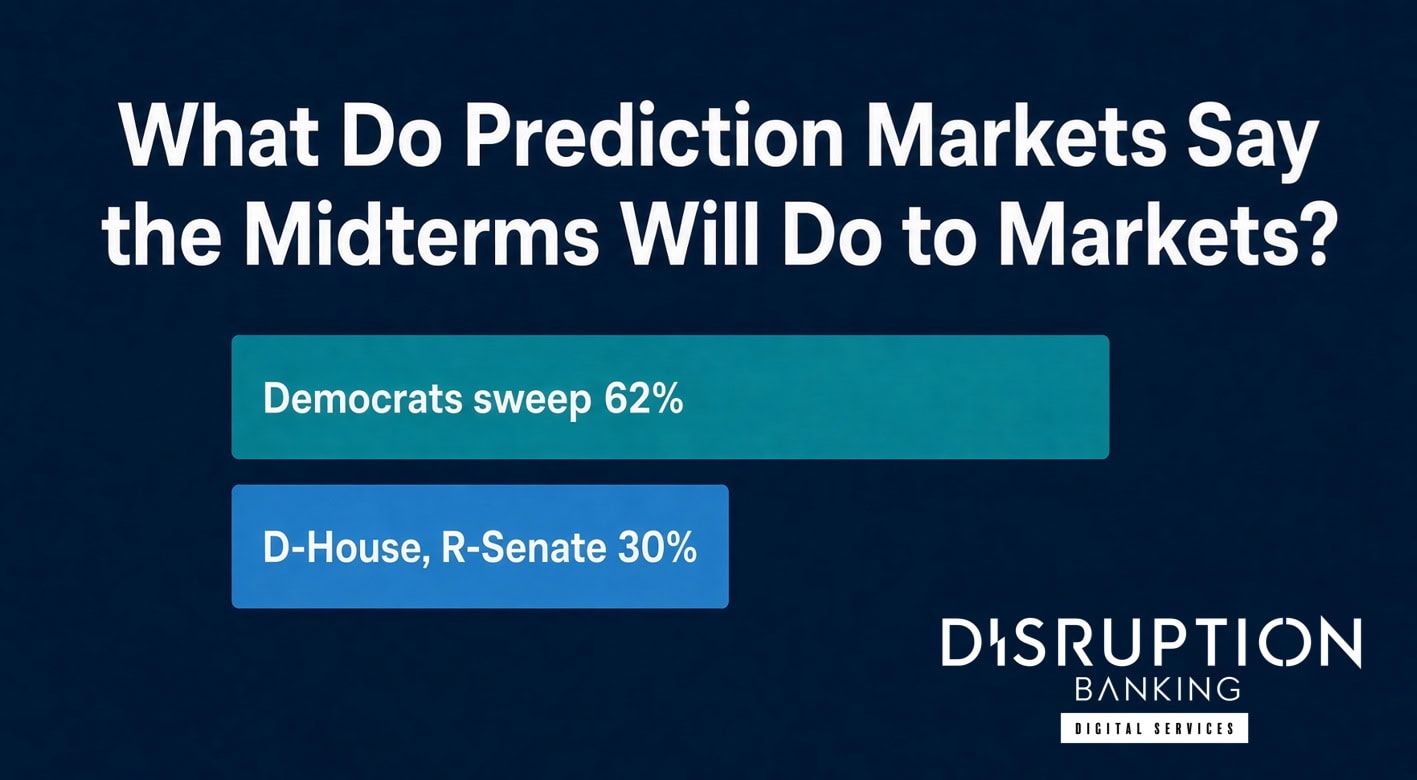
Prediction markets now put a Democratic sweep of Congress at roughly 61–63 per cent. Kalshi and Polymarket held those levels for the past week. The most likely single outcome priced on both venues is Democrats taking both chambers. A split Congress, with Democrats taking the House and Republicans holding the Senate, sits around 30 per cent. A Republican hold of both is around 10 per cent.
What a Democratic sweep is priced to do
Bank of America’s Michael Hartnett, famously known for coining the phrase “Magnificent Seven” in 2023, has called a Democratic sweep the main catalyst for a double-digit equity move into 2027. In an October note he said US stocks could fall more than 10 per cent under that outcome, with the dollar weaker and international equities outperforming. He framed it as a shift from “populist capitalism to populist socialism,” with AI infrastructure in particular exposed to higher scrutiny. The same note put the probability of a sweep at 64 per cent at the time, matching prediction markets. A split Congress, by contrast, was described as a “Gridlock = Goldilocks” case that could lift equities more than 5 per cent.
JPMorgan’s Dubravko Lakos-Bujas has run the same three scenarios. Gridlock, he wrote, has historically been associated with stronger S&P 500 returns than single-party control: +21 per cent over the following two-year congressional term since 1950 versus +18 per cent under unified control. Under a blue wave the bank’s sector list tilts toward healthcare and clean energy; under a Republican hold it tilts toward AI infrastructure, traditional energy, defence and banks. The equity impact, Lakos-Bujas said, is more stock-specific than the 2024 presidential race.
Why the equity market has not moved yet
Barclays data from October 1 showed the S&P 500 expected to move only about 0.8 per cent on November 4, the day after the election. Options traders have not priced a large move around the vote, even as bond yields and energy prices have already been volatile.
Morgan Stanley’s Institute noted on October 14 that fiscal policy, tariffs and deregulation would remain broadly in place under most outcomes; a change in congressional control would create more noise around funding and the debt ceiling than an immediate policy reversal. The AI and data center build-out, the note added, is more exposed to state and local permitting than to Congress.
What the midterms are not pricing
The prediction markets are pricing control of the chambers. They are not pricing a clean break in the fiscal stance or a sudden stop in AI capital expenditure. Most strategists still treat the Fed’s decisions, inflation, and earnings as the larger drivers of the next three months. A Democratic House would raise the odds of hearings and tighter oversight on technology and energy. It is unlikely to be able to reverse the deficit trajectory or the tax cuts already in place.
The vote is on November 3. Watching prediction markets for more updates is the new way of gauging market sentiment.
Author: Andy Samu
See Also:
Where Does Wall Street Stand On The US Elections? | Disruption Banking