Is a prediction market an investment or a bet? That one question now sits before federal appeals courts, around 20 state regulators, and the Commodity Futures Trading Commission (CFTC), which is determined to maintain control. The answer decides who governs a market Kalshi and Polymarket already shared, valued at about $60 billion combined as of early 2026, according to a June letter from Senate Banking Democrats to the CFTC.
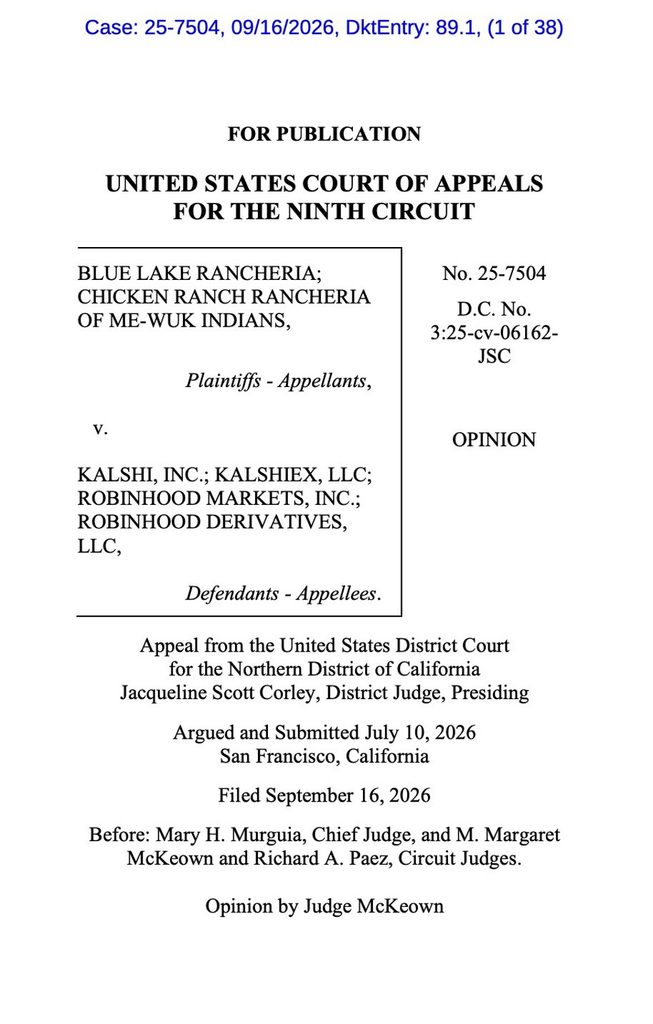
In September, the Ninth Circuit dealt Kalshi another blow, finding that two California tribes are likely to prove Kalshi’s sports contracts amount to illegal gaming on their land, weeks after the same court sided with Nevada’s gambling regulators. In April a 2-1 Third Circuit panel in New Jersey left a preliminary injunction in place and treated the contracts as federally regulated derivatives. Two appeals courts, one question, opposite answers.
Twenty states, one unsettled question: swap or wager?
The CFTC claims exclusive jurisdiction over event contracts under the Commodity Exchange Act and has sued Arizona, Connecticut, and Illinois to defend it. Chair Michael Selig calls prediction markets and sportsbooks “two separate things.” The states disagree, and courts are split on whether the contracts are federally regulated “swaps” or ordinary gambling.
New York and Wisconsin have moved to treat them as unlawful gambling. Because sports contracts drive about 80% of Kalshi’s volume, states keep arguing that this is sports betting wearing a financial label.
Texas asks whether a trade is really a bet
In September, the Texas Senate and House State Affairs Committees held hearings on whether to regulate or ban platforms like Kalshi. Kalshi’s Robert DeNault told lawmakers that the exchange is a federally regulated derivatives platform, not a sportsbook. The American Gaming Association’s Tres York countered that 85% of Kalshi’s volume is tied to sports and parlays, which is a sportsbook by function. State leaders have made a crackdown a priority for the session that opens in January 2027.
Katy Aldredge, Principal at Em Dash Strategies LLC, attended both Texas hearings. “After attending both committee hearings in Texas, it was clear to me that state legislators are clamoring to regulate prediction markets instead of leaving it to Washington,” she said. “The emphasis on marketing to minors, public integrity, and consumer protections shows that states believe they have the authority to impose guardrails on two different industries that appear similar but are regulated differently.”
Age 18, self-policed checks, and $5.4 billion in young money
This is where states push hardest. Most states set sports betting at 21; prediction markets take users at 18. York told the committee that, according to a recent analysis, 18-to-21-year-olds had traded about $5.4 billion on Kalshi this year. A survey cited to lawmakers found 61% of Americans view prediction markets as gambling, not investing. Critics also note that know-your-customer and anti-money-laundering checks are largely rules that the platforms enforce on themselves.
The CFTC is now writing new rules for the sector. The Senate this month declined to take up the CLARITY Act, which would have expanded the agency’s authority over digital-asset markets. Until a court or Congress decides, whether a contract is an investment or a wager still depends on the state you trade from.
Author: Ayanfe Fakunle
The editorial team at #DisruptionBanking has taken all precautions to ensure that no persons or organizations have been adversely affected or offered any sort of financial advice in this article. This article is most definitely not financial advice.