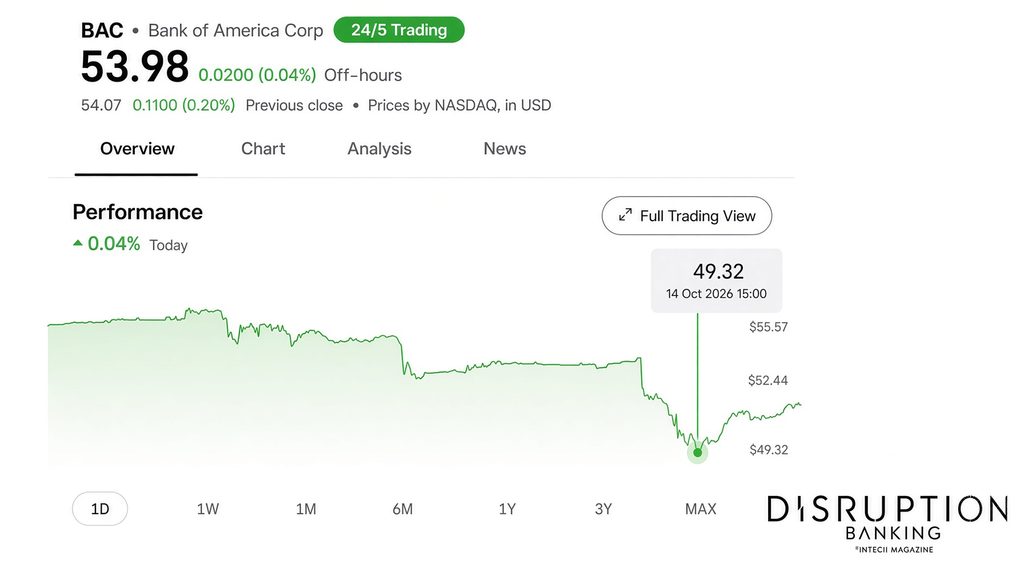
Bank of America shares fell more than 8% today after the U.S. Treasury imposed $1.21 billion in penalties for anti-money laundering and sanctions failures, and the bank reported weaker-than-expected third-quarter results. The stock drop wiped out more than $20 billion in market value, many times the size of the fine.
The $1.2 billion charge is non-tax-deductible and reduced third-quarter earnings by about 17 cents a share. Adjusted EPS was $1.08 against expectations of roughly $1.10.
Treasury and OCC impose record penalties
The Treasury said the actions were the third-largest penalty in its history and the largest ever from the Office of the Comptroller of the Currency. The bank admitted it willfully violated the Bank Secrecy Act by failing to maintain an adequate AML programme, conduct required due diligence on foreign correspondent accounts, and file suspicious activity reports on more than $5 billion in transactions. More than $1 billion of that activity involved national-security risks, including Chinese money-laundering networks and trade-based laundering linked to the southwest border.
Treasury Secretary Scott Bessent said the failures “exposed the entire US financial system to significant illicit finance risks” and that “even the biggest financial institutions are not above the law.”
Comptroller of the Currency Jonathan V. Gould called the bank’s response to earlier deficiencies “unacceptable” and said the continued violations justified the OCC’s largest civil money penalty on record.
Days earlier the OCC also fined American Express National Bank $350 million for separate BSA/AML failures, saying the bank had not reported roughly $13 billion in suspected trade-based money laundering activity over the past decade.
Earnings miss compounds the fine
The fine landed less than 24 hours before the bank announced third-quarter earnings. The $1.2 billion charge is non-tax-deductible and reduced third-quarter earnings by about 17 cents a share. The bank incorporated the charge into its materials and presentations the same morning it reported.
Even excluding the charge, results were mixed at best. Adjusted EPS was $1.08 against expectations of $1.10. Revenue was $30.0 billion against $30.76 billion expected. Trading revenue excluding DVA was $5.1 billion against $5.41 billion expected, with fixed-income trading at $2.5 billion (versus $2.86 billion) and equities at $2.5 billion (versus $2.63 billion). Wealth and investment management revenue was $7.12 billion, slightly above the $7.06 billion estimate. Net interest income was $16.4 billion and the net interest yield was 2.16%, ahead of the 2.11% estimate. Provisions for credit losses were $1.3 billion against $1.49 billion expected.
How investors and analysts are reading it
Analysts described the market reaction as larger than the fine alone would justify. UBS’s Erika Najarian said the penalty was likely to add to negative sentiment and raise questions about ongoing remediation costs and questioned whether the bank can sustain its roughly $6 billion quarterly buyback pace. Further commentators noted that the compliance issues were already known from a 2024 OCC order, so the market was reacting more to the combination of the penalty, the earnings miss, and the reminder of persistent control problems than to the absolute size of the fine. One widely shared view put the penalty at roughly two weeks of the bank’s annual profit.
The bank said it has already dedicated substantial resources to remediation and that those costs sit in the current expense base. It remains under a consent order requiring an independent third-party review of past transactions.
The individual-accountability question
The fine also drew a pointed response from Everett Stern, the former HSBC compliance officer whose disclosures contributed to that bank’s $1.92 billion settlement in 2012. In a post on X, Stern wrote that Bank of America “let money move for the enemies of America,” citing $5 billion in unreported suspicious transactions and 475 apparent sanctions violations tied to Russia, Iran, narcotics, and terrorism. He argued that “nothing changes until someone goes to prison.”
Stern also raised a serious question by asking “why has no one inside Bank of America come forward the way I did?”
What institutional holders are watching
For institutional holders the key questions are now the duration of the order, the incremental cost of remediation, and whether the trading miss is temporary. Today’s share-price reaction shows investors are pricing both.
Author: Andy Samu
The editorial team at #DisruptionBanking has taken all precautions to ensure that no persons or organisations have been adversely affected or offered any sort of financial advice in this article. This article is most definitely not financial advice.
See Also:
ECB sanctions BofA Securities Europe SA for breaching reporting requirements | Disruption Banking