PepsiCo reported third-quarter results on October 8, almost exactly a year after Elliott Investment Management built a stake of roughly $4 billion. The quarter beat expectations on both revenue and earnings, but management cut its full-year profit forecast because the North American turnaround is taking longer than the company had planned. Last week coverage suggested that PepsiCo is running out of time to meet the growth and margin targets it set after Elliott arrived, as the threat from GLP-1 weight-loss drugs to snacks and sugary drinks intensifies.
PepsiCo’s core operating margin was 16.3 percent of revenue in the first half, 15 basis points lower than a year earlier. It may be a small difference, but it still moved in the opposite direction to the December target for a 100-basis-point rise over three years that the company announced after discussions with Elliott.
What the third quarter showed
Adjusted earnings per share came in at $2.34, five cents ahead of estimates, on revenue of $25.27 billion, about $310 million above expectations. Management cut fiscal 2026 core EPS growth guidance from 5–7 percent to 2.5–3.5 percent. North America is causing the concern. Beverage volume fell 2 percent and the North American food division reported flat volume. Chief executive Ramon Laguarta attributed weaker-than-expected snack demand to the consumer environment. PepsiCo’searnings report stated that tariff refunds provided a 4-percentage-point favorable impact to core operating profit in the quarter. Without them, core operating profit would have fallen year on year.
PepsiCo’s International performance has been much better. Organic revenue growth accelerated to 8 percent in the quarter, the 22nd consecutive quarter of at least mid-single-digit growth, with core operating margin up 105 basis points. International accounted for 41 percent of net revenue year-to-date. The group can still grow if the rest of the world keeps delivering, but North America is where the bulk of the snacks and beverage profit has historically sat, and that is where the recovery has stalled.
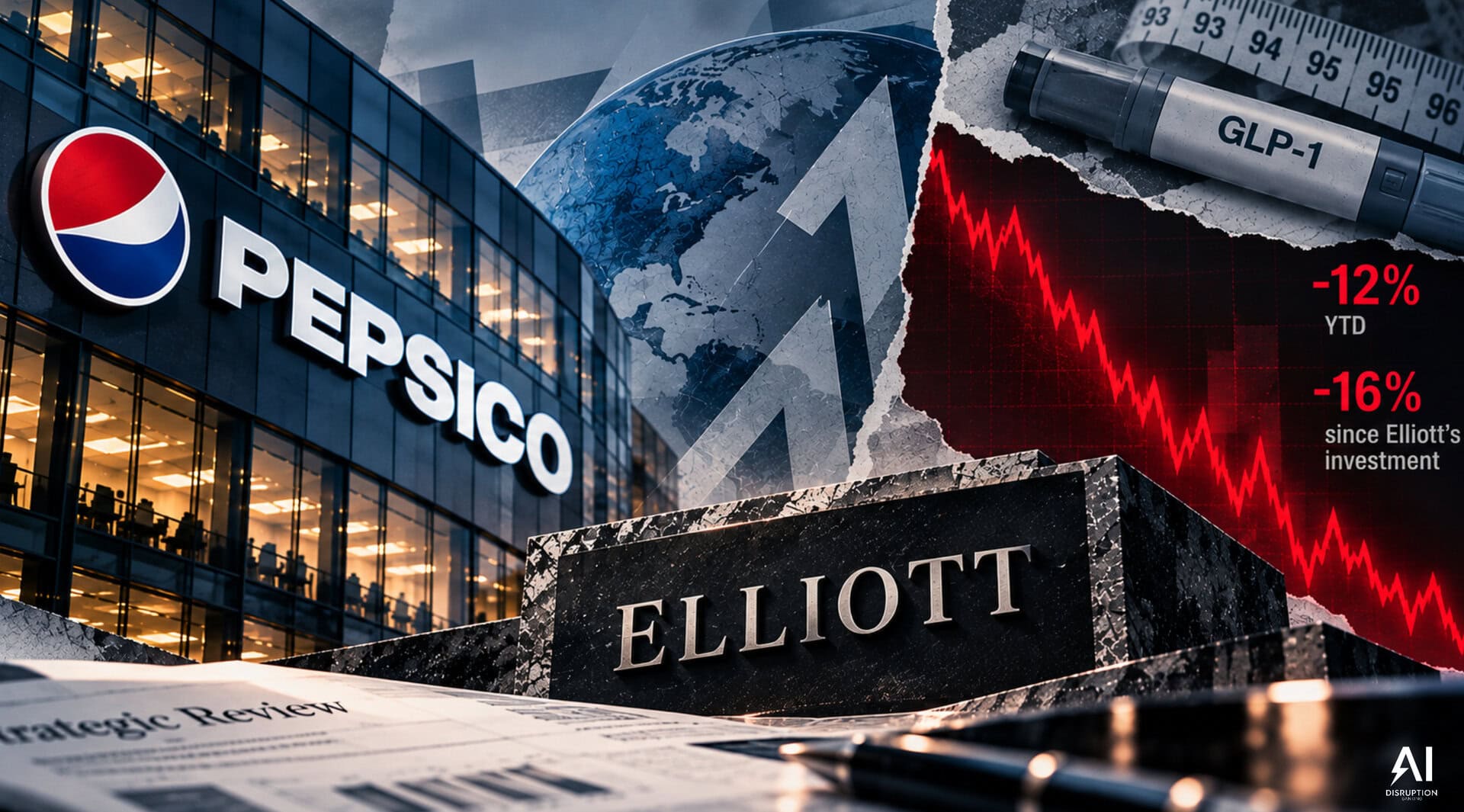
The shares are down almost 12 percent this year and about 16 percent since Elliott’s investment. PepsiCo’s enterprise value has fallen to 10 times EBITDA from 18 times in mid-2022, while Coca-Cola has pulled ahead.
JPMorgan and Deutsche Bank both downgraded the stock in late September, citing a stalled North American recovery.
The Elliott plan, one year on
After talks with Elliott, PepsiCo announced price cuts of up to 15 percent on products including Lay’s and Doritos in February, alongside record productivity savings. Pre-earnings coverage also cited three Frito-Lay plant closures and a 20 percent cut to the US product range.
PepsiCo cut prices on some products to try to recover volume after several years of increases. And volumes did improve. However, margins did not. The company has since moved to raise some US chip prices in line with inflation, a partial reversal of the February cuts. Laguarta said additional structural cost reduction actions are being identified and will be implemented in the coming months to fund investment in North America.
Elliott is the activist behind the Honeywell break-up that Disruption Banking covered earlier this year. At Honeywell the remedy was structural: separate the businesses so each could be valued on its own terms. At PepsiCo the remedy has so far been operational: cut price, cut cost, simplify the range, and wait for volume to follow.
The first year shows how much harder that is to deliver when the category itself is under pressure. While the three-year margin target still has two years to run, being behind after year one is not the same as missing the target, and the new cost programme is aimed squarely at the gap. The quarter itself was not a miss. Revenue and earnings beat, organic volume grew across global beverages and convenient foods, and the shares rose on the day.
The GLP-1 problem is structural
Weight-loss drugs have forced food producers from Kraft Heinz to Conagra Brands to reformulate, and PepsiCo has followed with launches including Doritos Protein and SunChips Fiber.
The threat is still visible in narrowing valuations across the sector. GLP-1 adoption lowers long-run volume expectations for exactly the categories PepsiCo depends on in North America: salty snacks and sugary drinks. A pricing-and-cost turnaround is fighting a shrinking pool of demand rather than a cyclical dip.
Stephanie Link, chief investment strategist at PepsiCo investor Hightower Advisors, said the company was simply too late, and now it has the threat of GLP-1s. Laguarta said on the quarter that the business in North America performed below expectations and represents a meaningful opportunity for improvement. Chief financial officer Steve Schmitt noted that last year the business saw low single-digit negative volume growth; this year it is low single-digit positive.
There are still two questions to consider. Whether the new cost cuts can restore margin without undoing the volume gains the February price cuts bought. And whether Elliott, a year in and with the shares below its entry, stays patient or escalates. The operational path has produced a volume recovery that is still too small and a margin that is still moving the wrong way. The structural path, the one Elliott chose at Honeywell, is still something to be considered.
Author: Tejas Bansal