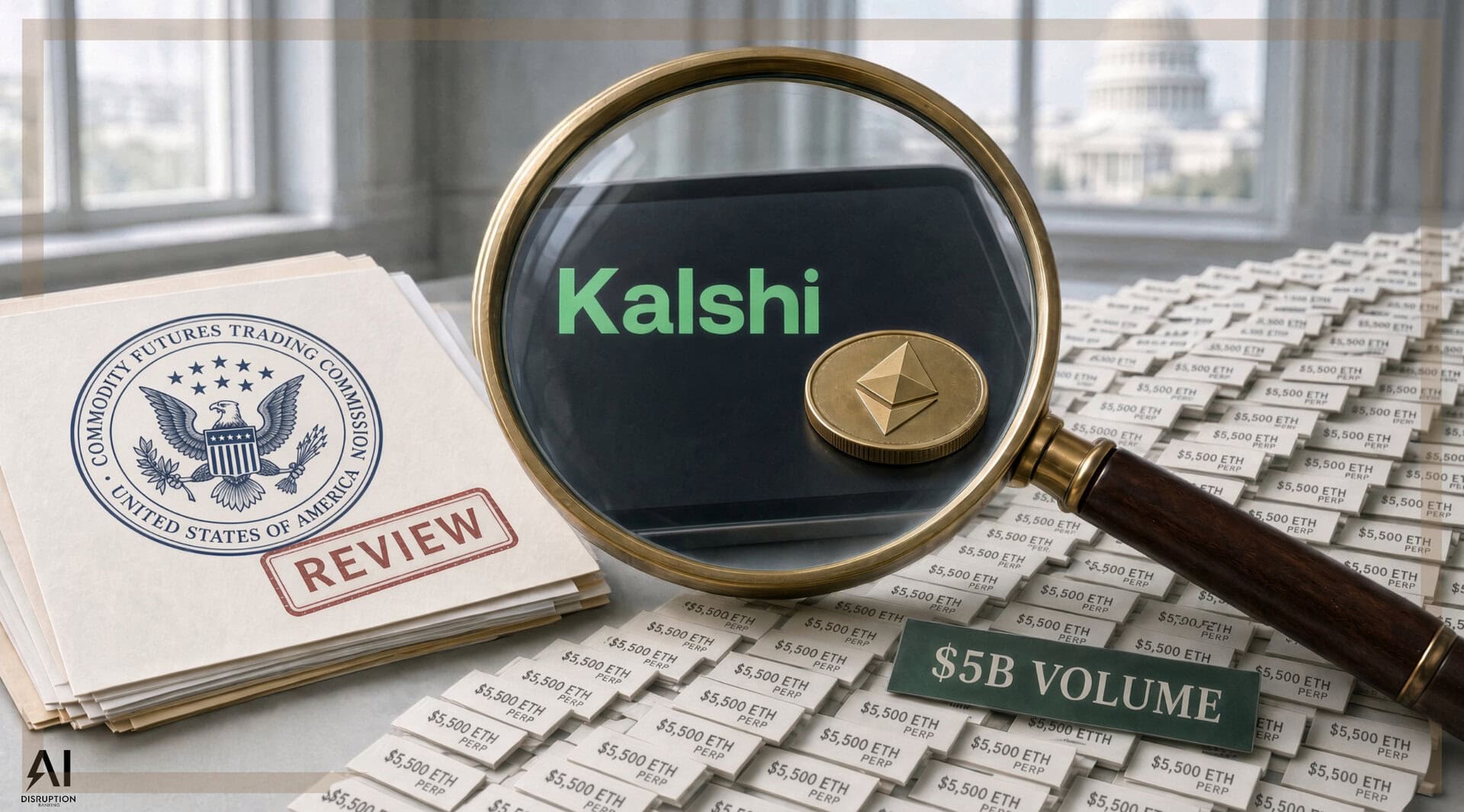
The Commodity Futures Trading Commission is reviewing trading activity in Kalshi’s ether perpetual futures market after nearly 1 million trades of almost identical size have gone through a single contract since August. No formal investigation has been opened. A person familiar with the matter told The Wall Street Journal that regulators are examining the data before deciding whether to open one.
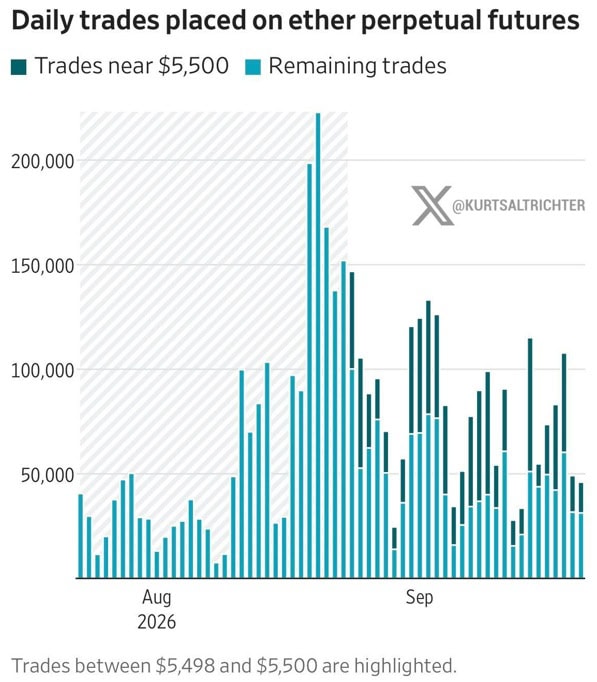
The Journal’s analysis of public trade data found that more than a third of recent trades clustered around $5,500. That pattern accounted for more than $5 billion in ether perp volume over the past month. The paper named Jump Trading and Wintermute among the firms involved. Jump said it trades for profit, uses self-match prevention tools, and does not coordinate with other traders.
Kalshi denies that any wash trading took place. The CFTC declined to comment on whether an investigation is underway.
$539 Million in Daily Volume Against $3.1 Million in Open Interest
The allegations started on X before the Journal’s story. Beni, a former quant trader and co-founder of research firm Stealth Neolab, pulled records from Kalshi’s public data feed. He counted roughly $539 million in 24-hour ether perp volume against about $3.1 million in open interest. That is turnover of roughly 174 times the value of open positions. He said the $5,500 trade size made up 48% to 58% of all ETH perp volume on four separate days.
High turnover on its own does not establish wash trading. Kalshi’s public data does not show who sits on either side of a trade, so outside analysts cannot tell whether a single entity controls both sides.
The product is new. Kalshi announced perpetual futures on May 29, billing them as the first in US history, and began listing crypto contracts in June.
Nearly 1 Million Trades at One Size: Kalshi’s Explanation
In a September 22 blog post, Kalshi said two things about how its exchange handles wash trading:
- Self-trading is mechanically blocked.
- Pre-arranged trading with a partner is banned and monitored.
Kalshi attributed the repeated sizes to its liquidity-provider incentives. These pay market makers a flat monthly fee to keep bid and ask orders of a minimum size on the book, within a set spread, for most of each hour. The company said the programs reward resting liquidity rather than volume.
Under that setup, a market maker required to keep quoting a fixed size gets repeatedly hit by faster firms whenever prices move on other venues, producing the same trade size over and over. Kalshi said the takers were hundreds of distinct traders who consistently profited against the maker. It argued that the result doesn’t fit wash trading, where neither side would be expected to make or lose money.
A Rebate That Matches Fees Paid, Dollar for Dollar
Critics also targeted Kalshi’s fees. Two programs are in the public filings. They are not the same.
Since July, Kalshi has run a temporary program that pays self-clearing members a month-end rebate equal to the fees they paid on perpetual futures trades. Kalshi says the CFTC filing blocks net-negative fees on a per-trade basis, so firms cannot be paid to trade more. While that program runs, self-clearing members pay no net fees on perps. Kalshi says any firm that meets CFTC requirements can self-clear.
A September 2 update to the same rebate filing is the document critics circulated. It would rebate crypto-perp taker fees to 0.3 basis points and leave makers a net 0.3-basis-point credit. That schedule takes effect only upon exchange notice, and not before 17:00 ET on September 16. Kalshi said in its September 22 post that the 0.3-basis-point program is not live.
The updated filing excludes rebates on trades that result from, or are under inquiry or investigation for, wash trading, self-matching, or pre-arranged trading. That removes the most direct rebate-farming incentive. It does not prove the activity did not occur.
The CFTC’s August Incentive-Program Advisory
The review comes soon after new regulatory guidance. On August 12, the CFTC’s Division of Market Oversight issued an advisory reminding designated contract markets of their obligations when self-certifying market-maker and incentive programs. It cited a rise in deficient filings tied to event contracts. The staff letter says exchanges must assess whether their programs could encourage manipulation or abusive trading.
Separately, on August 11 the CFTC invoked emergency authority after Kalshi notified it of a market emergency arising from New York’s lawsuit seeking to halt the firm’s event contracts.
Kalshi says it now has more than 350,000 lifetime perpetual traders and that open interest has doubled over the past 30 days. Those figures come from the company and have not been independently verified.
Author: Ayanfe Fakunle
The editorial team at #DisruptionBanking has taken all precautions to ensure that no persons or organizations have been adversely affected or offered any sort of financial advice in this article. This article is most definitely not financial advice.