
Wang Yuan thought he had cracked it. The 38-year-old software engineer in Shanghai invested one million yuan, about $148,000 today, in a quant fund run by Shanghai Wenbo Investment Management last October. Some managers had delivered returns above 50% in 2025. Then the floor gave way.
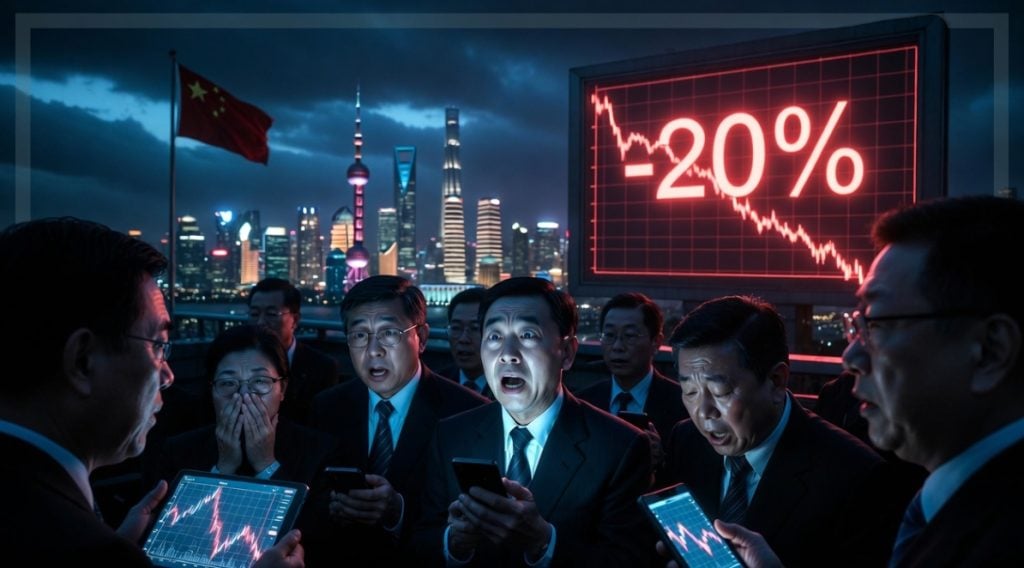
Within two weeks, net asset values at some funds fell more than 20%, wiping out months of gains. “It felt like a free fall,” Wang told Bloomberg. “One moment I was flying high and the next I was back down.”
China’s wealthy had flooded into quantitative funds because almost nothing else was working. Property remained depressed. Broad equities had disappointed for years. Market-neutral and index-enhanced strategies looked like a savvy option. Quant assets under management more than doubled in less than a year to over 2.6 trillion yuan, or roughly $384 billion. According to Citic Securities Co., long-only stock quants gained 44.7% in 2025, beating rival discretionary managers by 20.3 percentage points.
73 CSI 1000 Quant Products Lost 14% in One Week
The machines delivered until the factors flipped. A global chip selloff and renewed fears of an AI bubble pushed investors out of small- and micro-cap stocks and into larger benchmark names. Models positioned for the previous market regime adjusted too slowly. Crowded holdings became a stampede. Selling triggered more selling, while falling margin-financing balances and forced deleveraging amplified the move.
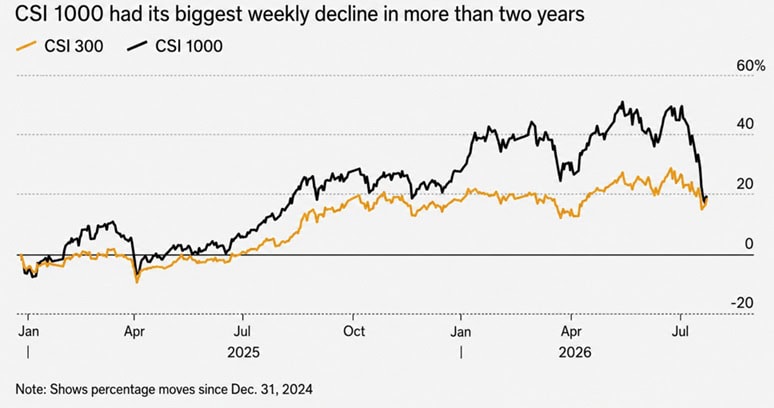
The damage was quick. Seventy-three products designed to beat the CSI 1000 Index lost an average 14% during the week ended July 17 and trailed the benchmark by 1.9 percentage points, Bloomberg reported. The index itself fell more than 12%, its worst week since the February 2024 “quant quake”. PaiPaiWang data reported by Caixin found that 95% of quant stock-selection products fell; every CSI 1000 index enhancer lost money, while 99% of CSI 300 and CSI 500 enhancers declined.
The 14% loss needs context. An index-enhancement product normally carries much of its benchmark’s market exposure. It is not market-neutral. Most of the 14% decline was beta. The more damaging result for managers was the negative alpha: their algorithms underperformed an index that was already falling sharply.
High-Flyer and BlackWing Expose China’s Crowded Quant Trade
A CSI 1000-enhancement fund at Zhejiang High-Flyer Asset Management, founded by DeepSeek’s Liang Wenfeng, fell 15.7% in seven days. High-Flyer oversees more than 70 billion yuan, or over $10.3 billion. BlackWing Asset Management’s stock strategy lost 19.39%, its largest weekly decline since inception.
According to Bloomberg, Joe Zhou, a whale investor, watched his 20-million-yuan ($3 million) investment fall nearly 30% over several weeks. A 32-year-old resident of Shanghai, Min Chen, invested one million yuan into a Ningbo Alpha2Fund product in early July after being told it could deliver stable returns regardless of market direction. It dropped nearly 19% in two weeks. She is redeeming.
These were not naïve retail buyers. They were wealthy engineers, manufacturers and professionals who treated last year’s winners as something close to risk-free. But when too much money chases the same momentum and beta factors, models stop finding independent edge and start reinforcing the crowd. Different algorithms can still produce similar portfolios. When the dominant factor reverses, their risk controls generate correlated selling. This was what happened here, or at least in part.
Beijing Can Stabilise the Market, Not Restore Quant Alpha
Managers are offering familiar explanations. BlackWing blamed external risks rather than model decay and expects a recovery. Shanghai Wenbo is standing by its principles. Alpha2Fund is buying its own products. State buying can arrest panic. It cannot restore lost alpha or make overlapping models different. The CSI 1000 has rebounded from its 12% weekly fall.
The China Securities Regulatory Commission (CSRC) met eight investor representatives on July 20 and heard proposals to regulate quant trading and AI applications. Two state-backed investors, China Reform Holdings Corp (CRHC) and China Chengtong Holdings Group, pledged to deploy about 60 billion yuan ($8.9 billion) to support equities.
China’s quant industry will survive. The belief that automated investing means protected investing should not. Stable returns in every market are sales language, not physics. The easy phase of China’s quant boom is finished. For investors in market-neutral funds and index enhancement, now you know that “AI-powered” describes a method, not protection. If the explanation begins and ends with an external shock, do not add money.
Author: Richardson Chinonyerem
The editorial team at #DisruptionBanking has taken all precautions to ensure that no persons or organisations have been adversely affected or offered any sort of financial advice in this article. This article is most definitely not financial advice.
See Also:
Could Short-Selling Restrictions Stunt The Growth Of China’s Quant Market? | Disruption Banking
How Much Potential Does Shanghai’s Quant Market Have? | Disruption Banking

Richardson Chinonyerem
Contributing author at Disruption Banking, covering capital markets.