- While strong fundamentals, such as low public debt, will continue to cushion the economy against shocks, economic growth has been tepid and uneven with a softening labor market, amid a worsening fiscal balance, rising inflationary pressures, and heightened uncertainty from the war in the Middle East.
- The fiscal deficit is expected to widen further under current policies amid structural increases in spending and a softening revenue growth. A moderate fiscal adjustment focusing on containing current expenditure is needed to preserve buffers, stabilize public debt and create room for growth-enhancing investment over the medium term.
- The financial system has continued to demonstrate resilience to elevated market stress episodes. Rising uncertainty and geopolitical risk require continued close monitoring of liquidity, leverage and funding in the multifaceted financial system.
Washington, DC – June 30, 2026: The Executive Board of the International Monetary Fund (IMF) completed the Article IV Consultation for Luxembourg.[1] The authorities have consented to the publication of the Staff Report prepared for this consultation.
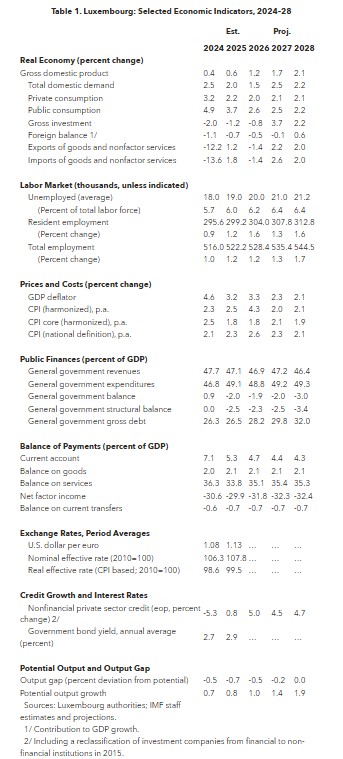
Luxembourg’s economy has yet to regain its past dynamism with growth lagging peers and the public sector playing a dominant role. Growth edged up to 0.6 percent in 2025, supported by expansionary fiscal policy and real income gains, while weak external demand continued to be a drag. The labor market has softened, with unemployment rising above 6 percent. Headline inflation rose above 2.5 percent in early 2026 due to higher energy prices, despite new electricity subsidies. The fiscal balance deteriorated sharply in 2025 as spending significantly outpaced revenue. The financial system has remained resilient, and banks and non-banks maintain high capital and liquidity buffers. Asset quality in the corporate sector is gradually improving, with remaining pockets of vulnerability from the real estate sector.
Growth is projected to remain moderate amid uncertainty from the war in the Middle East and domestic constraints. The growth momentum would be dampened by the expected slowdown in European trading partners, headwinds from weaker confidence and higher inflation, while strong public spending and solid private consumption would provide support. Against this backdrop, GDP growth is projected at 1.2 percent in 2026 and to pick up to 1.7 percent in 2027 as the impact of the conflict wanes. Growth is expected to gradually converge toward potential (around 2 percent) over the medium term as external demand recovers and private investment strengthens. Inflation is forecast to rise to 2.6 percent in 2026, driven by higher energy prices, automatic wage indexation, and second-round effects, before easing toward 2 percent in the medium-term. The outlook faces significant downside risks, including from a prolonged conflict, persistently high energy prices, weaker EU growth, financial market stress, and domestic challenges in the construction sector and the labor market. On the upside, faster progress on EU single market reform could strengthen growth prospects.
Executive Board Assessment[2]
Executive Directors noted that strong fundamentals, including low public debt and a resilient financial sector, provide buffers against downside risks, including from heightened global uncertainty. At the same time, they emphasized the need for careful policy recalibration to unlock private-sector led growth and help Luxembourg’s economy regain its past dynamism.
Directors considered the broadly neutral fiscal stance in 2026 appropriate but emphasized that the composition of spending should become more growth-friendly and the energy support measures more targeted to vulnerable groups. They generally stressed that the projected medium-term weakening in fiscal balances amid rising spending pressures calls for a moderate fiscal adjustment to preserve buffers, stabilize public debt, and create room for priority investment.
Directors highlighted the need to contain current expenditure, improve spending efficiency, and broaden the tax base. They welcomed the recent pension reform and noted that the planned income tax reform could support labor supply, while underscoring the importance of offsetting measures to contain its fiscal cost. Directors also encouraged strengthening the fiscal framework, including through an enhanced national fiscal rule and stronger fiscal risk analysis.
Directors agreed that Luxembourg’s financial system has remained resilient and commended the authorities for close oversight and strong fundamentals in the bank and non-bank sectors. At the same time, pockets of vulnerability remain, and elevated uncertainty, including due to geopolitical risks, require continued vigilance given Luxembourg’s large, outward-oriented, and highly interconnected financial sector. Directors called for continued close monitoring and proactive management of liquidity, leverage, funding, and concentration risks across banks, investment funds, and insurers, and welcomed good progress in implementing the 2024 FSAP recommendations. As the financial cycle enters an early expansion phase, Directors supported further recalibration of the macroprudential framework.
Directors underscored that structural reforms are critical to revive productivity and competitiveness, and rebalance growth toward the private sector. They encouraged the authorities to accelerate digital and AI adoption, strengthen support for innovation, and address skill mismatches through education, reskilling, and upskilling policies. Directors also stressed the importance of increasing labor market flexibility, easing housing pressures through supply-side reforms and land mobilization, and reducing administrative and regulatory burden on firms. They noted that energy diversification and deeper EU single market integration, including progress on the Savings and Investment Union, would further strengthen Luxembourg’s medium-term growth prospects.
[1] Under Article IV of the IMF’s Articles of Agreement, the IMF holds bilateral discussions with members, usually every year. A staff team visits the country, collects economic and financial information, and discusses with officials the country’s economic developments and policies. On return to headquarters, the staff prepares a report, which forms the basis for discussion by the Executive Board.
[2] At the conclusion of the discussion, the Managing Director, as Chair of the Board, summarizes the views of Executive Directors, and this summary is transmitted to the country’s authorities. An explanation of any qualifiers used in summings up can be found here: http://www.IMF.org/external/np/sec/misc/qualifiers.htm.
See also:
IMF Executive Board Concludes 2026 Article IV Consultation with Ireland | Disruption Banking
IMF Executive Board Concludes 2026 Article IV Consultation with Portugal | Disruption Banking