


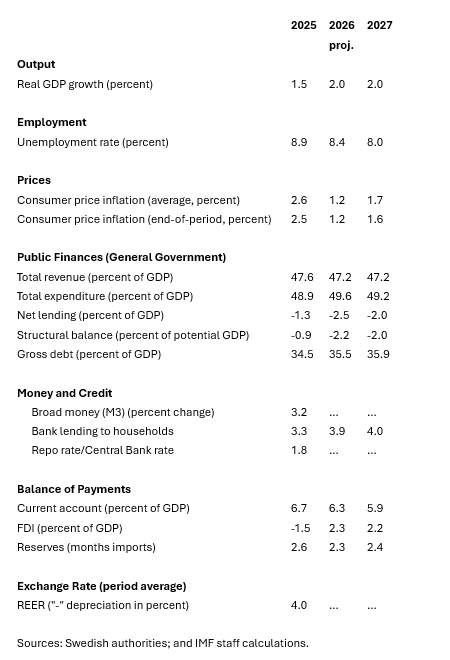
- A cyclical recovery is underway, with real GDP projected at 2 percent in 2026 and 2027. Inflation is expected to remain low in the near term. Uncertainty—about the duration of the energy supply disruptions and the transmission of high energy prices to inflation and activity—remains high, with downside risks to growth and upside risks to inflation. The financial system is sound, but structural vulnerabilities remain.
- Sweden enters this period from a position of strength. Credible policy frameworks, ample buffers, strong institutions, and a solid track record of policy implementation built over decades provide a firm foundation. Priorities center on navigating global headwinds, enhancing resilience, and fostering medium-term growth.
Washington, DC – July 21, 2026: The Executive Board of the International Monetary Fund (IMF) concluded the Article IV consultation[1] with Sweden and endorsed the staff appraisal without a meeting on a lapse-of-time basis. The authorities have consented to the publication of the Staff Report prepared for this consultation.[2]
A cyclical economic recovery is ongoing on the back of policy support and a rebound in real incomes. CPIF inflation has declined since August 2025, reflecting the appreciation of the krona last year and various temporary measures such as the reduced VAT rate on food, among others, this year. The confluence of multiple one-off factors and uncertainty about the persistence of the underlying shocks render more difficult the measurement of core inflation. Nonetheless, indicators of trend inflation, excluding the impact of one-off effects and energy prices, point to subdued inflationary pressures. In turn, medium-term inflation expectations are well anchored. The financial system remains sound, underpinned by strong capital and liquidity buffers. However, vulnerabilities associated with high household indebtedness, sizable exposures to the real estate sector, and banks’ reliance on market-based funding persist.
GDP growth is projected at 2 percent in 2026 and 2027, exceeding its potential rate in both years and contributing to closing the negative output gap. The war in the Middle East is estimated to have reduced cumulative real GDP growth by about 0.3 to 0.4 percentage points over this period.
Headline inflation is projected to remain slightly below target, at 1.6 percent in 2026 and 1.7 percent in 2027, as the temporary VAT reduction largely offsets higher global energy prices. Trend inflation is expected to rise gradually to around target by 2027, as spare capacity is absorbed and higher energy prices pass through to core inflation. Uncertainty—about the duration of the energy supply disruptions and the transmission of high energy prices to inflation and activity—remains high, with downside risks to growth and upside risks to inflation.
Executive Board Assessment[3]
In concluding the 2026 Article IV Consultation with Sweden, Executive Directors endorsed staff’s appraisal, as follows:
Growth is projected above potential in the baseline, but uncertainty is elevated, with downside risks to growth and upward risks to inflation. GDP growth projected at 2 percent in 2026 and 2027 while inflation is expected to remain temporarily below target before converging to around target in 2027. Uncertainty—about the duration of the energy supply disruptions and the transmission of high energy prices to inflation and activity—remains high, with downside risks to growth and upside risks to inflation, entailing difficult policy trade-offs. Sweden enters this period from a position of strength, with credible policy frameworks, ample macroeconomic buffers, a sound financial system, and a long-standing record of effective policy implementation.
Elevated uncertainty calls for vigilance and policy agility. The authorities should be prepared to respond to a range of possible outcomes. Policy priorities include:
(i) navigating the current shock, (ii) enhancing resilience in a world of frequent shocks through policies that preserve buffers and reduce vulnerabilities, and (iii) raising productivity.
Monetary policy can be on hold for now, but interest rates will need to go up as inflation rises and the economy strengthens, or if upside risks to inflation materialize. Low inflation provides a favorable starting point. Under the baseline, underlying inflation is expected to converge towards the target in 2027. Moreover, the temporary VAT cut on food is set to add to inflation in 2028. Against this backdrop, the Riksbank should continue to monitor inflation and inflation expectations closely and stand ready to adjust its stance based on data and developments, including indirect and second-round effects of ongoing shocks and the implications on the inflation outlook from changes in monetary policy stances abroad. As underlying inflation increases and negative output gap closes, some policy rate hikes would be needed, as indicated by the Riksbank’s published policy rate path. If upside risks to inflation materialize, the policy rate would need to be raised further. Forward-looking communication, including scenario analysis, will remain important in a more uncertain environment to keep inflation expectations anchored.
Ongoing refinements to the operational framework would support monetary transmission in a lower-liquidity environment. The Riksbank’s recent adjustments to its supplementary liquidity facility and collateral requirements are welcome. Further steps to strengthen incentives for interbank activity, reduce stigma around standing facilities, and review regulatory features that may constrain market functioning would help deepen interbank activity and support transmission.
The monetary policy framework is strong, and the 2026 external review provides a solid basis for targeted improvements. Priorities include refining the framework for unconventional instruments, deepening analysis of monetary-fiscal interactions, advancing forecasting and modeling capacity, strengthening mechanisms for macroprudential coordination. Implementing these recommendations would further enhance policy effectiveness.
Systemic financial risks have moderated somewhat but remain elevated. Large and interconnected real estate exposures, high household indebtedness, and sizable reliance on foreign-currency market funding continue to pose risks. A downside scenario could reverse recent cyclical improvements. Macroprudential settings, including the CCyB, should therefore remain unchanged. If downside risks materialize and credit supply constraints emerge, the CCyB should be released. The extension of risk-weight floors for mortgages and commercial real estate is welcome, and risk-weight densities should continue to be monitored to ensure IRB models adequately reflect credit risk.
The easing of BBMs warrants active monitoring and should be complemented by an income-based limit. While the relaxation is expected to have moderate effects, it could add to household vulnerabilities over time; its impact on household balance sheets and housing market dynamics should therefore be closely monitored. Over time, the authorities should introduce a consolidated credit registry and preemptively adopt IBMs to safeguard household debt sustainability by protecting borrowers against income and interest-rate shocks, particularly given the large share of variable-rate loans. The division of macroprudential and crisis-management responsibilities across several agencies underscores the need for strong coordination and cooperation mechanisms to mitigate inaction bias and ensure holistic and timely responses to financial stability risks. Closing key data gaps is a priority, notably by improving collection of and access to granular household balance sheet data to strengthen monitoring of household vulnerabilities and the analytical basis for macroprudential policy. Continued progress in addressing the 2023 FSAP recommendations is welcome.
The expansionary fiscal stance will support economic activity, and no further support is needed under the baseline, but discretionary measures should be better targeted. Pre-war measures, together with the temporary measures introduced in response to the war’s impact on energy prices, imply a sizable fiscal impulse in 2026, helping cushion the war’s impact on the economy. However, some measures are poorly targeted (such as tax cuts on food and fuel) and distort price signals, discouraging energy conservation at a time of constrained global supply. In a more shock-prone global environment, the authorities should develop systems to provide targeted, timely and effective support to vulnerable households. Under the baseline, no additional fiscal support is warranted. If downside risks materialize, automatic stabilizers should operate, and any discretionary support should be temporary, well targeted, and preserve price signals.
Given the challenges posed by a higher frequency of macroeconomic shocks, the authorities are encouraged to bring new permanent spending needs within the fiscal framework and clarify adjustment plans toward fiscal targets at an early stage. The fiscal framework is central to managing risks and preserving sustainability and macroeconomic resilience. In addition, close monitoring of large spending items, such as investments in nuclear power, and continued efforts to improve spending efficiency would help preserve buffers and mitigate risks.
Raising productivity remains a key medium-term priority. The Productivity Commission’s reform agenda provides a strong basis for action, including reducing housing and rental market distortions, strengthening public administration, and closing infrastructure gaps. Progress will require strong coordination and oversight. Policies that support AI diffusion, address skill mismatches, and facilitate labor market transitions will be critical to realizing and broadly sharing productivity gains. Supporting measures to deepen the EU Single Market, including in energy, would reinforce domestic reforms and enhance resilience. Additional measures are needed to meet the 2030 interim climate targets.
The external position in 2025 was stronger than implied by fundamentals and desirable policy settings. This assessment is in line with the findings of the 2026 External Sector Report and reflects the data available as of May 18, 2026.
[1] Under Article IV of the IMF’s Articles of Agreement, the IMF holds bilateral discussions with members, usually every year. A staff team visits the country, collects economic and financial information, and discusses with officials the country’s economic developments and policies. On return to headquarters, the staff prepares a report, which forms the basis for discussion by the Executive Board.
[2] Under the IMF’s Articles of Agreement, publication of documents that pertain to member countries is voluntary and requires the member consent. The staff report will be shortly published on the www.imf.org/[country] page.
[3] The Executive Board takes decisions under its lapse-of-time procedure when the Board agrees that a proposal can be considered without convening formal discussions.
See also:
IMF Executive Board Concludes 2026 Article IV Consultation with Austria | Disruption Banking
IMF Executive Board Concludes 2026 Article IV Consultation with United Kingdom | Disruption Banking
IMF Executive Board Concludes 2026 Consultation with Euro Area | Disruption Banking