

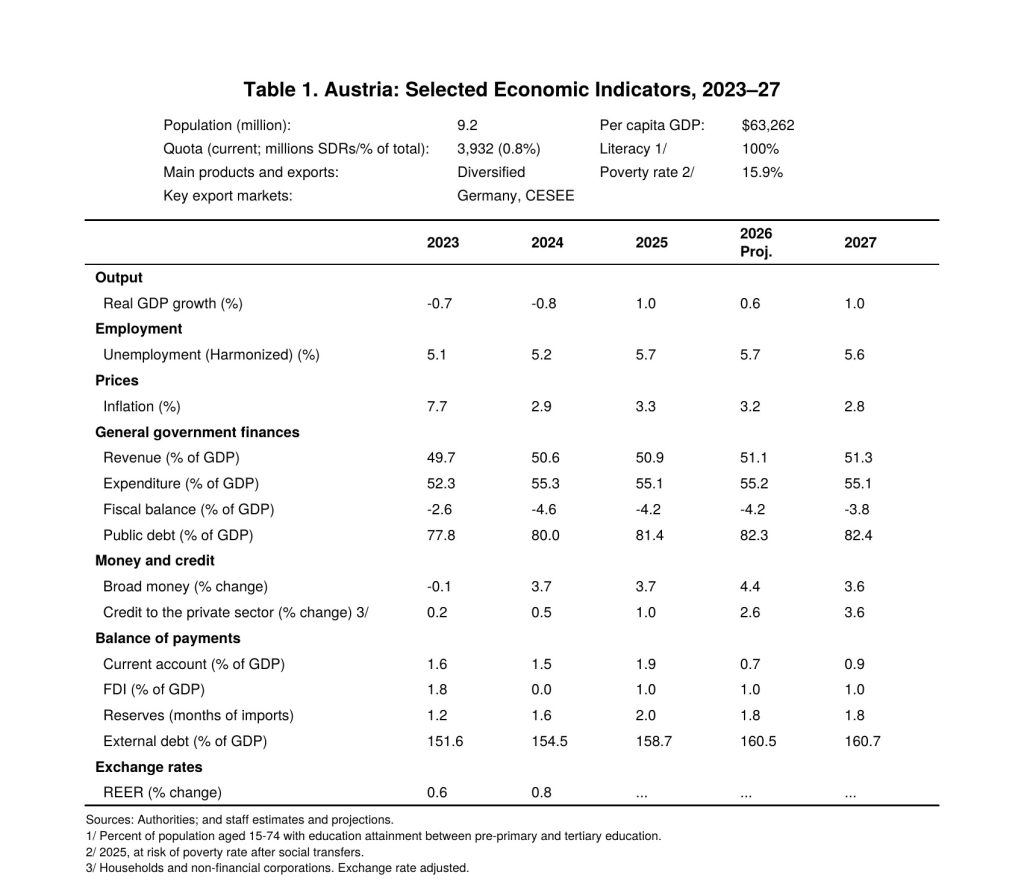
- Economic growth will remain positive in 2026, but slow to 0.6 percent as higher energy prices weigh on consumption. Growth is expected to recover gradually thereafter, with a stronger rebound expected in 2028–2029.
- The authorities’ 2028 fiscal target of 3 percent is appropriately ambitious, but further consolidation beyond what has been announced so far will likely be needed to achieve it.
- Beyond fiscal adjustment, the key priority is to revive productivity growth through domestic and European-level reforms.
Washington, DC – July 20, 2026: The Executive Board of the International Monetary Fund (IMF) completed the Article IV Consultation for Austria on July 8, 2026[1]. This also included a discussion of the findings of the Financial Sector Assessment Program (FSAP) exercise for Austria.[2] The authorities have consented to the publication of the Staff Report prepared for this.[3]
Though a modest economic recovery is underway, new challenges have emerged. The economy emerged from a two-year recession in 2025, with growth reaching 1.0 percent, supported by higher government spending, a recovery in external demand, and a rebound in fixed investment. After the deficit reached 4.6 percent of GDP in 2024, triggering the Excessive Deficit Procedure, the authorities announced a substantial multi-year consolidation with the plan to reach a 3 percent of GDP deficit target in 2028. Thus far, the fiscal adjustment has been somewhat modest, weighed down in part by the backward inflation indexation of wages and social benefits. Meanwhile, after inflation fell substantially in 2025, developments in the Middle East caused pump prices for gasoline to jump roughly 20 percent year-on-year, pushing headline inflation to 3.8 percent in May. Core inflation also rose, reaching 3.3 percent and suggesting some broadening of price pressures.
The war in the Middle East is expected to slow, but not derail, the near-term recovery. Economic growth will remain positive in 2026 but slow to 0.6 percent, as higher energy prices weigh on consumption. A stronger rebound is projected for 2028–2029 as inflation moderates and household savings rates normalize. The economy is then projected to slow again to potential growth of around 0.8 percent by 2031—below the 1.2 percent average of the past decade—reflecting persistently weak labor productivity growth and a shrinking workforce. Meanwhile, CPI inflation is projected to rise to 3.2 percent in 2026, about 1.4 percentage points above the prewar forecast due primarily to the impact of higher energy prices. Inflation is expected to then gradually fall toward the Euro area average as the energy shock dissipates and the impact of wage restraint takes hold. Key downside risks include a more severe energy shock and growing external competition in Austria’s key export industries.
The FSAP finds that short-term risks to the Austrian financial sector were low prior to the war in the Middle East and remain contained, with banks demonstrating resilience under severe adverse stress tests. Key risks to the financial sector at the current juncture arise from subdued economic activity, exposure to commercial real estate lending, and potential shocks in the Central Europe and Southeastern Europe region. Financial sector oversight is strong and has been further enhanced in recent years, but additional strengthening is needed, particularly in the macroprudential framework and aspects of institutional governance. The financial safety net would benefit from stronger coordination during normal times and clearer operational arrangements.
Executive Board Assessment[4]
The directors welcomed Austria’s recent economic recovery, supported by strong institutions and credible policies, despite repeated external shocks. Noting the rising debt and subdued medium term growth outlook, in the context of demographic headwinds and weak productivity growth, Directors underscored the importance of growth-friendly fiscal consolidation and durable supply-side structural reforms to strengthen resilience and enhance potential growth.
Directors welcomed the authorities’ progress on fiscal consolidation and their commitment to achieving a fiscal deficit of 3 percent of GDP by 2028. They generally emphasized that additional measures beyond what has been announced thus far may be needed to achieve this target and put debt firmly on a downward path. Noting Austria’s already high revenue ratio, they broadly encouraged greater reliance on durable expenditure reforms, particularly in pensions, healthcare, and subsidies. Directors stressed that support in response to higher energy prices should be targeted and temporary. Ongoing reforms to fiscal federalism should aim to improve transparency, ensure rules-based transfers, strengthen accountability, and advance digitalization.
Directors welcomed the resilience of the financial system and the finding of the 2026 FSAP that short-term financial stability risks are contained. While noting that banks remain profitable, liquid, and well capitalized, they urged continued vigilance on commercial real estate exposures, spillovers from Central, Eastern, and Southeastern Europe, and residential mortgage lending standards. Directors welcomed recent enhancements in financial sector oversight and encouraged implementation of key FSAP recommendations to strengthen the macroprudential and crisis management frameworks, enhance institutional governance and supervisory resources, and improve financial safety net operational arrangements.
Directors underscored that structural reforms are essential to boost productivity and enhance potential growth. They urged further efforts to boost labor supply, improve R&D efficiency, and reduce restrictive domestic regulations. Directors emphasized the need to complete pending energy reforms by accelerating renewable deployment and strengthening energy infrastructure to enhance resilience and competitiveness. Measures to deepen European capital markets are also important.
[1] Under Article IV of the IMF’s Articles of Agreement, the IMF holds bilateral discussions with members, usually every year. A staff team visits the country, collects economic and financial information, and discusses with officials the country’s economic developments and policies. On return to headquarters, the staff prepares a report, which forms the basis for discussion by the Executive Board
[2] Under the FSAP, the IMF assesses the stability of the financial system, and not that of individual institutions. The FSAP assists in identifying key sources of systemic risk and suggests policies to help enhance resilience to shocks and contagion. In member countries with financial sectors deemed by the IMF to be systemically important, it is a mandatory part of Article IV surveillance. The last FSAP exercise took place in 2020.
[3] Under the IMF’s Articles of Agreement, publication of documents that pertain to member countries is voluntary and requires the member consent. The staff report will be shortly published on the https://www.imf.org/en/countries/aut page.
[4] At the conclusion of the discussion, the Managing Director, as Chairman of the Board, summarizes the views of Executive Directors, and this summary is transmitted to the country’s authorities. An explanation of any qualifiers used in summings up can be found here: http://www.IMF.org/external/np/sec/misc/qualifiers.htm.
See also:
IMF Executive Board Concludes 2026 Article IV Consultation with United Kingdom | Disruption Banking
IMF Executive Board Concludes 2026 Consultation with Euro Area | Disruption Banking
IMF Executive Board Concludes 2026 Article IV Consultation with Israel | Disruption Banking