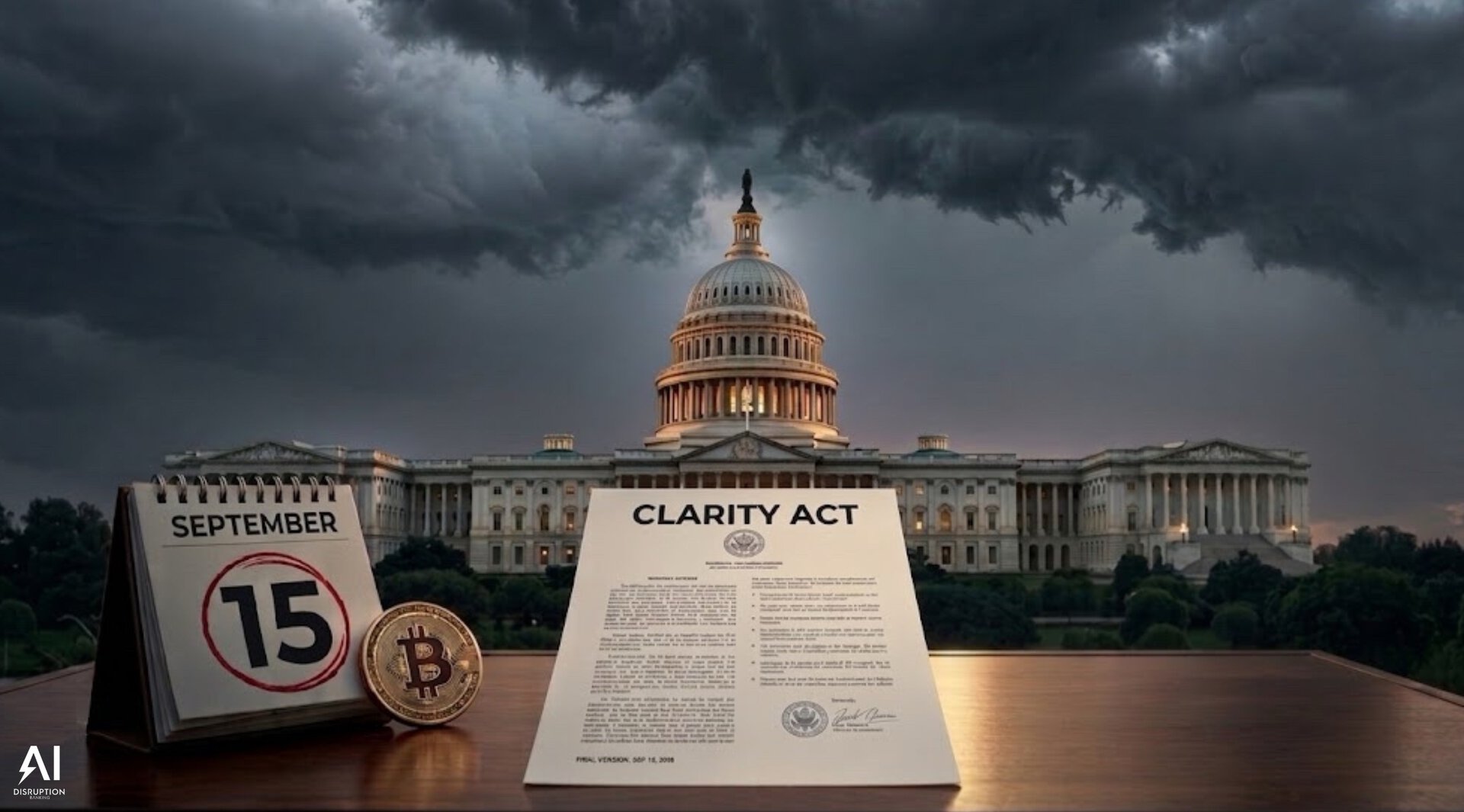
There are usually announcements at big international events like the Point Zero Forum. However, this morning there was an addition to the agenda that was a little unusual.
Titled “Clarity on CLARITY and a brief update on GENIUS” the extra keynote was made by Dante Disparte, Chief Strategy Officer and Head of Global Policy and Operations, Circle, who had already been on the main stage yesterday talking about Europe’s Currency at a Crossroads.
Today he was back on the main stage explaining to delegates how it was important to address policy changes in the U.S. Especially when the audience was as prestigious as the one in Zurich for one of Europe’s most significant banking, policy and technology events.
Dante Disparte on the CLARITY Act and GENIUS Act at Point Zero Forum 2026
“Our country is unique in that we regulate payments and banking at the state level,” Disparte shared. “That means every single state in America has an opinion, they have a banking supervisor, they regulate companies like PayPal, Apple Pay, Stripe, Circle.”
Disparte felt that it was important to highlight this unique landscape in the U.S. He highlighted how there has historically been regulation at state level, but that what was changing now was that there would also be regulation on the federal level.
“The other thing that is unique about the United States up until the GENIUS Act is that we were the only advanced economy that did not have a whole economy licensing framework for non-bank payment systems activities,” he added.
Disparte pointed to the Libra project from seven years ago (Facebook’s project at the time), which had been set up in Switzerland. He explained that Libra wasn’t set up in Switzerland because of regulatory arbitrage, but how it was set up there because there was no licensing framework in the U.S. appropriate enough for an activity that would incorporate blockchains, payments, and bank-like risk in the project.
The Rise of the Stablecoin
What the GENIUS Act has done, Disparte continued, was reconcile, at least for stablecoin activity, the requirement of uploading the U.S. dollar onto the internet, and it set the standards for what that might look like.
“Obviously that’s important for the U.S.,” he added. “Because the majority of stablecoins reference the U.S. dollar, albeit to different degrees.”
The good news, he explained, is that the U.S. is no longer alone. He was complimentary about the steps taken in Europe with MiCA and a euro stablecoin.
Reverting to the GENIUS Act, Disparte shared how the regulation allows for a pathway in which a bank, a non-bank, and a credit union could operate at the state level, keeping that federal pre-emption and keeping a sort of federalism in the American fintech system. One which is subject to rules.
It was important that once you reach a certain size, he explained, that you must graduate from state supervision and state oversight to getting a license in the United States by the banking regulator. In the case of banks, it is the Office of the Comptroller of the Currency (OCC), and in the case of credit unions the National Credit Union Administration (NCUA).
“Isn’t it ironic,” Disparte raised, “That in the future of money and banking and payments, banking may well be the path forward.”
How Banking may be the Future
Disparte pointed at how many new banking licenses had been issued in the U.S. in the recent past. This is because banks and non-banks in the U.S. can now issue stablecoins backed 1:1 by U.S. dollar reserves. In this case issuers of these stablecoins primarily pursue National Trust Bank (NTB) charters granted by the OCC, allowing them to manage reserves, provide custody, and settle transactions.
He explained how Europe’s regulatory framework helped convince Congress to get a law passed on stablecoins. This led to 100+ Democrats voting for the GENIUS Act which allowed bipartisan support for a critical piece of legislation.
“It (the GENIUS Act) is meant to be global,” he explained. “It’s meant to be reciprocal.”
Why we need CLARITY
In the U.S., perhaps rivalled only by the UK, there is a complex set of regulatory bodies. These bodies have oversight over different parts of the financial markets. In the U.S. the states regulate banking payments alongside federal counterparties. Disparte explained how there are also regulators of commodities activities and securities activities.
“One of the challenges that crypto assets introduce,” he continued. “Is that these products might look like securities at birth. Currencies or collectibles during the middle of their life. But eventually they look like currencies or parts of the payment system at the end of their life.
“It’s the inability to bank digital assets end-to-end that has created confusion,” he shared. Historically the Commodity Futures Trading Commission (CFTC) has been the de facto regulator of record for digital assets in the U.S. Disparte pointed to bitcoin futures and how they were regulated as an example.
This historic lack of clarity has been a problem. The previous SEC leadership tried to label everything in the crypto industry as a security. This is a very complex and risky proposition for market participants, consumers, investors, and others.
Watch Disparte deliver the special keynote “Clarity on CLARITY and a brief update on GENIUS” at Point Zero Forum:
NEWS: @ddisparte of @circle explains to delegates at the @pointzeroforum the most important aspects of why we need the #ClarityAct and some of the complexities of the US banking sector today.
— Digital Startup (@digitalstartup5) June 25, 2026
Federal level regulation is needed, but more importantly it is bi-partisan.#Circle… pic.twitter.com/GyJHULOMLJ
What needs to be done to get Clarity
Disparte explained that what the CLARITY Act will do is effectively designate some lines between the CFTC and the SEC. It will provide oversight into the classification of different assets and technically be a critical add-on to the GENIUS Act. This strengthens stablecoin activity inside banking and payments with clarity.
“How far do we have to go to get there?” Disparte asked.
“There are really two big issues that stand in the way of the CLARITY Act advancing in Congress,” he shared. It (the CLARITY Act) just had a markup a few weeks ago. That markup, which could be described as narrowly bipartisan, had some Democrats vote in favor of it. Importantly, Senator Mark Warner, a Democrat heavyweight, has also been in favor of regulating digital assets. However, he is concerned about conflicts of interest too.
One of the issues that blocked the Act in the past was remuneration of stablecoins in secondary markets (or yield). Something that Disparte highlighted had agitated the bank lobby. He pointed to the words exchanged between JP Morgan’s Jamie Dimon and Coinbase’s Brian Armstrong as examples. This has pitted the banking and crypto industries against each other.
If stablecoins can pay rewards, or remuneration in secondary markets, the argument is that this would drain deposits from banks’ deposit base.
“That argument doesn’t bear out in our view in practice,” Disparte explained. However, it’s an argument, he added.
The other issue, Disparte continued, is about conflicts of interest. This is a more difficult problem. He pointed to how the GENIUS Act took seven years to become legislation. He added how the midterms raised further challenges for the passing of the CLARITY Act.
Regulation Needs to be Reciprocal
The passing of the CLARITY Act remains a big priority for the crypto industry. But, Disparte highlighted, it will only really work if the provision of regulatory reciprocity and harmonization is applied. Otherwise stablecoins across the world would not be compatible, which would be of no use to anyone.
“The point of these innovations and technologies is to make the world more accessible,” Disparte highlighted. He called for regulatory reciprocity at the core of relevant legal frameworks. He pointed to how the U.S. and UK were already working together on harmonizing regulation following on from the establishment of the U.S. – UK Transatlantic Taskforce for Markets of the Future.
Disparte explained how important it was that the world’s leading financial institutions remain interconnected. The GENIUS Act has that provision specifically built into it, and it should act as a message of encouragement. Not just to the private sector actors today, but also to the public sector actors as well.
“We need to make sure that we don’t go backwards in time,” Disparte summarized. “That we don’t end up with a financial system that doesn’t work for us the way the technologies that we’ve been talking about are designed to do.”
The CLARITY Act continues to dominate the crypto dialogue in Washington DC. Perhaps Disparte helped shine a light on how much engagement it needs outside the U.S. too.
Author: Andy Samu
The editorial team at #DisruptionBanking has taken all precautions to ensure that no persons or organisations have been adversely affected or offered any sort of financial advice in this article. This article is most definitely not financial advice.
See Also:
Why the United States Needs the Clarity Act | Disruption Banking