- In an uncertain global environment, priorities should be to entrench the remarkable gains achieved in recent years in strengthening economic and financial resilience, while accelerating convergence toward higher living standards.
- Fiscal policy should continue focusing on debt reduction while reorienting public spending toward higher investment. Efforts should rely on tax reform, improved efficiency of spending, and measures to contain spending pressures from aging.
- Continued strengthening of the financial policy framework will help preserve stability and increase access to finance. Reinforcing the macroprudential policy toolkit, closely monitoring the real estate market, and fostering the growth of the NBFI sector are key.
- Higher medium-term growth requires productivity-enhancing reforms, including measures to support innovation and firm growth, streamlined bureaucracy, product and labor market reforms, and continued improvement in education. Working with its EU partners, Portugal has much to gain from a deeper common market, the savings and investment union, and greater energy market integration.
Washington, DC – June 24, 2026: The Executive Board of the International Monetary Fund (IMF) concluded the Article IV consultation[1] with Portugal.
Portugal’s economic performance has been strong. After a remarkable post-pandemic recovery, Portugal’s economy has been growing strongly, faster than the euro area average. The budget recorded a surplus for the third consecutive year in 2025, bringing public debt just below 90 percent of GDP, an impressive reduction from the 2020 peak of 134 percent of GDP. Although volatile, inflation has declined and is close to target. Despite weak external demand, strong tourism inflows supported a current account surplus. The banking system’s stability indicators improved further and systemic risks remain moderate. The baseline outlook is favorable, but significant risks, mostly from the external environment, could lower growth or reignite inflation.
Executive Board Assessment[2]
The Executive Directors commended Portugal’s strong economic performance, with growth above the euro area average and inflation declining toward target. Directors noted that while the outlook remains positive, growth is expected to moderate. Furthermore, significant risks—particularly from an uncertain external environment, population aging, and low productivity growth—could push growth further down and inflation up. Directors called for policies and reforms to strengthen resilience and enhance productivity and potential growth.
Directors underscored the importance of additional measures to ensure broadly balanced fiscal positions, while prioritizing public investment. They cautioned that, in 2026, significant EU funds inflows could compound the inflationary impact of higher energy prices and may require tightening fiscal policy. Directors agreed that the fuel excise tax reduction implemented in response to the energy shock should be replaced by targeted support to lower-income households and viable firms under strain in energy-intensive sectors. They encouraged further saving measures to achieve medium-term targets, including reducing tax expenditures, increasing spending efficiency, and further reforming the pension system.
Directors welcomed that the banking sector is resilient to severe adverse macro-financial conditions. They nevertheless emphasized the importance of preserving financial sector stability and resilience by strengthening the financial policy framework, in line with FSAP recommendations. Noting the sizable exposures, Directors urged vigilance on housing-market risks and sovereign exposure. They also emphasized that reducing real-estate market imbalances will require supply-side measures, while reversing misdirected demand-support measures. Directors welcomed the introduction of a positive neutral countercyclical capital buffer and saw merit in further strengthening the macroprudential toolkit. They highlighted the importance of developing the financial sector beyond banks to expand savings and investment channels.
Directors welcomed the authorities’ focus on boosting productivity to achieve sustained convergence with European peers. They underscored the need to enhance private investment and economic efficiency by streamlining bureaucracy. Directors also emphasized the need for continued efforts to improve education, reduce skill mismatches, prepare for AI diffusion, and for greater labor market flexibility to improve resource allocation. They encouraged further work with EU partners to deepen the single market, advance the savings and investment union, and better integrate the energy market.
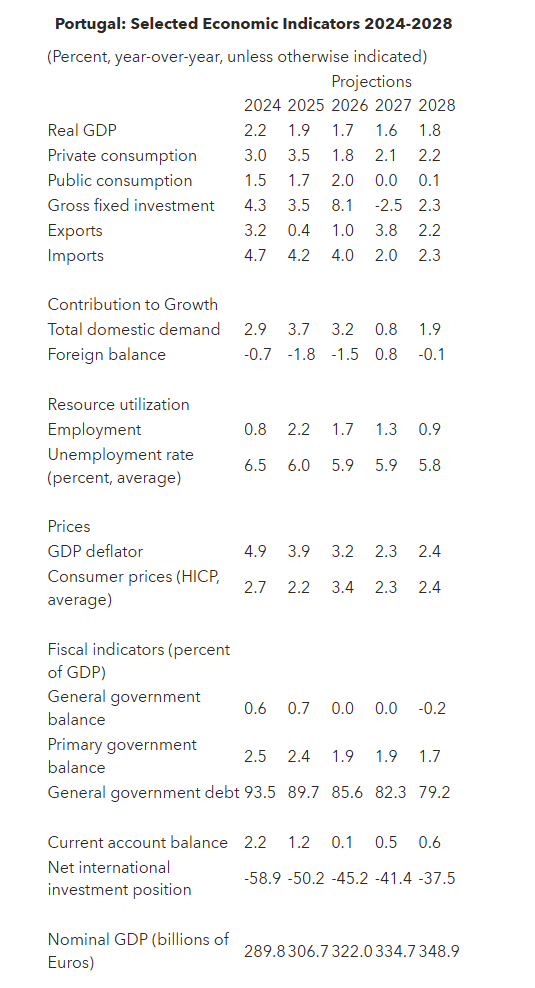
Sources: BdP, Eurostat, INE, Haver Analytics, Portugal’s Ministry of Finance, and IMF staff calculations/projections.
[1] Under Article IV of the IMF’s Articles of Agreement, the IMF holds bilateral discussions with members, usually every year. A staff team visits the country, collects economic and financial information, and discusses with officials the country’s economic developments and policies. On return to headquarters, the staff prepares a report, which forms the basis for discussion by the Executive Board.
[2] At the conclusion of the discussion, the Managing Director, as Chair of the Board, summarizes the views of Executive Directors, and this summary is transmitted to the country’s authorities. An explanation of any qualifiers used in summings up can be found here: http://www.IMF.org/external/np/sec/misc/qualifiers.htm.
See also:
IMF Executive Board Concludes 2026 Article IV Consultation with Spain | Disruption Banking