- The Spanish economy has continued to outperform the euro area, with solid growth expected this year despite the adverse impact from the war in the Middle East. Growth should then gradually ease over the medium term as immigration slows and population aging intensifies. Risks to growth are mainly on the downside, and those to inflation on the upside.
- Given still strong growth under staff’s baseline projection, the authorities should accelerate the pace of discretionary consolidation to rebuild fiscal buffers ahead of the looming sharp rise in aging-related spending pressures—starting with discontinuing recent energy support measures, except if a severe scenario materialized, in which case they should be narrowly targeted and not distort energy prices.
- Deteriorating housing affordability calls for more decisive action to boost housing supply, including faster urban development, reducing legal uncertainty, and streamlined construction permitting procedures. To pre-empt a buildup of housing-related financial risks amid rapid house price growth and early signs of easing lending standards, mortgage-related borrower-based measures should be introduced, at least in the form of supervisory guidance, in the coming year.
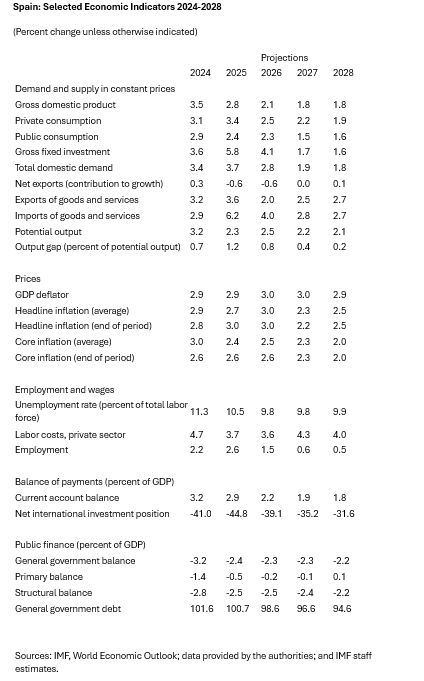
Washington, DC – May 22, 2026: The Executive Board of the International Monetary Fund (IMF) completed the Article IV Consultation for Spain.[1] Spain’s economy has remained robust, growing at 2.8 percent in 2025 as a pickup in domestic demand and investment offset subdued net exports. On the supply side, strong immigration has underpinned labor force gains, unemployment has further declined slightly, and productivity growth has been stronger than prior to COVID-19. Amid a strong economy and labor market, headline inflation has proven sticky, hovering around 2.5–3 percent before the war in the Middle East due to persistent core and services inflation. Strong economic growth has also supported tax revenue growth and thereby the improvement in public finances, with the deficit narrowing to 2.4 percent of GDP in 2025. Systemic financial risks remain low, with households, corporates, and banks in good financial health. However, if sustained, the continued rise in house prices and early signs of easier lending standards could eventually foster financial sector vulnerabilities. Despite recent progress, the employment rate remains one of the lowest in the euro area, the productivity pickup is still recent, and the speed of demographic aging is one of the fastest among peers.
Notwithstanding a hit from the war, growth is projected to remain solid at 2.1 percent in 2026 owing to still strong domestic demand, before slowing gradually as demographic headwinds intensify. In the short term, consumption will be supported by continued strong immigration, a tight labor market and a normalization of the still high saving rate, while investment will benefit from the final year of NGEU funding and firms’ intangible investment plans. In the medium term, growth would settle around its potential rate of around 1.7 percent as immigration slows and the employment rate remains stable. While the large share of renewables in the electricity mix is dampening the inflationary impact of higher gas prices, the overall energy shock is projected to keep inflation at 3 percent by end-2026, before a decline to 2.2 percent in 2027. Risks to growth are predominantly on the downside, including from a lengthy Middle East conflict—which could also make inflation stickier, other geopolitical and trade tensions, and domestic political fragmentation.
Executive Board Assessment[2]
Executive Directors commended Spain’s strong economic performance, which has outpaced euro area peers despite a challenging external environment. Directors welcomed that near-term growth is projected to remain resilient before moderating in the context of demographic challenges. They nonetheless considered that risks to the outlook are tilted to the downside, particularly from a prolonged war in the Middle East, and emphasized the importance of rebuilding fiscal space and boosting structural reforms to ensure sustainable growth.
Directors broadly encouraged more rapid, growth-friendly discretionary fiscal consolidation to rebuild fiscal buffers, amidst rising aging-related expenditure. Key measures include phasing out recent energy support measures, consideration of further pension reform, and harmonizing VAT rates while protecting vulnerable households. In the event of prolonged high energy prices, narrowly-targeted, non-price distortionary support measures could be considered. Noting the importance of supporting credibility and discipline, Directors highlighted the need to implement a fully-fledged medium-term fiscal strategy, reinforce the role of the independent fiscal council, and align subnational fiscal rules with the EU fiscal framework.
Directors noted that overall systemic financial risks remain low, while highlighting the potential risks emanating from fast-rising house prices and early signs of easier bank lending standards. Accordingly, they saw merit in introducing mortgage-related borrower‑based measures, potentially in the form of supervisory guidance, while continuing analysis on their design and calibration ahead of implementation. Noting the need to further bolster financial sector resilience, Directors encouraged continued progress on implementing the remaining FSAP recommendations.
Directors underscored the importance of further reforms to boost employment and enhance productivity. They recommended efforts to strengthen active labor market policies and further facilitate firms’ scaling-up and innovation. Important measures include redesigning the R&D tax credit, addressing skills mismatch, and reducing remaining barriers to trade across Spanish regions and EU countries. Noting the deterioration in housing affordability, Directors encouraged decisive actions to boost housing supply, including by accelerating urban development, simplifying permitting, and reducing legal uncertainty.
[1] Under Article IV of the IMF’s Articles of Agreement, the IMF holds bilateral discussions with members, usually every year. A staff team visits the country, collects economic and financial information, and discusses with officials the country’s economic developments and policies. On return to headquarters, the staff prepares a report, which forms the basis for discussion by the Executive Board.
[2] At the conclusion of the discussion, the Managing Director, as Chair of the Board, summarizes the views of Executive Directors, and this summary is transmitted to the country’s authorities. An explanation of any qualifiers used in summings up can be found here: http://www.IMF.org/external/np/sec/misc/qualifiers.htm.
See also:
The IMF Holds the Second High-Level Strategic Dialogue on Capacity Development | Disruption Banking