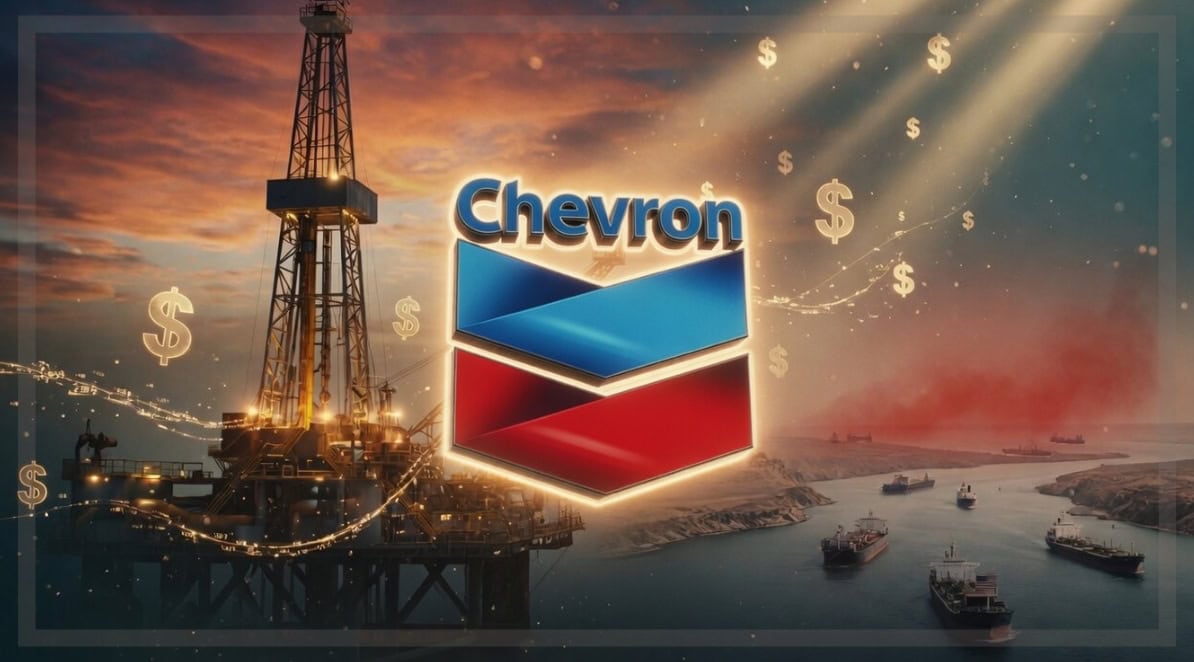
Chevron posted stronger than expected first-quarter 2026 results. Its upstream business delivered solid gains amid higher oil prices. The company reported adjusted earnings of $1.41 per share, well above Wall Street forecasts of 95 cents.
Despite the strong earnings beat, overall profit fell to its lowest level in five years, partly due to unfavourable timing effects from financial derivatives.
What Powered Chevron’s Upstream Success?
Chevron’s upstream segment stood out as the key driver. It generated $3.9 billion in earnings, up 4 percent year-over-year. Higher crude prices linked to the U.S.-Israeli conflict with Iran fueled the improvement.
The war that began on February 28 disrupted shipping through the Strait of Hormuz and tightened global supply. Oil prices surged by as much as 50 percent in the quarter.
The company benefited from limited Middle East exposure of less than 5 percent of total production. U.S. output remained robust, exceeding 2 million barrels per day for the third straight quarter. Overall net oil-equivalent production averaged 3.86 million barrels per day. A slight sequential decline came from downtime at the Tengiz field in Kazakhstan.
Why Did Chevron’s Downstream Segment Report a Loss?
Downstream operations faced significant pressure. The refining and marketing unit swung to an $817 million loss from a $325 million profit a year earlier. Chief Financial Officer Eimear Bonner cited derivative-related timing mismatches as the primary cause. Approximately $1 billion in these effects is expected to reverse favorably in the second quarter.
Net income for the quarter reached $2.2 billion, down from $3.5 billion year-over-year. This marked the lowest quarterly profit in five years. Free cash flow turned negative at $1.5 billion due to lower operating cash flow. Adjusted figures also declined from the prior year.
Chevron maintained strong shareholder returns. It paid $3.5 billion in dividends and repurchased $2.5 billion in shares. The full-year buyback target remains between $10 billion and $20 billion. Capital spending increased due in part to the Hess acquisition, partially offset by reduced Permian Basin outlays.
The company targets at least 10 percent annual growth in adjusted free cash flow through 2030.
CEO Mike Wirth emphasised portfolio strength: “Despite heightened geopolitical volatility and related supply disruptions, Chevron delivered solid first-quarter performance, underscoring the resilience of our portfolio and the value of disciplined execution,” he said.
Chevron’s results highlight its ability to capture commodity upside while navigating risks. With strong U.S. production and limited regional exposure, the company stays well positioned. The anticipated second-quarter reversal of timing effects should provide further earnings support. Investors will watch ongoing execution amid energy market volatility.
Author: Ruben McCarthy
The editorial team at #DisruptionBanking has taken all precautions to ensure that no persons or organizations have been adversely affected or offered any sort of financial advice in this article. This article is most definitely not financial advice.
See Also:
Why Chevron (CVX) Collapsed More Than 6% Today | Disruption Banking
Chevron: The Last Oil Giant in Dow Jones | Disruption Banking