Caterpillar Inc. (NYSE: CAT) and Chevron (NYSE: CVX) are no longer just industrial and energy heavyweights, they are now the Dow Jones Industrial Average’s (DJIA) anchor points in Texas. And their recent relocations may be signaling something much bigger.
While the DJIA tracks 30 of the largest U.S. companies, only these two now call the Lone Star State home. Caterpillar operates out of Irving in the Dallas-Fort Worth corridor, while Chevron relocated its global base to Houston in 2024, a move that would have seemed unlikely a decade ago. Today, it places them at the center of a rapidly forming corporate and capital markets ecosystem that is pulling in some of the biggest names in American business.
New exchanges and dual-listing platforms such as Nasdaq Texas, NYSE Texas, and the Texas Stock Exchange (TXSE) are preparing to compete for listings in Texas, while a growing list of major companies over the past decade have shifted their headquarters or legal domiciles to the state. Thus, turning Texas into one of the fastest-expanding corporate hubs in the United States.
This backdrop makes the relocations of Caterpillar and Chevron useful case studies ahead of TexCap 2026 in Dallas, which aims to highlight the rise of Texas as both a corporate and capital markets hub.
We have been tracking the rise of Texas capital markets for several years. Previous Disruption Banking coverage examined the launch of TexCap, the birth of “Y’all Street”, and the potential impact of the Texas Stock Exchange, including its early crypto-friendly structure for investors.
Here’s what the Caterpillar and Chevron moves show, and why firms like ExxonMobil, Tesla, Coinbase, and others are locking in.
Caterpillar’s 2022 Relocation to Irving Delivers Strategic Edge in Texas
Caterpillar moved its global headquarters from Deerfield, Illinois, to Irving, Texas, on June 14, 2022, citing stronger long-term growth, talent access, and proximity to key customers.
Relocating to the Dallas-Fort Worth metroplex placed Caterpillar in one of the country’s most active corporate corridors. The region hosts numerous Fortune 500 companies and benefits from major logistics networks, international airports, and proximity to customers across the energy, construction, and industrial sectors.
The company doubled down on that move in December 2025 with the purchase of an additional office building in Irving, reinforcing its long-term commitment to North Texas.
Chevron’s 2024 Houston Move Reinforces Energy Leadership and Dow Jones Presence in Texas
Chevron’s relocation to Houston in 2024 adds a second Dow heavyweight to Texas, strengthening the state’s position at the center of global energy markets.
The company shifted its global headquarters from California, with Chairman and CEO Mike Wirth, Vice Chairman Mark Nelson, and other senior leaders relocating to Houston by the end of 2024. The broader transition is expected to continue over five years.
Unlike Caterpillar’s manufacturing and industrial footprint in North Texas, Chevron’s Houston base places it at the heart of the U.S. energy complex, alongside peers, infrastructure, and capital providers.
Together, Caterpillar and Chevron now give Texas representation across both industrial and energy pillars within the Dow Jones Industrial Average.
Post-Move Performance Hits Records in 2025 for Caterpillar and Chevron
Operational results strengthened following the relocations, with both Caterpillar and Chevron delivering solid, though contrasting, performances in 2025.
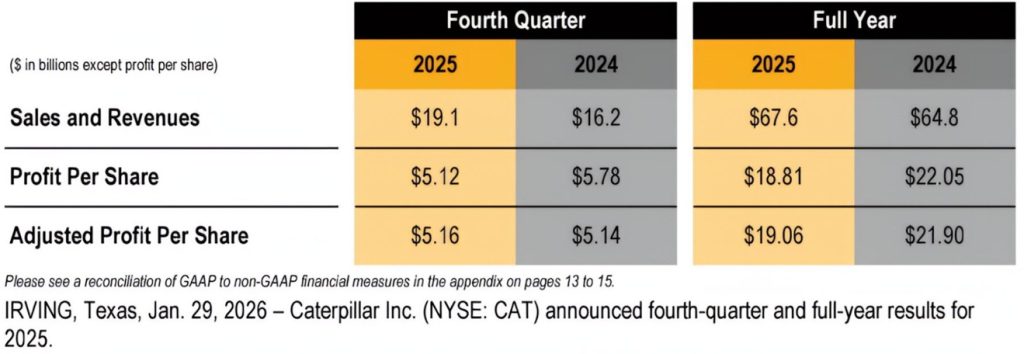
Caterpillar reported record full-year 2025 sales and revenues of $67.6 billion, up 4% from 2024, with Q4 sales reaching $19.1 billion and margins reflecting strong demand across infrastructure, mining, and energy.
Caterpillar CEO Joe Creed noted in January 2026: “Our centennial year marked a significant milestone, underscored by the highest full-year sales and revenues in Caterpillar’s history...”
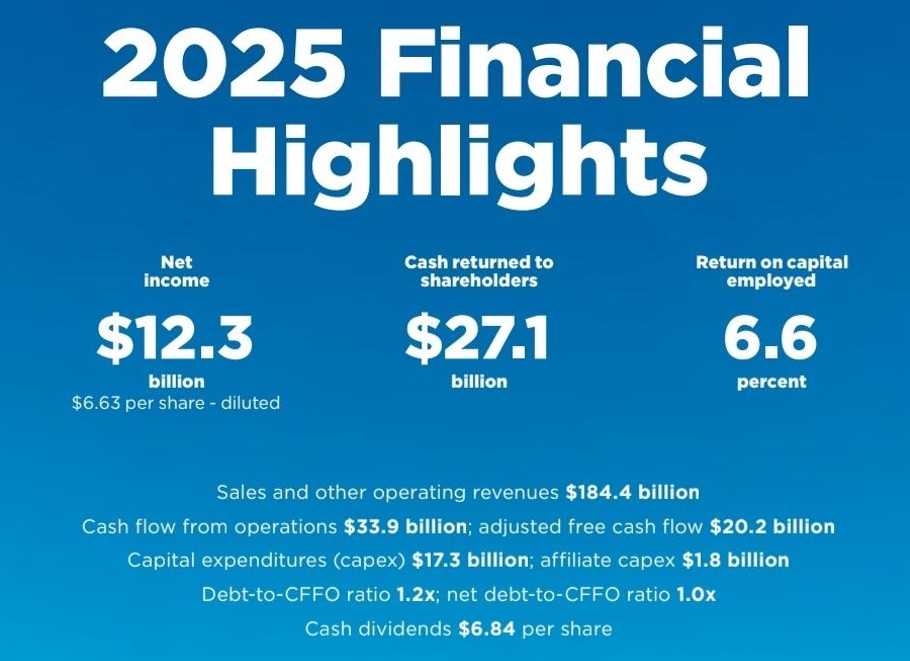
Chevron, by contrast, reported approximately $184 billion in revenue and $12.3 billion in net income for 2025, with record oil and gas production helping offset weaker crude prices and lower year-on-year earnings.
Fourth-quarter earnings came in at $2.8 billion, as higher production volumes and strong cash flow generation balanced margin pressure across parts of the business.
Together, the results point to resilience across both industrial and energy segments, reinforcing the strategic logic behind their Texas base.
Corporate Migration to Texas Accelerates with Tesla, Oracle, HP and New Stock Exchanges
The moves by Caterpillar and Chevron are not isolated. They are part of a broader shift in where corporate America chooses to operate, incorporate, and raise capital.
Tesla (NASDAQ: TSLA) moved its headquarters to Austin in 2021 from Palo Alto, California; and later reincorporated in Texas. As of the time of writing, the electric vehicle maker holds one of the largest market capitalizations among Texas-based firms at approximately $1.48 trillion.

As the only Magnificent 7 company headquartered in Texas, Tesla’s early move helped de-risk the idea for others. Proving that scale, talent, and capital access could all be sustained outside traditional hubs like California and New York.
Oracle relocated its headquarters to Austin in 2020, while Hewlett Packard Enterprise moved its headquarters to Houston the same year.
What started as a handful of high-profile relocations has since turned into a pipeline. Companies are no longer just testing Texas, they are committing to it.
ExxonMobil and S&P 500 Firms Accelerate Migration to Texas Amid NYSE Texas, Nasdaq Texas and TXSE Launch
Energy and finance companies have joined the trend as well.
ExxonMobil (NYSE: XOM), with core operations in Spring near Houston since 1989, announced on March 10, 2026, that its board recommends redomiciling its legal headquarters from New Jersey to Texas. Shareholders vote in May.
The company cited Texas’s business-friendly environment and the alignment between its legal structure and where most of its operations already take place.
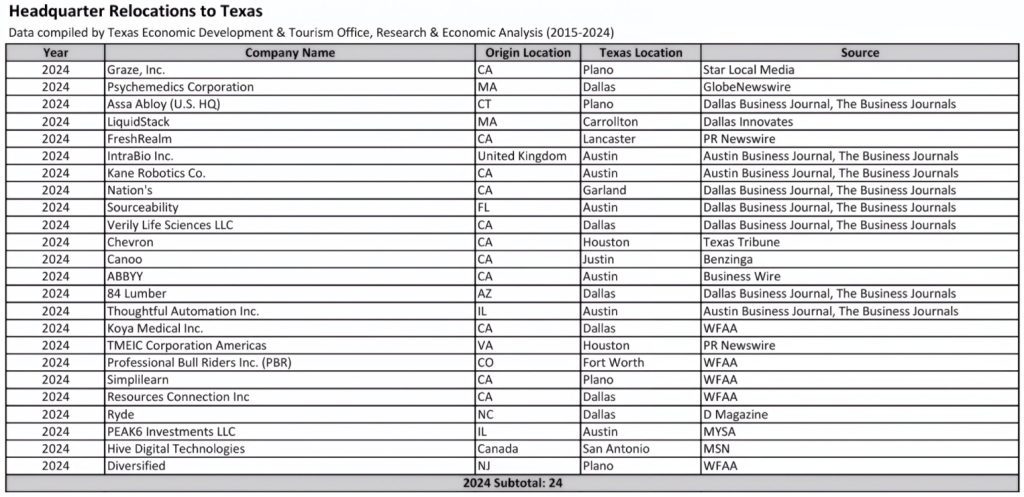
Coinbase has reincorporated from Delaware to Texas, following similar legal actions taken by Elon Musk’s SpaceX and Tesla in what is being termed a “Dexit” (Delaware Exit) movement. Broader relocation data shows the scale of the shift: at least 314 companies relocated headquarters to Texas from 2015 through 2024, with 24 arriving in 2024 alone and more than half landing in Dallas-Fort Worth.
Alongside Caterpillar and Chevron, these moves reflect a clear preference for Texas’s no-state-income-tax structure and lighter regulatory environment.
Building a Texas Capital Markets Ecosystem with New Stock Exchanges
Texas is not only attracting mega cap headquarters. It is also building the financial infrastructure needed to support them.
NYSE Texas launched in 2025 and reached more than 100 dual listings with over $2 trillion in combined market capitalization by year-end. Nasdaq Texas became fully operational in March 2026 as a dual-listing exchange domiciled in the state. Meanwhile, the Texas Stock Exchange (TXSE) targets live trading between July 2 and 17, 2026.
These developments signal the emergence of a regional capital markets ecosystem designed to complement traditional listing centers like New York.
Nasdaq Texas executive Rachel Racz said at launch, “Nasdaq Texas is open for business!”
NYSE Group President Lynn Martin added that the platform offers “the highest level of support to our issuers in the state of Texas and beyond.”
Dual Listings on Nasdaq Texas, NYSE Texas and TXSE Bring Clear Benefits
Dual listings on Nasdaq Texas, NYSE Texas, or the upcoming TXSE are emerging as a strategic bridge, not a replacement, for traditional exchanges. This setup provides local investor visibility, access to regional capital pools, and potential savings on listing and compliance costs.
For companies already rooted in Texas, it closes a long-standing gap between where they operate and where they raise capital.
Texas’s economy ranks eighth globally (with $2.77 trillion in economic output in late 2024/2025) and is projected to surpass France in the coming years for seventh place. Public companies headquartered in the state employ roughly one-third more people on average and pay higher wages.
Tax structure adds further appeal. Texas imposes no state corporate or personal income tax. Instead, a franchise tax applies, often with no tax due below roughly $2.65 million in revenue for 2026.
Lower energy costs, business courts, and a growing financial ecosystem round out the advantages.
TexCap 2026 Highlights Texas as Emerging Capital Markets Powerhouse with New Stock Exchanges
TexCap 2026 arrives May 20 at Southern Methodist University in Dallas.
The second edition of the event aims to position Dallas, and Texas more broadly, as a new hub for corporate listings and investment activity.
Executives from Nasdaq Texas, NYSE Texas, and the Texas Stock Exchange are expected to discuss how dual listings, governance frameworks, and regional investor participation could reshape capital formation for public companies.
Past TexCap speakers have included exchange executives such as Nasdaq Senior Vice President Rachel Racz, NYSE Texas Regional Head of Capital Markets Liz Hocker, NYSE Texas President Bryan Daniel, and Texas Stock Exchange Global Managing Director Nicole Chambers, alongside TXSE Global Managing Directors Robert Marrocco, Jeff Karcher, and Marc Cunningham.
Even Gov. Greg Abbott, Texas State Governor, Rebecca Zarutskie, SVP and Senior Research Advisor, Federal Reserve Bank of Dallas, Chairman Charles Schwertner, Texas State Senator, Rob Holmes, Chairman, President & CEO of Texas Capital, Chairman Morgan Meyer, Texas House of Representatives, have also spoken in the past at TexCap.
With Caterpillar and Chevron now firmly embedded in Texas, and firms such as ExxonMobil, Tesla, and Coinbase aligning operations or legal structures with the state, the conference highlights a capital markets ecosystem that is no longer emerging, but actively taking shape.
Author: Richardson Chinonyerem
The editorial team at #DisruptionBanking has taken all precautions to ensure that no persons or organizations have been adversely affected or offered any sort of financial advice in this article. This article is most definitely not financial advice.
See Also:
TexCap 2026: Dallas Set to Cement Texas as the New Capital Markets Powerhouse | Disruption Banking
TexCap Inaugurates ‘Y’all Street’: Texas’s Capital Markets Revolution | Disruption Banking