

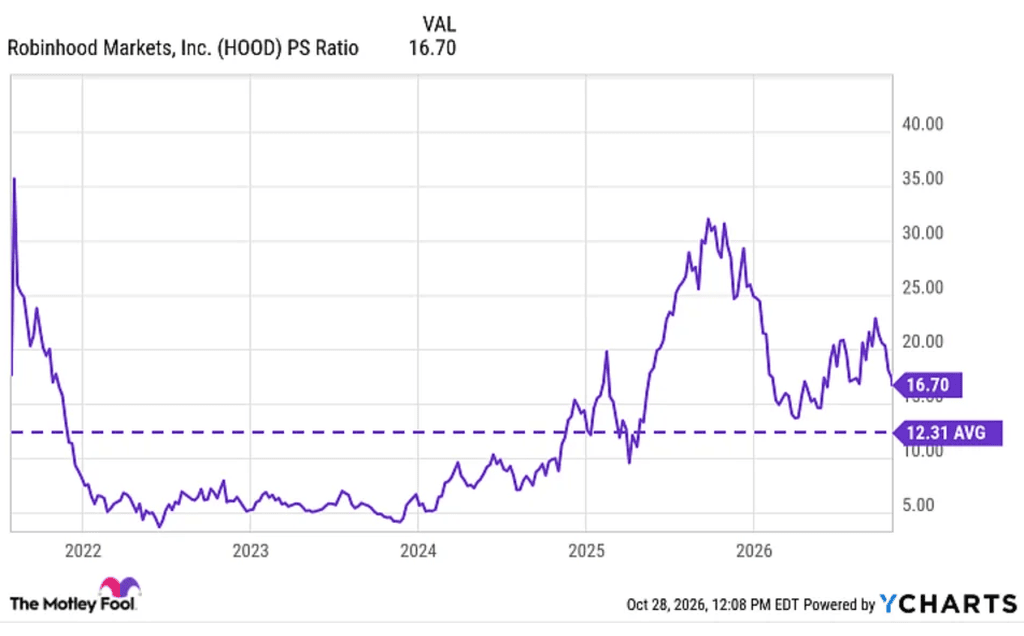
Robinhood’s third quarter, reported on October 27, was a mixed bag. Robinhood shares have fallen roughly 40% from their 2025 record high of $152.46, as investors question whether the brokerage can sustain growth driven by options, cryptocurrency, and prediction-market trading.
Revenue hit a record $1.42 billion, up 12% year over year, and still missed what analysts wanted. Net income came in at $476 million, down 14%. Diluted earnings per share fell 16% to $0.51, below consensus. On an adjusted basis the picture softens: adjusted EPS of $0.60 was down only 3%, and adjusted EBITDA of $808 million rose 9%.
The interesting part is the mix underneath. Transaction-based revenue reached $867 million, up 19%, and the four lines inside it moved in wildly different directions. Options, still the biggest, brought in $399 million, up 31%. Equities added $121 million, up 41%. Event contracts, the prediction market business, returned $173 million, more than six times a year earlier. Crypto collapsed 55% to $120 million.
14% Profit Decline
Three things drove the profit decline, and only one of them is crypto.
A $67 million unrealized loss, worth $0.07 a share, came mostly from marking down Robinhood Ventures Fund I, the closed-end fund that lets retail investors buy into private fintech and AI companies including OpenAI and Stripe. Private valuations move when nobody is trading them, and this quarter they moved against Robinhood.
Total operating expenses were $739 million, up 16%. Note that $739 million is the total, not the increase. A large chunk of the growth sits in credit. The provision for credit losses jumped 173% to $71 million, from $26 million a year earlier, which is what happens when you lend to more people. The Gold Card now has 1.3 million customers and more than $19 billion in annualized payment volume. Gold subscriptions overall reached a record 5.2 million, up 34%.
So the card business is working, and the cost of it arriving on the income statement before the losses do is exactly what a provision is.
Where the Crypto Traders Went
2026 has been brutal for crypto. Total market capitalization ended the second quarter at $2.1 trillion, roughly 52% below the October 2025 peak, according to CoinGecko. Spot volume across the ten largest centralized exchanges fell from $2.70 trillion in the first quarter to $1.95 trillion in the second, a drop of 27.9%.
Some of that volume did not vanish. It moved. Decentralized exchanges handled $6.8 trillion in spot volume in the third quarter, about a quarter of all crypto spot trading, and tokenized stocks and ETFs have started trading on chain in meaningful size.
Robinhood saw this coming and built for it. Robinhood Chain contributed $26 million of the quarter’s $120 million in crypto revenue, and in its first quarter on mainnet generated more than $50 million in chain fees against more than $80 billion in on-chain volume.
Strip Robinhood Chain out and the legacy crypto business brought in roughly $94 million, which is 6% below the second quarter’s $100 million. Include it and crypto revenue actually rose 20% sequentially. Both framings are true, and which one you lead with says more about your thesis than about Robinhood. Year over year the decline is unambiguous: $268 million in the third quarter of 2025, $120 million now.
Robinhood has been here before. Between the second quarters of 2021 and 2022, options revenue fell 31% and cryptocurrency revenue collapsed 75%, as the company’s stock lost roughly 90% of its value. The latest 55% decline in crypto revenue raises the question of whether Robinhood is again approaching the end of a speculative trading cycle, even as options and prediction markets continue to grow.
The 6x That Was Really 11%
The headline on event contracts is spectacular. Customers traded 16.4 billion of them, more than seven times the year-ago figure, and the $173 million in revenue has been widely reported as prediction markets overtaking crypto for the first time.
That last claim is not right. Prediction markets passed crypto in the second quarter, when they produced $156 million against crypto’s $100 million. Measured against that, the third quarter’s $173 million is sequential growth of about 11%, not 600%.
That matters because the comparison you choose determines whether this looks like a rocket or a plateau. Against a tiny base a year ago, it is a rocket. Against last quarter, it is a business settling into a run rate.
Robinhood Takes an Ownership Stake
Robinhood launched event contracts as a storefront for Kalshi’s CFTC-regulated exchange, charging a small per-contract fee on top of Kalshi’s. That arrangement has been unwinding for a while. Robinhood’s share of Kalshi’s volume fell from nearly 60% in September 2025 to roughly 20% by April 2026.
Rothera is why. Launched in mid-2026 and jointly operated by Robinhood and Susquehanna International Group, it self-certified its first sports contract on May 21 and began taking Robinhood order flow in June. It holds dual registration with the CFTC as both a designated contract market and a derivatives clearing organization, meaning Robinhood now owns the exchange and the clearing, not just the app.
In its first full quarter Rothera exceeded $100 million in annualized revenue, with more than 6.4 billion contracts traded since launch. Robinhood still routes to Kalshi and ForecastEx for markets Rothera does not list, and the company expects to shift most volume in house. Every contract that migrates converts a fee Robinhood pays into a fee Robinhood collects.
The $2 Billion With No Coupon
In June, Robinhood priced $2.0 billion of 0.00% convertible senior notes due October 2029, at a conversion premium of roughly 65% and an initial conversion price near $174.42 a share.
Zero coupon means no interest until maturity, which is cheap money by any measure. The usual worry with converts is dilution if the stock runs past the conversion price, and Robinhood pre-empted part of that: $112 million of the proceeds went into capped call transactions specifically to blunt it, and another $290 million went straight into buying back stock at pricing. That leaves roughly $1.57 billion to deploy into growth, acquisitions or further buybacks.
The risk is not the coupon. It is that $2 billion now has to earn its keep in a business whose three growth engines are a credit card with a rising loss provision, a crypto desk down 55%, and a prediction market facing an unresolved question about whether it is legal in most of the country.
Three Circuits, Three Answers
The draft version of this story is that the CFTC claims exclusive jurisdiction, states object, courts have blocked the states, and one day the Supreme Court will sort it out. That was accurate in the spring. It is not accurate now.
In July, 44 state attorneys general, led by Ohio’s Andy Wilson, told the CFTC that its proposed prediction-markets rule “goes well beyond its statutory authority” and would expand federal power into an area states have always regulated. Their line was blunt: “States have long regulated gambling, including sports bets. The federal government has not.”
The courts have since split three ways on whether sports event contracts are swaps at all.
The Third Circuit ruled in April that they are, and that New Jersey could not enforce its gambling laws against them. The Ninth Circuit went the other way in August, letting Nevada’s cease-and-desist stand. Then on September 25 the Sixth Circuit held unanimously that Kalshi had not shown the contracts are swaps, because they are not inherently tied to a “financial, economic, or commercial consequence.” It affirmed the denial of an injunction in Ohio and vacated the one Kalshi had won in Tennessee.
The legal landscape has shifted sharply against Kalshi. New Jersey remains the exception, where a federal injunction protects its sports contracts from state gambling enforcement. In Nevada, Tennessee and Ohio, Kalshi has failed to secure that protection, leaving regulators free to pursue enforcement under state gambling laws. None of these decisions represents a final ruling that the contracts are illegal, but the implications for Robinhood’s expanding prediction-market business are substantial.
What Happens When the Court Answers
However, considering that Nevada, Tennessee, and Ohio are Republican states, and that Donald Trump, Jr. is a “strategic adviser” to Kalshi, it may be more likely that Kalshi is allowed to continue business as usual, even with that ridiculous and patently false argument that betting on whether the Kansas City Chiefs win a football game is NOT sports gambling, but rather a “financial derivative.”
New Jersey filed a cert petition on September 2, asking the Supreme Court whether federal law preempts states from regulating sports bettors inside their own borders when the bets run through CFTC-registered venues. The question is on the docket, not hypothetical.
Which brings the quarter into focus. Robinhood’s fastest-growing revenue line more than tripled in a year and now runs through an exchange and clearinghouse the company owns, built with a partner, sitting on $2 billion of borrowed money that has to go somewhere. The economics are excellent. Three federal appeals courts cannot agree on whether the product is a derivative or a bet, and the one body that can settle it has been asked.
Everything else in this report is a trading business having an ordinary quarter: options strong, equities strong, crypto weak, costs up with the card book. The prediction market line is the one carrying the growth story, and it is the one whose legal foundation is actively being litigated. That is the trade Robinhood has made, and the next ruling prices it.
—
Author: Tim Tolka, Senior Reporter
#Crypto #Blockchain #DigitalAssets #DeFi
The editorial team at #DisruptionBanking has taken all precautions to ensure that no persons or organizations have been adversely affected or offered any sort of financial advice in this article. This article is most definitely not financial advice.
See Also:
Robinhood Closed August With $384 Billion of Assets | Disruption Banking

Tim Tolka
Tim Tolka, Senior Reporter at Disruption Banking, covers digital assets, monetary policy and the politics of global finance. Based in Mexico City, he brings an investigative edge to his reporting, informed by a Master's in International Affairs and his work as an author and screenwriter.