
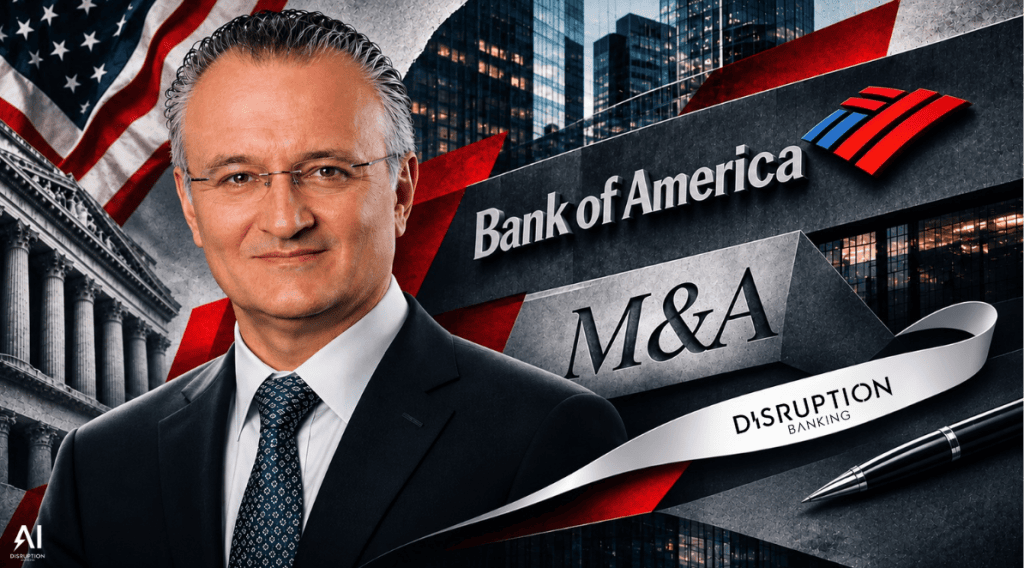
Bank of America reported third-quarter results on October 14. Total investment banking fees, excluding self-led deals, were about $1.8 billion, down from a strong year-ago quarter because of lower advisory and debt underwriting fees. The same day it was reported that JPMorgan is recruiting Richard Peacock, a consumer and retail M&A banker who this year became co-head of BofA’s new private capital M&A group.
The two facts sit against the bank’s own view. Chief financial officer Alastair Borthwick said BofA was third in announced M&A in the quarter and that investment banking fees were up 16% after nine months. Ivan Farman, co-head of global M&A, runs the business in the middle of it.
This is the seventh piece in a series on the bankers who run Wall Street’s largest M&A teams. Previous pieces covered Tom Miles at Morgan Stanley, Stephan Feldgoise at Goldman Sachs, Anu Aiyengar at JPMorgan, Andrew Woeber at Barclays, Robert Leitão at Rothschild & Co, and Vis Raghavan at Citi. Today’s story looks at Ivan Farman and Bank of America’s M&A franchise.
Who runs M&A at BofA
Farman and Eamon Brabazon are co-heads of global M&A. Brabazon, based in London, was named alongside Farman in October 2024. He joined the bank in 2015 as head of financial sponsors M&A after JPMorgan.
Farman studied electrical engineering at Cooper Union, then took a Juris Doctor at Harvard Law School and an MBA at Harvard Business School. He spent two years as an M&A lawyer at Wachtell, Lipton, Rosen & Katz before joining Bank of America in 1998. He built his career in healthcare, covering hostile defence, sell-side and buy-side work. He became co-head of US M&A in 2018 alongside Kevin Brunner, and co-head of global M&A in 2024.
The third-quarter numbers
The second quarter had been exceptional: investment banking fees rose 50% to $2.1 billion. In September chief executive Brian Moynihan warned that third-quarter fees would fall more than 10% from a year earlier, against a market that was itself down about 10%. The result was roughly $1.8 billion of fees. Year-to-date investment banking fees are still up 16%, and global banking revenue is up 5%.
Borthwick said the bank was third in announced M&A in the third quarter. Advisory fees are recognised when deals close, not when they are announced. A bank can therefore rank third on announced volume in a quarter while still reporting lower advisory revenue if those deals have not yet completed. Advisory is the pure M&A fee line, and it is our focus in today’s story.
Farman has described the current market in straightforward terms. Speaking to the New York Post on the record year for deal size, he said: “Large deals are driving the market. And when you see big deals, it’s a sign of CEO and boardroom confidence.” In July he told Reuters that a $1 billion to $3 billion deal takes as much management time as a much larger one, which is one reason boards are leaning toward bigger bets.
What the quarter still shows
Moynihan put it directly: “What we’re seeing is the market generally in investment banking is down 10%. We’re not as well positioned in some of the businesses that have more activity, so we’ll be down probably a bit more than that.”
There has also been movement among senior bankers. JPMorgan hired David Fishman from BofA in August to run its North American technology M&A business. Reports also name Amy Lissauer and Kevin Brunner among BofA bankers recruited by JPMorgan this year, alongside Peacock. For balance, BofA says it hired more than 40 managing directors in its corporate and investment bank during 2026. In May it hired Richard Hardegree from UBS as vice chair of M&A, reporting to Farman and Brabazon. Hiring has gone in both directions.
What remains open
Two questions remain. Whether a third-place ranking in announced deals turns into advisory fees as those deals close next year. And whether Bank of America can hold its senior M&A bench while JPMorgan continues to recruit from it. The year-to-date fee growth and the announced ranking show the franchise is still competing, but the third-quarter results and the departures show the pressure.
Author: Tejas Bansal
See Also:
Who Is Vis Raghavan? The Former JPMorgan Banker Rebuilding Citi’s M&A Business | Disruption Banking
Who Is Anu Aiyengar? The First Woman to Run M&A on Wall Street | Disruption Banking