The European Commission is examining a special European structure to receive the roughly €200 billion in frozen Russian central-bank assets held mainly at Euroclear. A senior Brussels official likened the idea to a “bad bank.” Once under the new EU structure’s control, the funds could support financing for Ukraine, with residual Russian claims shared among member states.
What the EU “Bad Bank” Would Move From Euroclear
A bad bank, in the ordinary sense, is a vehicle that takes troubled assets off a balance sheet so the original institution can keep operating. The proposal under discussion is different. It would move sovereign central-bank claims and the associated sanctions and legal risk into an EU-level vehicle.
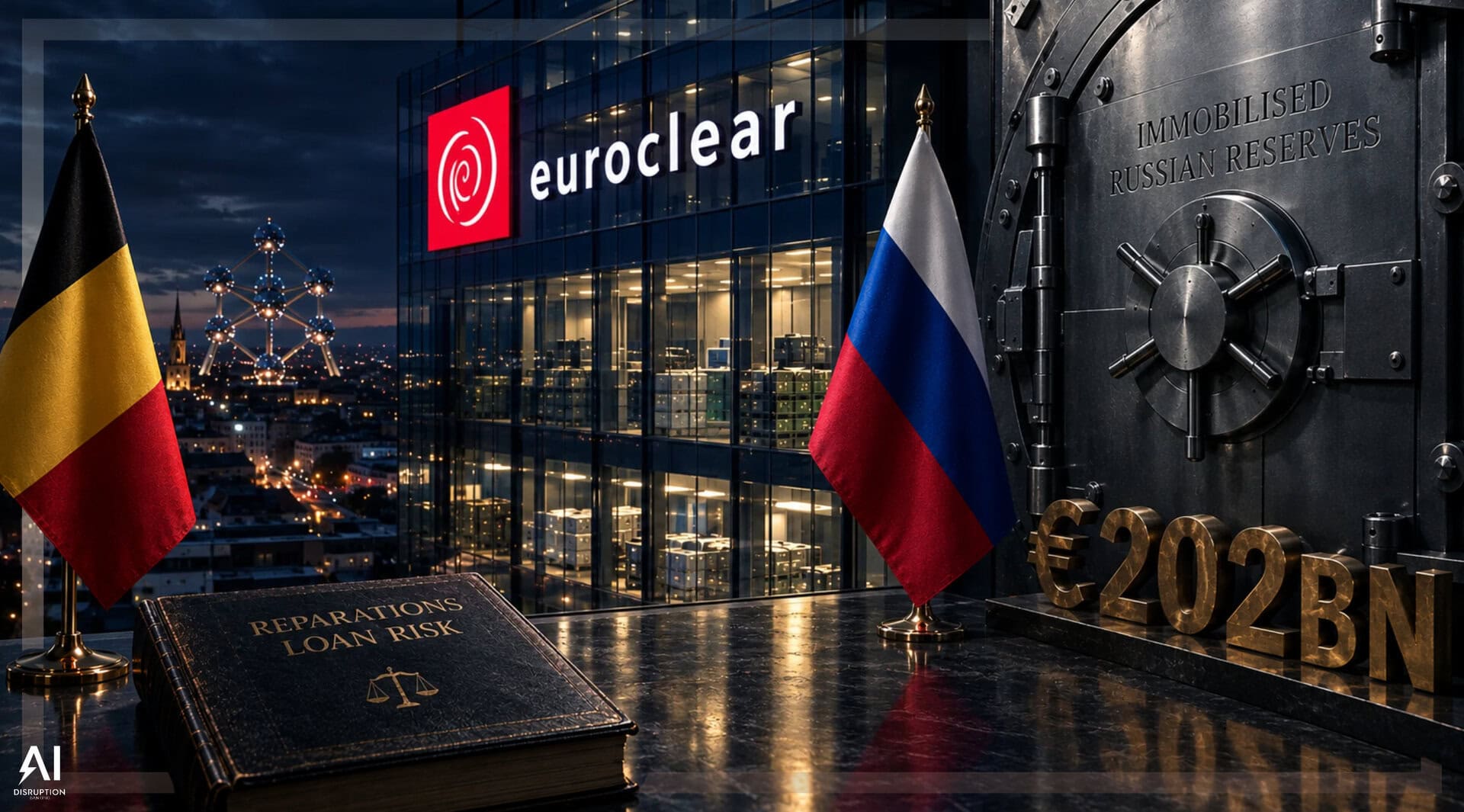
Euroclear sits at the centre of European settlement. Its balance sheet stood at €241 billion at the end of June 2026, of which €202 billion related to sanctioned Russian assets. Of that, estimates place the immobilised central-bank portion at roughly €185 billion. Disruption Banking reported that total EU and G7 freezes of Russian sovereign assets are around €300 billion, the bulk in Europe and concentrated at Euroclear.
The proposed vehicle would take both the assets and the matching liability, aiming to isolate Euroclear’s balance sheet while leaving ordinary settlement and custody operations untouched. Commission officials maintain the arrangement would not amount to confiscation, on the basis that Ukraine would repay once Russia pays war reparations. Moscow treats any use of the principal as expropriation.
Moving the Liability Off Euroclear’s Balance Sheet
A separate campaign has already described how transferring custody might work. In an August statement, former German defence minister Annegret Kramp-Karrenbauer, MEP Nathalie Loiseau and former US official Daleep Singh called for a new EU custodian to take both the frozen accounts and the matching liabilities. Russia’s central bank would remain the accounts’ owner. “The EU is far better placed than individual financial institutions or member states to withstand pressure from Moscow,” they wrote.
That is an advocacy proposal, different from the Commission discussions reported in October. Its central argument is that shifting the obligation to repay matters as much as moving the assets.
Why Earlier Russian Asset Proposals Stalled on Belgium
Belgium has resisted schemes that would leave it and Euroclear carrying sole exposure. In December 2025, the Commission proposed a reparations loan that would borrow cash balances linked to the immobilised assets and lend the proceeds to Ukraine, without formally confiscating the underlying securities. Belgium sought binding, uncapped guarantees that other member states would cover any residual liability if Russia enforced claims. Those safeguards were judged inadequate. Leaders instead approved a €90 billion ($100.85 billion) loan for 2026–2027 funded by EU borrowing and backed by budget headroom.
Ukraine has since signalled it will need an additional €30 billion ($33.61 billion) in 2027. Four member states, Spain, Sweden, the Netherlands and Poland, have pressed the Commission to explore fresh options, noting that the existing loan will not cover longer-term needs. No agreement exists among the 27 on either the mechanism or the allocation of losses from Russian claims.
Russian Court Claims Against Euroclear and the November 26 Hearing
A Moscow court ordered Euroclear in May 2026 to pay the Bank of Russia 18.17 trillion roubles (roughly €200 billion) for losses tied to the freeze; the appeal failed in July. Euroclear rejects Russian jurisdiction and has brought Belgian proceedings to resist enforcement. Parallel challenges by the Russian central bank against EU measures continue in Luxembourg. The EU has dismissed related claims as speculative.
On October 2, the General Court rejected as inadmissible actions by three Russian investors whose securities, held through the National Settlement Depository at Euroclear, became inaccessible after sanctions on the NSD. The investors themselves were not listed; the court cited lack of individual concern and the regulatory character of the measures.
Separately, a private bankruptcy petition against Euroclear Bank, filed in July by Russian investor Ilya Petrov over an unpaid sum of about 2.5 million roubles (€29,851) linked to frozen eurobonds, is scheduled for a hearing on November 26. Euroclear has asked the Moscow court to terminate the proceedings, citing lack of jurisdiction and the absence of insolvency indicators. The court has asked the petitioner to confirm he will fund the process (minimum 220,000 roubles on deposit). Earlier private bankruptcy applications against the firm were discontinued or left without consideration.
Euroclear’s Expanding Role in European Settlement
According to its company post, Euroclear Bank has been designated an alternative central securities depository (CSD) for eligible Italian government-bond trades executed on MTS Italy Cash, MTS Italy Repo and the E-Bond Market. Clearing members can settle CCP-cleared activity alongside wider European fixed-income business, consolidating collateral movement and simplifying post-trade operations. The firm described the step as a greater choice and a further contribution to connected European capital markets.
Operational expansion continues while the Russian assets remain on the balance sheet. A CSD that is still widening its role in integrated settlement is simultaneously the subject of proposals to carve out that position.
What Isolating Russian Assets Would Mean for CSDs and Investor Confidence
Investor confidence in CSDs rests on the expectation that they remain neutral custodians whose liabilities match client assets and whose legal exposure is limited and predictable. A special-purpose structure shares residual risk among member states. It does not eliminate the possibility that counterparties, rating agencies or third-country authorities will treat the episode as evidence that European settlement infrastructure can be subordinated to sanctions policy.
Any such mutualisation still requires political agreement among member states on binding risk-sharing. That agreement does not yet exist. Fitch has already flagged liquidity and legal risks linked to earlier loan designs, even while judging near-term materialisation remote. Until member states agree on binding risk-sharing and the new vehicle’s legal architecture is published, the roughly €200 billion remains on Euroclear’s balance sheet and the question of isolation is still open.
($1 = 0.89 euros)
Author: Richardson Chinonyerem
The editorial team at #DisruptionBanking has taken all precautions to ensure that no persons or organisations have been adversely affected or offered any sort of financial advice in this article. This article is most definitely not financial advice.
See Also:
Why Is Euroclear Still Holding Over €200 Billion of Russian Money? | Disruption Banking
How Much Russian Money Does Clearstream Hold, and Who Bears the Risk? | Disruption Banking