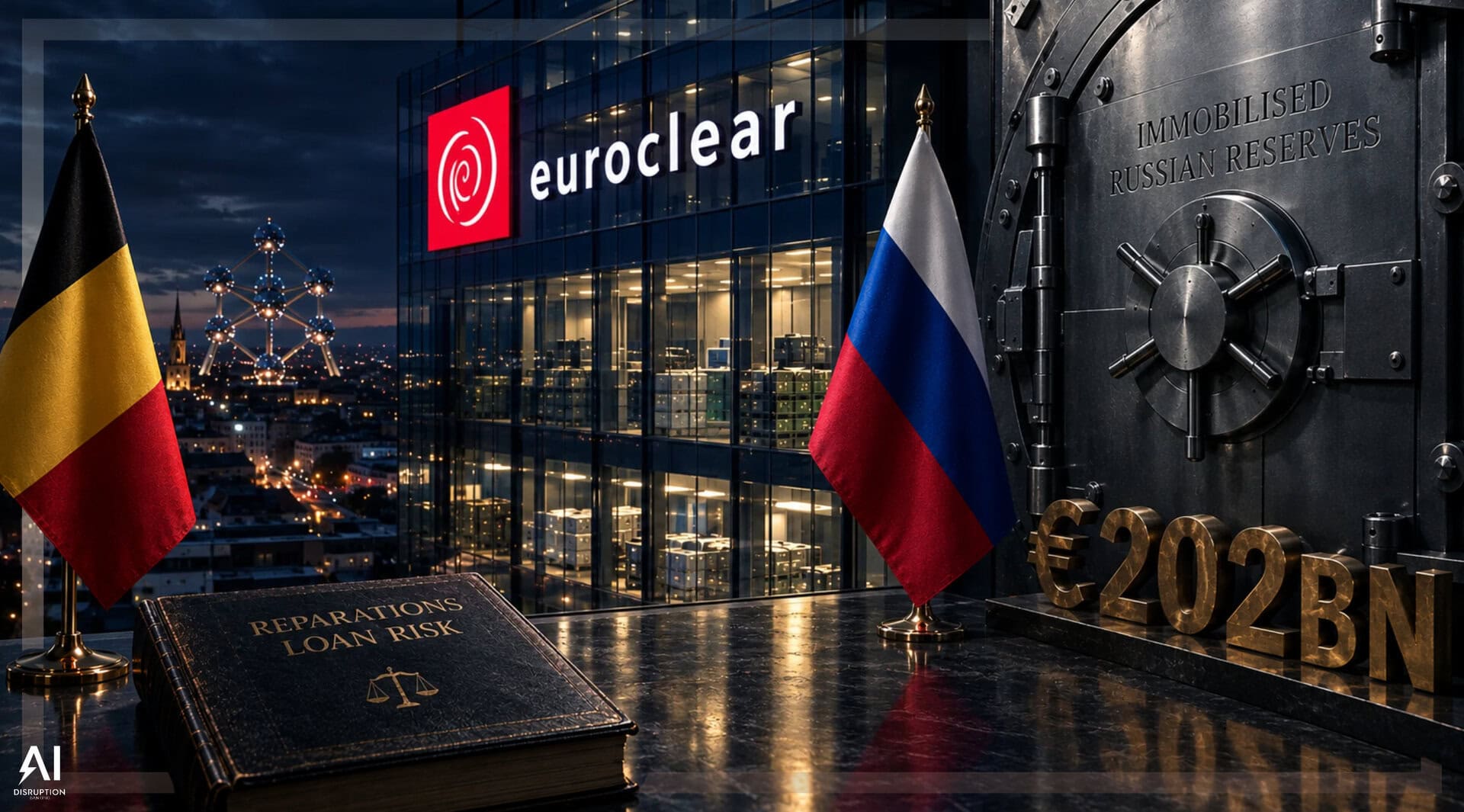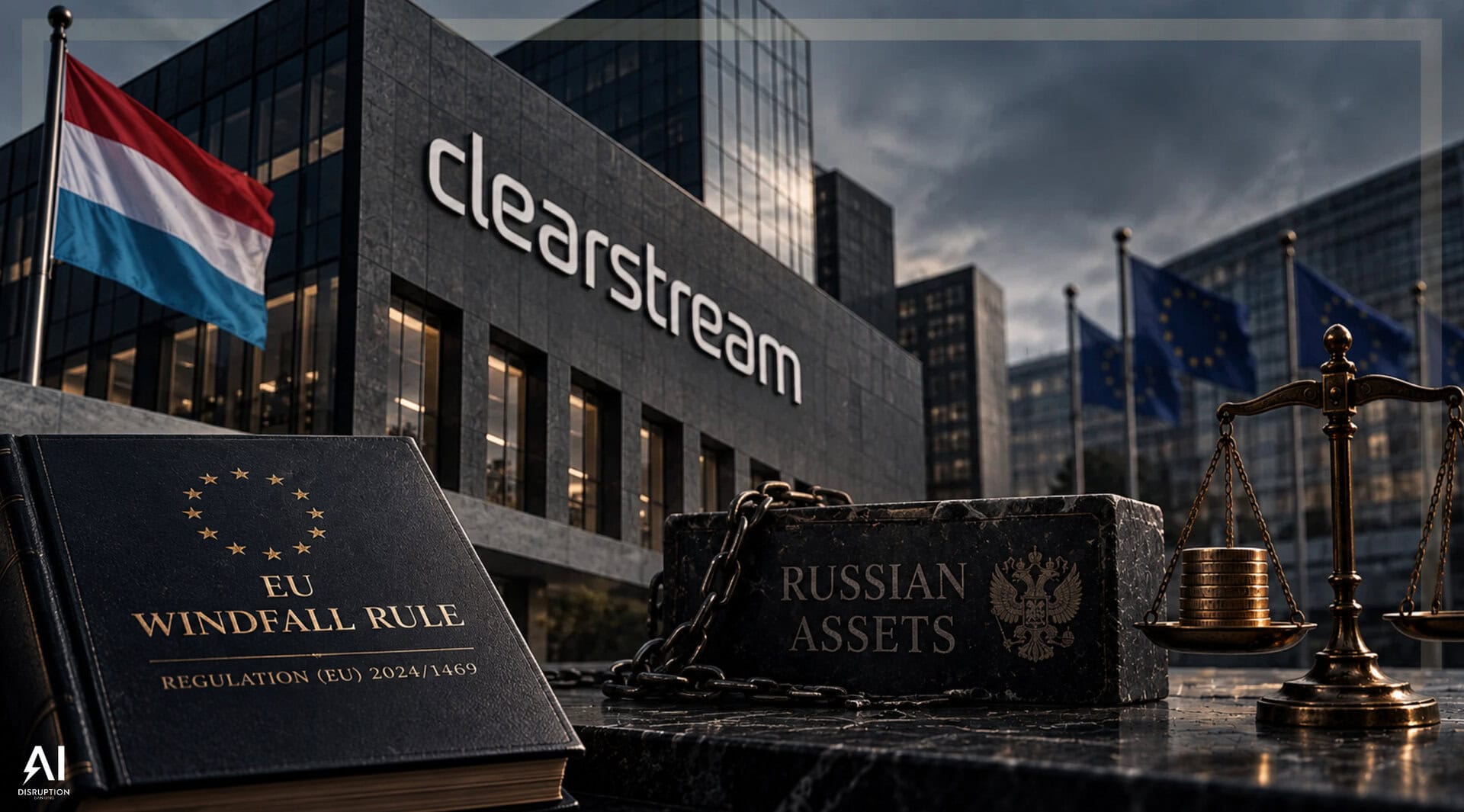
Clearstream has not published a figure. Euroclear has: it said €202 billion of its balance sheet related to sanctioned Russian assets at the end of June 2026. Clearstream, the Luxembourg depository owned by Deutsche Börse, sits under the same EU windfall rule, yet its public documents carry no matching line.
What Clearstream Has Published, and Who Would Carry a Loss
Clearstream has disclosed losses tied to Russia’s National Settlement Depository (NSD) but has not disclosed a central-bank balance. Clearstream Banking S.A., the Luxembourg bank, published its Pillar III report in May 2026, with unaudited figures as of December 31, 2025. The Russia section names the NSD but does not mention the central bank. It says the NSD debited Clearstream’s cash balances to zero on August 15, 2024, and that Clearstream then offered clients compensation, which made it liable to them again. Deutsche Börse’s Q2 2026 results presentation reports €18.9 billion of total cash balances for Securities Services in Q2 2026, up 7 percent from €17.681 billion a year earlier. It provides no Russia-specific breakdown.
The numbers that do exist come from outsiders, and they disagree. Nicolas Véron inferred in 2023 that Clearstream possibly held a few billion euros. A September 2025 European Parliament briefing reported estimates for Luxembourg ranging from several billion euros to about €20 billion and used €10 billion as a conservative figure. That is the usual source of the “over €10 billion” estimate, and it covers Luxembourg as a whole. In November 2025, Luxembourg’s finance and foreign affairs ministers said that Russian central-bank assets immobilised in the country stood below €10,000. Clearstream has published no reconciliation of the three figures. Subtracting Euroclear’s €202 billion from the roughly €210 billion estimate for the EU freeze does not isolate Clearstream’s share. The €202 billion is a balance-sheet line; the €210 billion is an estimate of central-bank assets.
The windfall rule covers Clearstream by type. Regulation 2024/1469 applies to any depository under the EU’s Central Securities Depository (CSD) Regulation that holds more than €1 million of Central Bank of Russia assets. Luxembourg’s financial regulator, the Commission de Surveillance du Secteur Financier (CSSF), licensed Clearstream Banking S.A. as a CSD under that regulation in April 2021. Covered depositories book the cash separately and pay 99.7 percent of the net profit on it to the EU, after expenses and corporate tax. They may provisionally keep up to 10 percent of the contribution and need supervisor approval for more. The rule only applies once a depository holds more than €1 million of Russian central-bank assets. The Luxembourg ministers’ figure would leave Clearstream below it; the Parliament’s estimate would put it far above.
Euroclear’s July report puts its payments at about €6.6 billion to date, with another €1.4 billion estimated for July. The Commission received €1.4 billion on August 3 and puts total windfall receipts since immobilisation at €8 billion, without naming the depositories. Euroclear’s two figures add to about €8 billion. Within rounding, that leaves a few hundred million euros at most for anyone else. For scale, at Euroclear’s first-half ratio of €2.3 billion of interest on its €202 billion line, a €10 billion balance would earn roughly €110 million in six months. No official source states it.
If accounts moved, the claim sits where the liability sits. That liability sits with Clearstream Banking S.A. Its Common Equity Tier 1 capital was €1.03 billion at the end of 2025; its required economic capital was €291 million. Those figures describe the bank’s capital and carry no information about central-bank exposure. The CSSF supervises the bank and approves any retention above 10 percent of the windfall contribution, subject to a Commission check. The Grand Duchy has its own exposure. Egmont Institute’s Jan Balliauw notes that Russia, as the Soviet successor, can bring expropriation claims under a 1989 investment treaty signed by Belgium and Luxembourg. However, the public record does not say how a loss would be divided between the bank, its German parent and the state.
A move to an EU custodian would change that structure. Annegret Kramp-Karrenbauer, Nathalie Loiseau and Daleep Singh called for one in August. A draft regulation published on The Russian Transfer advocacy site, in a version dated September 22, would put the Union in the depository’s place on the liability, discharge the depository without client consent, and compensate losses, including Russian retaliation. It would apply to every EU-established holder, depositories included. It is a campaign draft. No Commission proposal is public, so Luxembourg’s exposure today is unchanged.
What does Luxembourg’s silence tell us? The windfall income does not look large, on either estimate. The principal is still open. The published range runs from a few billion euros to about €20 billion, and any legal exposure follows the size of that balance.
Three disclosures would settle it: a central-bank line in Clearstream’s reporting, a CSSF decision on retention above 10 percent, or a Commission breakdown of windfall payments by depository. Deutsche Börse’s Q3 statement on 20 October is the first scheduled chance to see one.
Author: Richardson Chinonyerem
The editorial team at #DisruptionBanking has taken all precautions to ensure that no persons or organisations have been adversely affected or offered any sort of financial advice in this article. This article is most definitely not financial advice.
See Also:
Why Is Euroclear Still Holding Over €200 Billion of Russian Money? | Disruption Banking