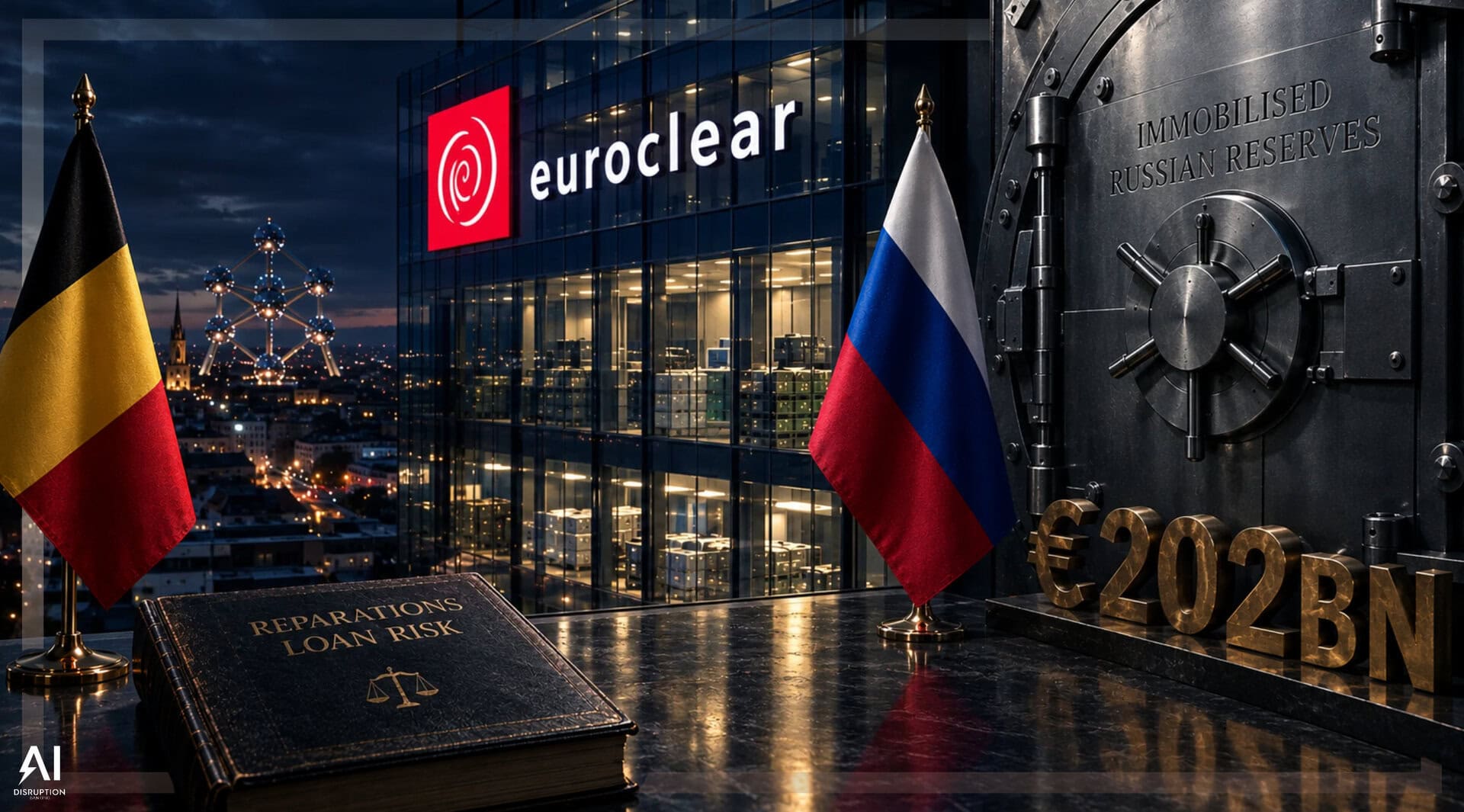
Euroclear is financial plumbing: the Brussels settlement system that records and transfers ownership of securities across Europe. In the first half of 2026, it said assets under custody exceeded €45 trillion ($51 trillion). Since Russia invaded Ukraine, it has also held the largest concentration of immobilised Russian central-bank reserves in the EU. That has put Euroclear at the centre of a fight over who pays for Ukraine and who bears the legal risk.
Euroclear said €202 billion ($229 billion) of its balance sheet related to sanctioned Russian assets at the end of June 2026. Belgium hosts Euroclear. EU sanctions caused the freeze of the assets. Governments across the bloc want the reserves to help Ukraine. Belgium wants a binding answer to a harder question: who pays if Russia enforces a claim on the frozen assets?
An accident of custody
Euroclear already held the assets when sanctions blocked transactions with Russia’s central bank in 2022 in the wake of the Ukraine invasion. Disruption Banking’s earlier report on Elvira Nabiullina’s reserve policy described how Russia diversified its reserves away from the dollar before the invasion. As bonds matured and made payments, cash accumulated on Euroclear Bank’s balance sheet. The EU’s December 2025 emergency measure further prohibited transfers of immobilised central-bank assets to Russia while the measure’s conditions persist. Euroclear holds the accounts under EU rules. Belgium cannot simply decide to send the money back.
The €202 billion figure describes the portion of Euroclear Bank’s €241 billion ($273.2 billion) balance sheet related to sanctioned Russian assets, rather than the central bank’s exact principal. An estimate reported in August put Russian central-bank assets held at Euroclear at roughly €185 billion (around $210 billion). The wider screening problem is evident in a separate LSEG analysis of sanctions-linked securities that we reported, which found that ownership and control accounted for about a third of the instruments linked to sanctions in its dataset.
The cash produces income. Euroclear earned €2.3 billion ($2.61 billion) in interest from sanctioned Russian assets in the first half of 2026, down 13 percent from a year earlier as rates fell. Belgium committed tax receipts from that income to Ukraine. Since 2024, EU rules have also captured much of the extraordinary net profit. In its July results, Euroclear said it had paid about €6.6 billion in windfall contributions to date. On August 3 the EU received a further €1.4 billion from central securities depositories, the fifth tranche, covering the first half of 2026. The underlying reserves stayed immobilised.
Why does Belgium fear a ruinous bill?
The interest mechanism leaves the Russian central bank’s claim to its original assets in place. Using the accumulated cash balances to finance a much larger loan raises a separate question. Under the proposed reparations loan, Euroclear would exchange cash for an EU debt instrument while retaining its liability to the Russian central bank. Belgium wanted guarantees that the EU could repay Euroclear if that obligation fell due or losses arose.
Jan Balliauw’s Egmont Institute paper “The Euroclear Saga” describes Belgium’s fear of damages claims running into hundreds of billions of euros. It identifies a 1989 investment treaty between Belgium and Luxembourg and the Soviet Union as one possible basis Russia might invoke. “A specific fear stems from the bilateral investment treaty signed in 1989 by Belgium and Luxembourg on the one hand, and the Soviet Union on the other. As the successor state to the Soviet Union, Russia has taken over that treaty. It contains guarantees for investments in each other’s countries. Under that treaty, the Russians can submit a claim regarding the expropriation of Russian assets to an independent arbitration panel. Such arbitration is highly unpredictable,” the paper said.
Euroclear also faces potential attempts to enforce Russian judgments against its assets outside the EU. The Commission says its proposal complied with international law and offered safeguards. Belgium judged the proposed guarantees inadequate.
That is the basis for the bankruptcy warning. It is a worst-case scenario, rather than an established debt. A Moscow judgment against Euroclear does not automatically become a claim payable by the Belgian state. Russia would have to overcome legal barriers to enforcement, and any public liability would require a further legal or political basis. Belgium’s demand was that other EU states commit to sharing the remaining risk before the plan went ahead.
Why the reparations loan stalled
In December 2025, the European Commission proposed a reparations loan that would borrow cash balances linked to immobilised Russian central-bank assets from institutions such as Euroclear and lend the proceeds to Ukraine. The plan envisaged safeguards and national guarantees or EU budget support for remaining risks. Its design did not formally confiscate Russia’s securities. For Belgium, the question was whether those protections would hold if Russia later prevailed.
German Chancellor Friedrich Merz backed using the assets. Belgian Prime Minister Bart De Wever resisted without broad, uncapped protection. At their December summit, EU leaders instead agreed on a €90 billion (about $102 billion) loan to Ukraine for 2026 and 2027, funded by EU borrowing on capital markets and backed by EU budget headroom. The Council finalised its legal framework in April. About €60 billion is intended for defence capacity and €30 billion for budget support.
The summit left the Russian-assets question open. Leaders asked officials to keep working on the reparations loan, and the Commission said in January that the proposal remained on the table.
The court battles spread
A Moscow court ruled for the Bank of Russia against Euroclear on May 15, 2026, over losses attributed to the freeze. The claim was for 18.17 trillion rubles (roughly $217 billion), Euroclear’s lawyers Maxim Kulkov and Sergei Savelyev were quoted as saying. Euroclear appealed and lost on July 16, according to its H1 2026 report. It rejects the Russian court’s jurisdiction and says the claims and judgments against it in these proceedings are not recognised under EU law. Euroclear has also brought proceedings in Belgium to resist enforcement.
The Russian central bank has mounted separate challenges to EU measures in Luxembourg. One contests the December 2025 ban on returning the assets; another targets the 2026 Ukraine-loan framework. In September, it announced a further case against a July rule that can restrict efforts to enforce certain Russian court orders abroad. These are legal challenges. None has overturned the EU freeze.
A Belgian court has exposed a different weakness. On September 11, the Council of State annulled a Treasury decision refusing to release assets belonging to BCS Bank, a private Russian bank with funds held through Russia’s National Settlement Depository at Euroclear. The official who refused the request lacked properly delegated authority. The court did not order the assets released. Its judgment concerns a separate sanctions route and does not resolve the central bank’s claim.
Can the EU move the risk?
In August, Annegret Kramp-Karrenbauer, Nathalie Loiseau and Daleep Singh called for the frozen central-bank accounts to move to a new EU custodian, with the assets and matching liabilities travelling together. Russia would still own the accounts. The point, they said, was to take Euroclear and Belgium out of the front line. It remains a proposal.
The Netherlands, Poland, Spain and Sweden subsequently called for new options, arguing that €90 billion would not cover Ukraine’s longer-term needs. The IMF’s $8.1 billion programme for Ukraine, approved in February, forms part of a $136.5 billion international support package. Belgium’s foreign minister Maxime Prévot said in September that its concerns had not disappeared. Ukraine appears on the provisional agenda for the European Council’s October 15–16 meeting. The agenda promises no decision on the Russian accounts.
Who signs for the risk?
Euroclear remains liable on the Russian central-bank accounts it holds. The underlying assets remain immobilised under EU rules, while income from them continues to support Ukraine. Fitch assessed Euroclear Bank’s near-term liquidity and legal risks from these assets as remote in July. That assessment gives EU leaders time, but it does not answer Belgium’s question.
The EU can revive a reparations loan with binding guarantees Belgium accepts or consider moving the accounts and their liabilities to an EU custodian. The court fights in Moscow and Luxembourg continue. A separate Belgian ruling has exposed a flaw in one sanctions decision. Until member states agree on who would cover an enforceable loss, the accounts remain at Euroclear. Before the frozen cash finances a larger loan for Ukraine, someone must sign for the risk.
Note: The euro (EUR) to U.S. dollar (USD) exchange rate used in this article is EUR = 1.13 USD, at the time of writing.
Author: Richardson Chinonyerem
The editorial team at #DisruptionBanking has taken all precautions to ensure that no persons or organisations have been adversely affected or offered any sort of financial advice in this article. This article is most definitely not financial advice.