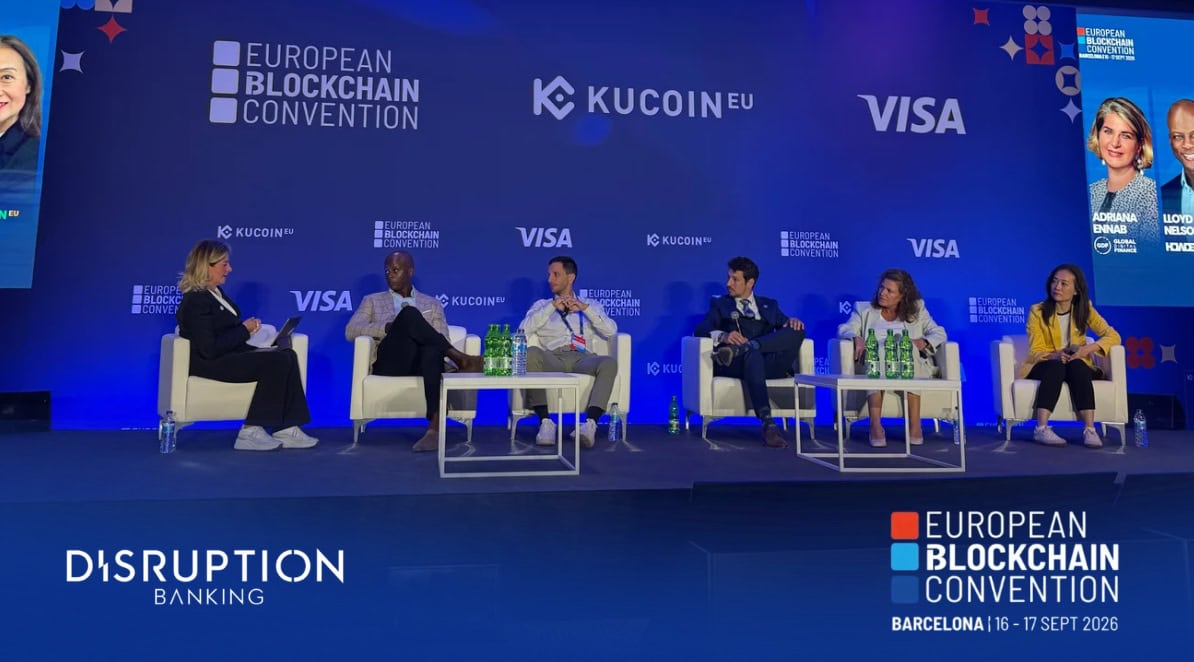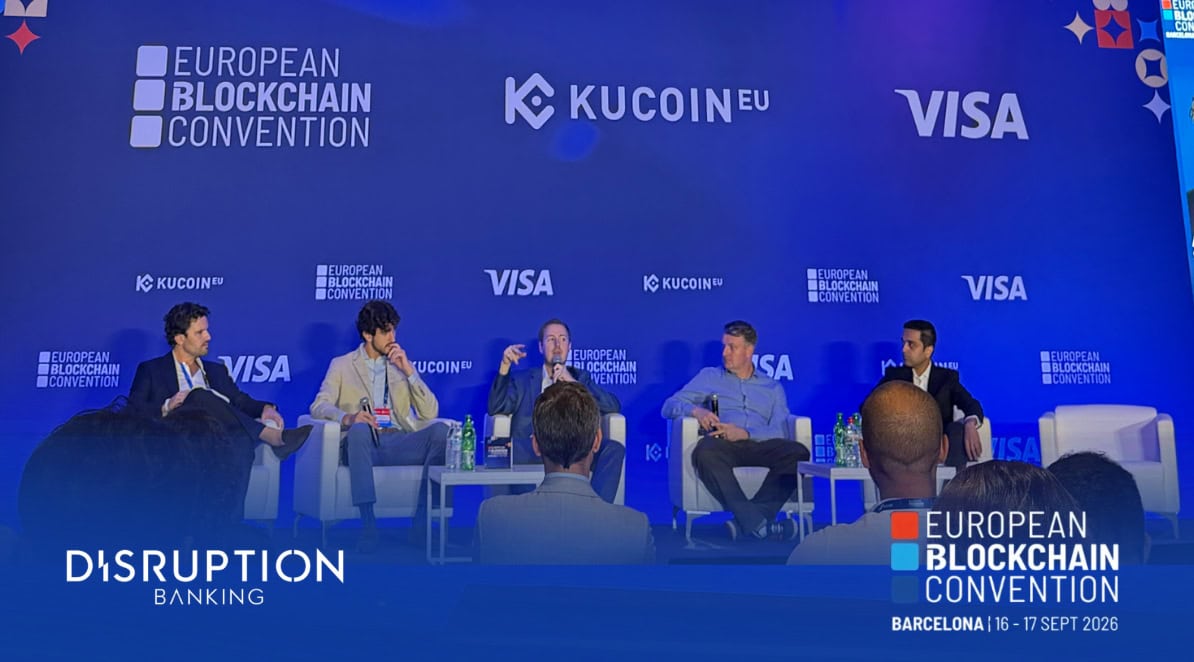
Day two of the European Blockchain Convention was another busy day for our editorial team. The KuCoin EU Main Stage had seen speakers talk about institutional adoption and tokenised assets in the morning. In the afternoon it turned to Stablecoins and FX Automation for a Multi-Currency World.
Aaron Sanchez, Director of Industry Engagement at the MiCA Crypto Alliance, moderated. On the panel were Jan-Oliver Sell, CEO of Qivalis, Gabriel Lera Campo, Digital Assets Specialist at BBVA, Immo Garlichs, Product Manager for Digital Assets and Currencies at Deutsche Bank, and Sudeep Mehta, COO of STBL.
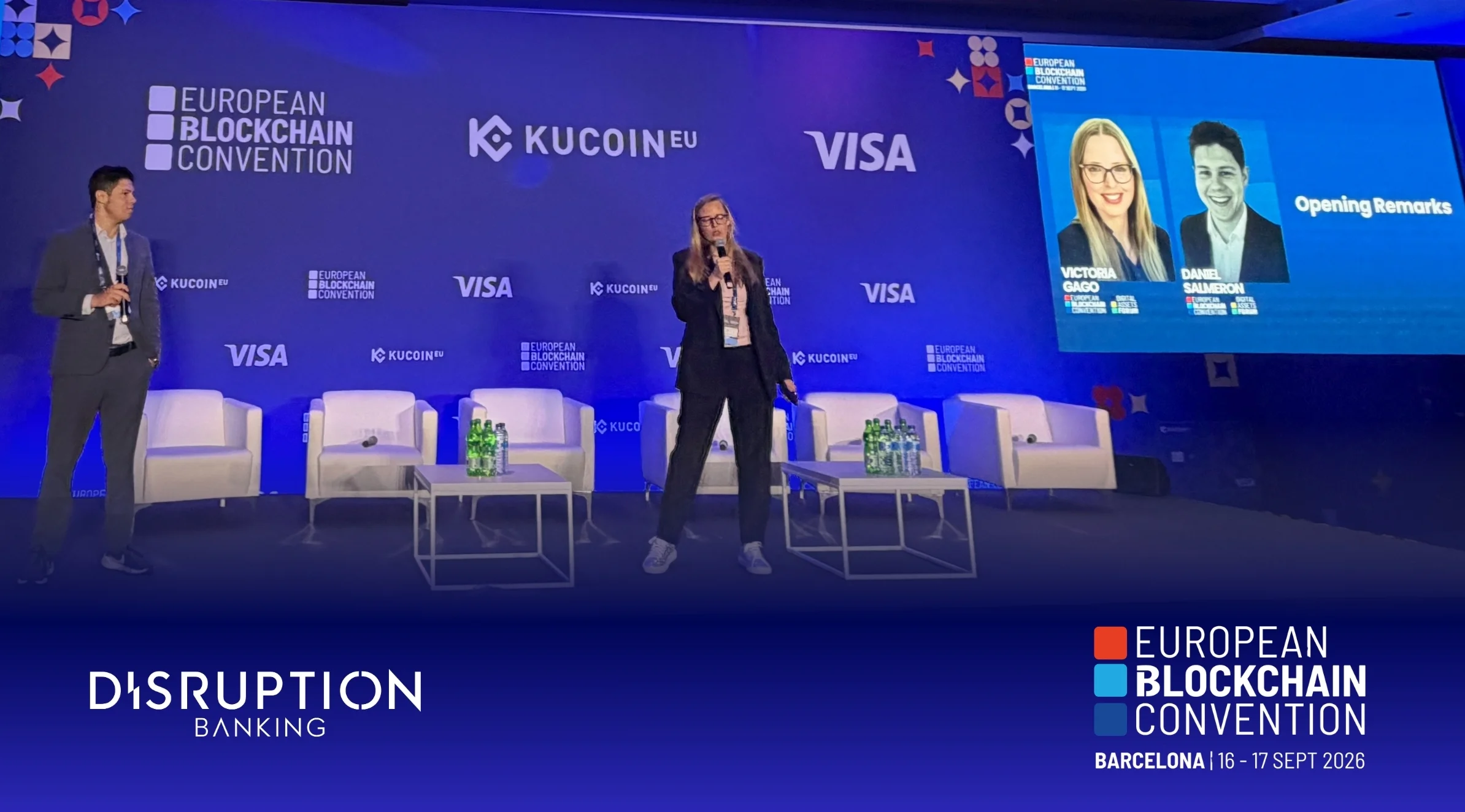
Victoria Gago, Co-CEO and Co-Founder of the EBC, had pointed at Qivalis from the opening on Wednesday, a euro stablecoin built by a group of European banks. Disruption Banking first wrote that joint venture last December and came back to it in June. Thursday was the first time that story sat on this stage next to two of the banks that would have to use it.
Stablecoins and FX Automation for a Multi-Currency World, on the main stage at EBC12.#EBC12 #Stablecoins @EBlockchainCon pic.twitter.com/yMwqhowaDe
— Digital Startup (@digitalstartup5) September 17, 2026
Thirty-Seven Banks, and a Launch This Year
Sell used his opening to put a number on the consortium and a date on the launch. He explained that Qivalis is “currently backed by 37 European banks and it is an open consortium, so that number will hopefully grow.” He continued that they’re “looking to put the euro on chain with institutional grade trust and liquidity to make it genuinely useful at scale.”
Qivalis is in an EMI licence application and Sell is “hoping to launch later on this year,” which still sits inside the second-half window already reported.
The point he kept making was that institutions now have a rulebook, but they still need a cash leg they can use. MiCA has given institutions enough comfort to look at blockchain processes, he said, “but they need a cash leg.” For now that means tokenised deposits or stablecoins.
Garlichs put Deutsche Bank’s own next step on the record. FX is the bank’s daily business, and stablecoins are “just a natural addition” to the payments book. Digital asset custody for corporate institutions goes live “in a couple of weeks.”
Africa, Collateral, and the Corridors That Still Take Days
Campo did not argue that a euro stablecoin should replace what already works inside the Union. European payment systems are efficient, he said, and they are still being improved. The flow he had heard about the day before, from a euro issuer, was coming from somewhere else.
“Most of the volume flows that they are seeing come from Africa, because Africans and African businesses are buying the euro stablecoin, sending it to Europe so that it exchanges for euros, and then a payment can be made.” That, he said, is where stablecoins belong. The corridors that are still slow.
Garlichs came at the same gap from the credit desk. When a client wants more volume and the money cannot be moved around the globe quickly enough, the cap cannot be raised. “It’s just a lack of collateral. Any sort of acceleration of collateral movement is always good for our business and also for our clients.”
The Dollar Still Does the FX
Sanchez asked what a multi-currency stablecoin market looks like in practice, and whether the coins swap with each other or still need a dollar line through the middle.
Sell said the long-run picture should look like the fiat map we already have. “A multi-currency stablecoin space will look very similar to today’s fiat space.” The euro is already the second reserve currency, with “probably 20-25% of cross-border payments” and “something like 30% of global bond issuances.” He wants that shape on-chain. Speed on its own is not the whole product. “You need to also then put the FX piece on chain because then you can really automate the entire cycle.”
Mehta was clearer about where the market is today. Most on-chain stablecoins are still dollars, and most of the volume is still trading, on-ramps and off-ramps. Payments at scale are what would pull the euro through. Campo did not expect a new rail to rearrange FX. “The dollar will keep on its importance.”
The Bank Still Picks the Rail
Underneath the currency is another choice. Stablecoin, tokenised deposit, or central bank money.
Garlichs said it depends on the client. A company with little cross-border flow will hand the invoice to the bank. Deutsche already has a product for that, FX for Cash: a home account in euro, an invoice, and the bank does the rest. Larger corporates want more control, and for some corridors a stablecoin can sit inside treasury. “They can take more control where they want to. But it’s really an important point that where they want to, they don’t have to.” On Deutsche’s own rails, “roughly 90% of the value is actually arriving even less than an hour.” The remaining 10 percent is the problem the panel was discussing.
Sell split the decision into use case, access and risk profile. A wholesale CBDC will not make a payment from Peru to Germany. “They’re all complementary.” In his version of the European stack, wholesale CBDC sits as a final settlement layer, stablecoins sit in the middle, and tokenised deposits sit alongside. A stablecoin is a bearer instrument. A tokenised deposit is not.
Campo did not want the end customer in that choice. Most people want an account-to-account payment and should not have to know whether it moved as an instant payment, through Swift, on a stablecoin or as a tokenised deposit. “Banks will keep on being the ones choosing how to do the payment.” The bank becomes a router, best execution for payments in the same way it already is for FX.
Custody First
Mehta put the blockers in this order. “The first is liquidity, followed by interoperability followed by distribution and then regulation.” Demand, he said, is already there.
Garlichs named the constraints that actually sit with a European bank. A MiCA-licensed firm inside the EU cannot trade a Korean won or Japanese yen stablecoin directly from the Union. There is also no standard way to put a stablecoin on a bank balance sheet, which “prevents adoption in the end.” A Fireblocks survey in April found that only about 15 percent of banks described their custody and wallet infrastructure as production-ready. Deutsche is about to join that smaller group.
Campo added capital treatment, because stablecoins are still not cash-equivalent, and a client base that is not about to run its own on-chain payments. Banks still create credit. He does not want that given away.
That is where the market is today. Qivalis still has 37 banks and a launch window this year. Deutsche Bank is about to switch on custody. A euro stablecoin has a case on the thin corridors. Most European banks still cannot hold the asset, and the dollar still does the FX.
Author: Grace Sharp
See Also:
European Blockchain Convention Kicks Off in Barcelona as Institutions Take the Floor
What Makes a Bank Say Yes to Tokenization, According to Cardano Foundation