A day after the Senate refused to take up the CLARITY Act, blame is still being assigned. Coinbase, Circle and bitcoin did not wait. Crypto sold off into and after the vote, and the exchanges that spent the year lobbying for the bill took the worst of it.
It was not a vote on the bill. It was cloture on the motion to proceed to H.R. 3633, the Digital Asset Market Clarity Act. The motion failed 49–50. It needed 60. Senator Chris Coons did not vote. No Democrat voted yes. Four Republicans did vote no: Susan Collins, Josh Hawley, Jerry Moran and Thom Tillis. Tillis switched to no so he could file a motion to reconsider. That is the only procedural path still open before the midterms.
The Provision That Sank It: Trump’s Crypto Ties
The bill didn’t die over market structure. It died over ethics and whose crypto profits the rules would touch.
Democrats wanted ethics language barring senior officials and their families from profiting from crypto ventures while in office, a direct reference to President Donald Trump’s holdings.
Republican leaders released fresh ethics wording on Sunday. State attorneys general could sue, and officials had to divest a significant crypto interest or put it in a blind trust. That was not enough. Democrats still wanted a forced sale of existing family ventures, not a trust, and rules that reached children and cabinet officials, not only spouses. Michigan Democrat Elissa Slotkin said plainly that she voted no because the ethics provisions were “too thin.”
The Democrat Who Whipped Yes, Then Voted No
The strangest twist came from Kirsten Gillibrand. The New York senator privately urged fellow Democrats to back the bill on Monday, then voted no herself the next day, according to Politico’s reporting. Her office didn’t explain the switch.
She wasn’t the only Democrat sending mixed signals. Angela Alsobrooks, who had earlier moved the bill through committee on the condition it carried strong ethics rules, said Democrats were “ready to strike a deal.” She then accused Republican leadership of shutting down talks in the final hours.
Both Sides Point Across the Aisle
Senator Ruben Gallego blamed Republicans for the loss, arguing they refused to cross the president rather than negotiate a bill with real ethical teeth. Republicans countered that Democrats moved the goalposts once a deal was near.
The White House didn’t hide its frustration. Crypto adviser Patrick Witt called the result a “major disappointment”.
Bitcoin Below $76,000 as Crypto Stocks Slide
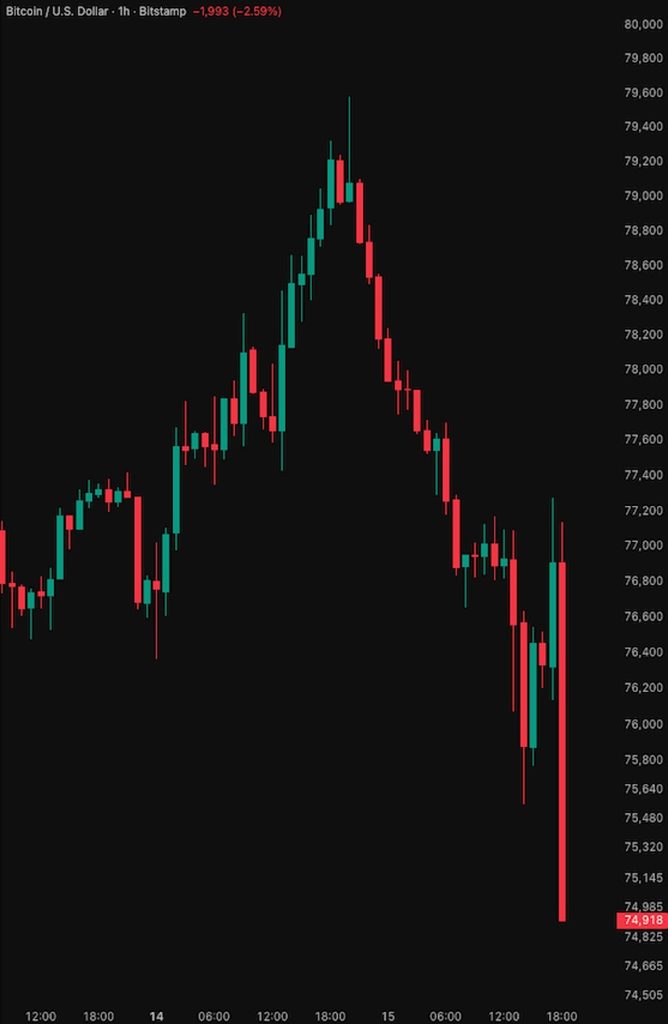
Traders didn’t wait for the blame game to settle. Bitcoin slipped to around $75,000, down roughly 4% on the day. The pain was sharper for the companies most closely tied to the bill’s fate: Coinbase shares fell about 10%, Circle dropped by more than 10%, and bitcoin-treasury firm Strategy slid around 5%.
Prediction markets including Polymarket had already cut the bill’s odds overnight, so much of the bad news was priced in before the gavel. What the sell-off really showed was how tightly crypto valuations are now bound to Washington; a single procedural vote knocked billions off the market in an afternoon.
The $189 Million Election Threat Hanging Over the Senate
The sector poured roughly $189 million into the 2026 election cycle by late June, according to watchdog group Public Citizen, already topping its 2024 spending with months still to run. Fairshake, the leading crypto super PAC, accounts for more than $82 million of that. Industry advocates framed Tuesday’s vote as a scorecard, a public record of who backed the sector and who didn’t, and signaled they’ll carry it into the campaign. For a chamber seven weeks from midterm season, that’s not an idle threat.
Meanwhile, the regulators keep moving without Congress. The SEC has pressed ahead on its own crypto rulebook, a reminder that the rules get written either way, just not by the senators who couldn’t agree on Tuesday. The bill can still come back. The bad blood it left behind will be harder to clear.
Author: Ayanfe Fakunle
The editorial team at #DisruptionBanking has taken all precautions to ensure that no persons or organizations have been adversely affected or offered any sort of financial advice in this article. This article is most definitely not financial advice.
See Also:
CLARITY Act Falls Short in the Senate, Stalling U.S. Crypto Rules for 2026 | Disruption Banking