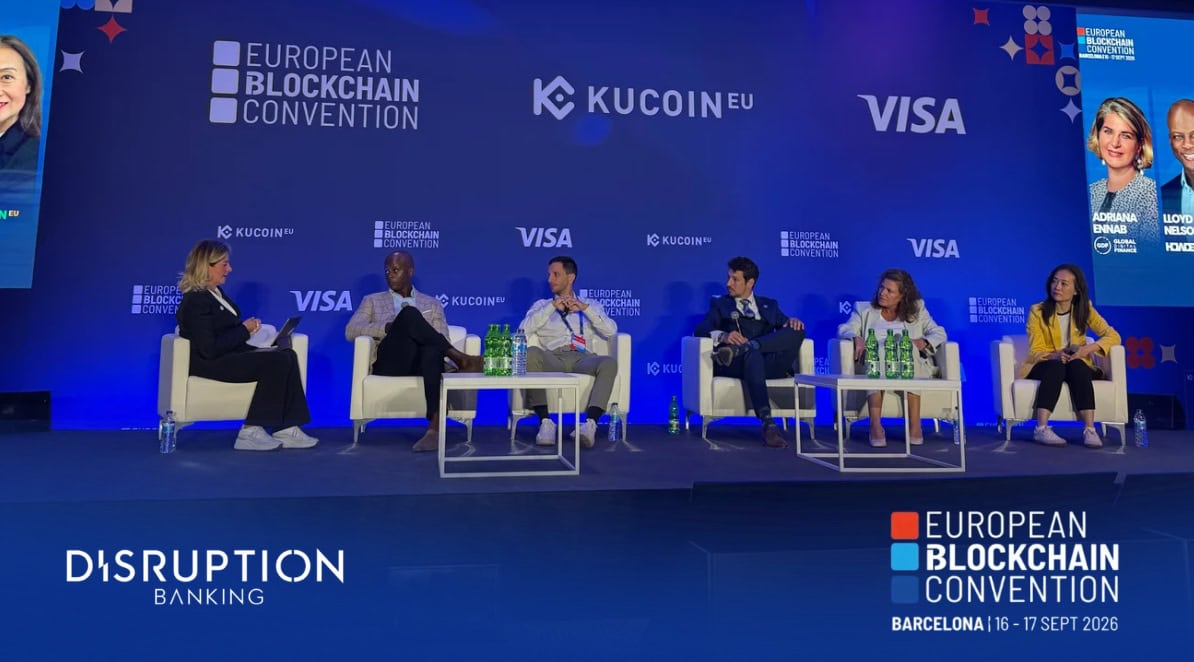
Unlike a lot of European crypto events, EBC12 in Barcelona is being sold as a marketplace for institutions. That is the room the Cardano Foundation was speaking into on Wednesday.
Frederik Gregaard, CEO of the Foundation, put the argument in one line on Wednesday afternoon on the KuCoin EU Main Stage.
“The leaders of the next decade will compete on the integrity of the entire digital ecosystem.”
The prize, he said, is not the next tokenized asset.
“I’m going to argue that the winner of the next boom in the blockchain economy is not who tokenizes the next asset. The winner is going to be those who build trust into the infrastructure by design.”
“The winner of the next boom in blockchain in economy is not who tokenizes the next asset. The winner is going to be those who build trust into the infrastructure by design.” Frederik Gregaard, CEO, Cardano Foundation, at EBC12, Barcelona.@F_Gregaard @Cardano_CF @EBlockchainCon pic.twitter.com/Fw8KaJkxIp
— #DisruptionBanking (@DisruptionBank) September 16, 2026
Sandro Knöpfel, Global Lead for Market Structure and Strategic Partnerships at the Cardano Foundation, took the same argument to the bank question. He spoke on Wednesday’s morning panel “What Makes a Financial Institution Say Yes to Tokenization?” and then sat down with Disruption Banking afterwards. Knöpfel explained that a bank does not say yes to a token, it says yes to something its clients will buy that still fits the plumbing it already runs.
Disruption Banking has covered the Foundation before, at the Point Zero Forum and at Digital Assets Forum in London in February. From there the conversation moved off the stage and onto what makes an institution sign.
What Makes a Bank Say Yes
Knöpfel wanted the bank question separated from the market-infrastructure question.
For a bank, the first test is whether a token sits inside the stack they already run. New plumbing is a cost a bank will only take if client demand pays for it.
“If they create the friction, that’s the last thing they want to have. Unless the demand is high enough and the investors are willing enough to pay the margin that they can cover the costs. So, at the end of the day, it must be commercially viable.”
The second test is a buy side. Early tokenization, he said, spent too long on assets that were technically interesting and had no product-market fit. Custody and insurance sat on top of that. The work now is on established assets, where blockchain lets an asset manager or a bank extend what they already offer clients.
His example was MembersCap, the Bermuda-regulated manager behind a reinsurance fund. Reinsurance risk is already accessible through instruments such as catastrophe bonds and insurance-linked securities, but access to specialist private reinsurance strategies has traditionally been concentrated among larger institutional investors. Through the tokenized structure, the minimum ticket is $50,000 for qualified investors. The fund targets in the region of 10 percent, with performance primarily driven by insured natural catastrophes rather than conventional financial-market or political developments. That gives the strategy low expected correlation with equities, commodities, cryptocurrencies and currencies, and thus the potential to provide portfolio diversification.
“If you just tokenize something for the sake of tokenization, it doesn’t help,” he said. When tokenization allows a bank to give eligible clients more efficient access to a specialist strategy that may not otherwise sit within its conventional product set, it becomes commercially relevant. For the risk-originating side, it can also provide an additional route to institutional capital and risk-transfer capacity. The fund was at the center of the first transaction on LSEG’s Digital Markets Infrastructure, one of the strongest examples yet of established market infrastructure moving into tokenized private markets. In parallel, FCA-regulated Archax facilitated the representation of fund interests on public blockchains, including Cardano.
That is the test. No buyers, no product. If there are buyers but no way to use the pipes the bank already runs, it gets complicated. Not impossible, he said. Complicated.
Why Market Infrastructure Is Slower
Financial market infrastructure, Knöpfel said, is not looking at the issuance moment. It is looking at rights and obligations after the trade. Dividends. General meetings. Tax. Reporting. Most of that still runs through the bank.
Where a token represents interest issued through a special purpose vehicle, the legal rights, authoritative ownership records and subsequent servicing must remain aligned with the on-chain representation. If corporate actions, tax, reporting and other lifecycle processes remain disconnected, the result can be another operational silo.
He pointed to the SEC no-action letter given to the DTC’s tokenization service last December as evidence of the US stepping further towards a controlled production environment. Europe, he said, is more complicated, and is trying not to lose the pace. That includes the bank-led euro stablecoin work being discussed at EBC this week. Private chains are still what most FMIs build. Then they have to work out how those chains talk to each other.
Cash at the end of the trade is still mostly fiat. That is why commercial banks are exploring tokenized deposits, while central banks are considering wholesale CBDC and other forms of tokenized central-bank money, and why so much of the live conversation has moved to stablecoins.
On the morning panel Knöpfel boiled that down to one word.
“I would summarize this as harmonization, across jurisdictions, technologies, and existing market silos. That’s the only way tokenization can move beyond individual use cases and achieve institutional scale.”
Mastercard, and Meeting in the Middle
On Tuesday, the Foundation joined Mastercard’s Crypto Partner Program. Knöpfel would not treat it as a live corridor. It is, he said, one of the places the industry has to sit down together.
“We need to have the established tradfi players such as Mastercard on the table as well because they can kind of guide these conversations and also help to identify the right working groups.”
Those groups are being defined now. He would not go into detail. The aim is that payments rails and public rails meet in the middle.
The piece both men would attach to that conversation is identifiers. Use what the current system already has. Legal Entity Identifiers are already widely used across the financial system. The next step is the verifiable LEI, or vLEI, rather than creating a new organizational identity standard for each blockchain.
That is the bank test. The infrastructure test is slower, and it is not only a European problem.
Putting the Accounts On-Chain
On Tuesday, the US Senate declined to take up the CLARITY Act. Without a shared framework, Gregaard said, you get islands. Technology does not respect borders. Institutional-grade trust, for him, is identity, accountability, auditability and cross-border assurance.
The longer-term opportunity is to move from periodic verification of selected records towards more continuously verifiable evidence. Blockchain does not replace the auditor or the underlying audit procedures, but it can give auditors and other stakeholders a tamper-evident record against which information and organizational authority can be independently verified.
The Foundation has demonstrated this by applying this approach to its own reporting. Grant Thornton Switzerland performed the independent audit, while the resulting audit attestation was anchored through Reeve and linked to verifiable organizational identifiers using vLEI. This makes it possible to verify the provenance and integrity of the evidence, including which identified entities issued and authorized it.
Gregaard said reinsurers are already refusing to cover banks for the loss of data. That cost now sits on the balance sheet.
“The future is called trust by architecture.”
The twelfth European Blockchain Convention runs September 16th and 17th. More from Barcelona to follow.
Author: Grace Sharp
See Also:
European Blockchain Convention Kicks Off in Barcelona as Institutions Take the Floor