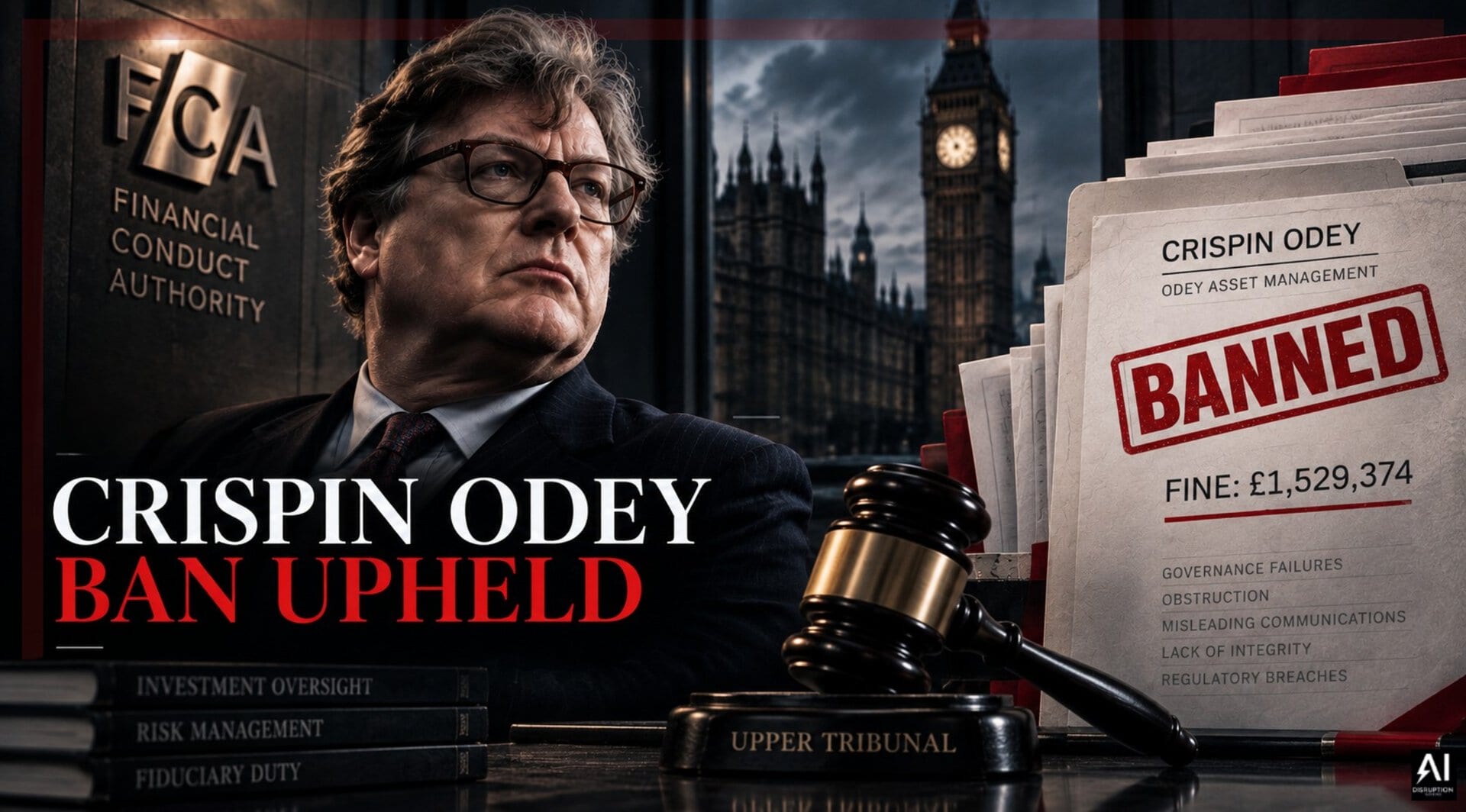
Crispin Odey’s challenge to his financial-services ban has failed. The Upper Tribunal (Tax and Chancery Chamber) upheld the prohibition and determined that his financial penalty should be £1,529,374, down from the £1,835,200 originally set by the Financial Conduct Authority (FCA).
The judgment is dated 10 September 2026. The FCA announced the outcome on 14 September. After a contested hearing, the tribunal upheld all five allegations of lack of integrity. The case centred on how Odey used his control of Odey Asset Management (OAM), the London firm he founded and which later wound down, to obstruct an internal disciplinary process, and what that did to the firm’s governance. The conduct assessed ran from 24 December 2021 to 17 November 2022.
Two Committees Removed
Odey, the firm’s founder and majority owner of OAM, faced allegations that he had breached a final written warning issued in February 2021 over repeated and persistent inappropriate behaviour towards female employees. On 24 December 2021, he removed the executive committee (ExCo) due to hear the case and appointed himself its sole member. He then postponed the hearing indefinitely, saying he could not conduct it impartially.
The FCA previously reported that Odey appointed replacement committee members on 12 January 2022, then removed them on 31 March after further disagreement over the proceedings. He remained alone on ExCo until appointing two new members on 4 July. The disciplinary hearing eventually took place on 29 November 2022. That third committee did not dismiss him, but the tribunal found that the later outcome did not justify the earlier removals.
What the Tribunal Rejected
Odey argued that the earlier committees could not give him a fair hearing and that his dismissal could threaten the firm’s survival. The Tribunal rejected those justifications. It found that he had bullied and threatened executive directors and acted to protect himself from accountability. His concerns about fairness and the business did not provide a reasonable basis for removing those charged with deciding his case.
The tribunal also found that Odey showed no insight into why his conduct lacked integrity, expressed no contrition and wrongly regarded himself as the victim. It found his evidence lacked credibility in multiple respects. “Mr Odey clearly thought he could act with impunity,” said Therese Chambers, the FCA’s executive director of enforcement and market oversight, per the FCA’s September 14 press release. The tribunal’s task was to decide the governance and integrity issues; it did not need to determine the truth of every underlying sexual-misconduct complaint.
What the Communications Concealed
The findings also covered Odey’s dealings with OAM, its clients, investors and the FCA. A letter to clients and a statement dated 12 January 2022 presented the management changes without revealing the disciplinary dispute behind them. The tribunal found that these communications concealed the circumstances of the first committee’s removal. It also upheld findings concerning false assertions to the FCA and threatening behaviour towards its staff.
The FCA’s March 2025 decision notice recorded a commercial consequence: OAM had to notify investors of operational risks and stopped marketing its funds to new investors in June 2022. The notice also identified a failure to complete Odey’s annual assessment as fit and proper to perform his fund-management role. His obstruction of the disciplinary process had interfered with a separate regulatory requirement governing whether he could continue doing that job.
OAM announced in October 2023 that it would wind down. Its funds were moved to other managers.
That gives allocators a concrete distinction to make when a manager announces leadership changes. A routine succession announcement and the removal of people exercising oversight can have very different implications for investment control.
The Fine and the Ban
The fine was cut because the tribunal removed the FCA’s 20% uplift for aggravating factors. It recognised some cooperation and remediation, including the appointment of replacement committees, and sought to avoid counting the same factors twice. The starting figure was £764,687, calculated as 30% of his £2,548,957 relevant income. It kept a separate doubling for deterrence: £764,687 became £1,529,374. Against the original proposed penalty, that is a reduction of £305,826, or about 16.7%.
The prohibition under section 56 of the Financial Services and Markets Act 2000 covers functions connected with regulated activities conducted by authorised or exempt persons, or exempt professional firms. The financial penalty falls under section 66. The FCA’s announcement does not state whether it has been paid.
Who Controlled Portfolio Risk?
The governance failures reached directly into investment oversight. The tribunal found that Odey’s appointment as sole ExCo member compromised the required separation between portfolio management and risk management. He remained a portfolio manager while holding ultimate authority over risk, including the power to override the risk committee.
For allocators, the specific issue is who can require a portfolio change when the manager disagrees. At OAM, the tribunal found that ExCo alone could force a portfolio manager to reduce risk. During the periods when Odey occupied it alone, that authority rested with Odey himself.
Author: Richardson Chinonyerem
The editorial team at #DisruptionBanking has taken all precautions to ensure that no persons or organisations have been adversely affected or offered any sort of financial advice in this article. This article is most definitely not financial advice.
See Also:
Will investors harmed by Woodford successfully sue Hargreaves Lansdown? | Disruption Banking