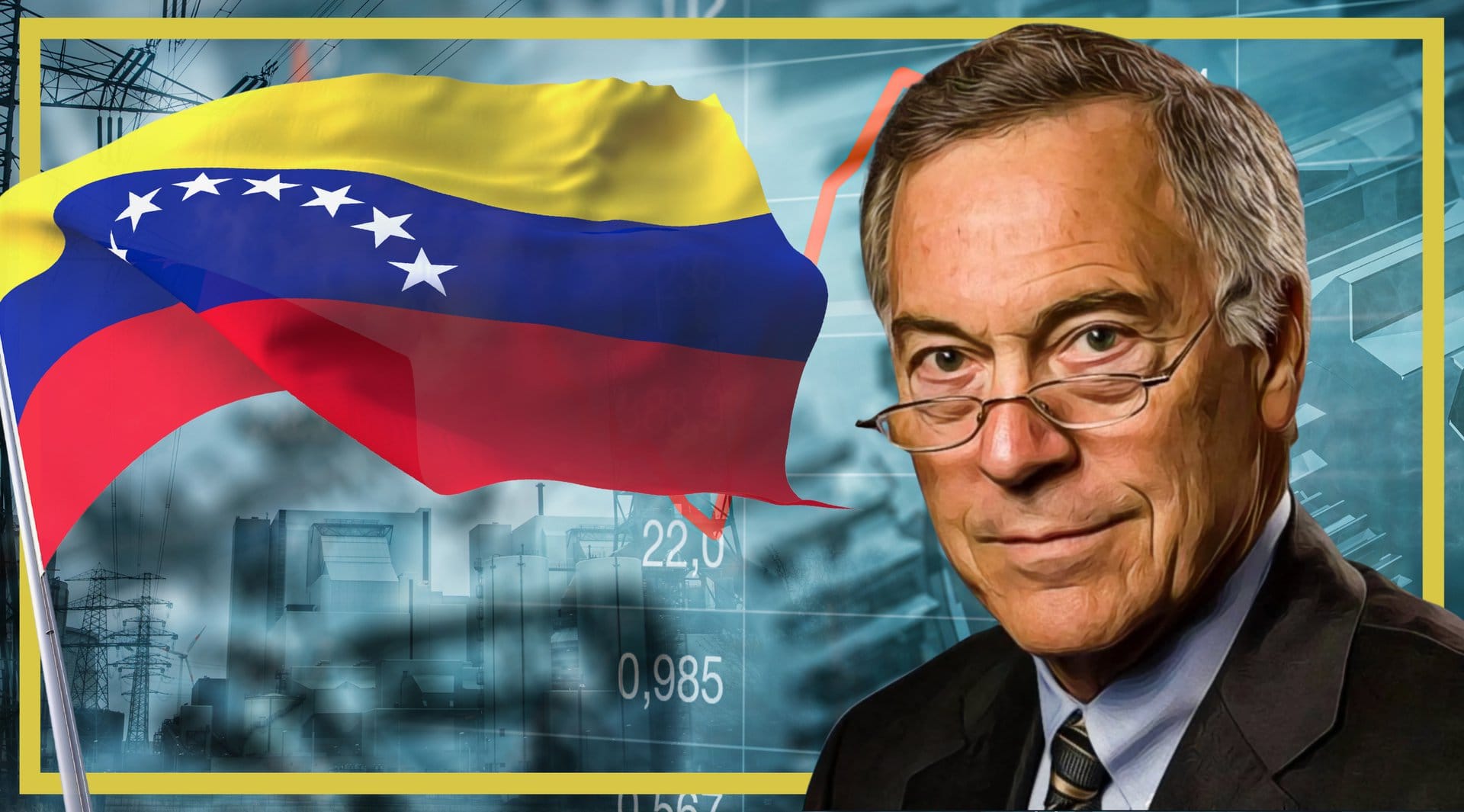
Steve Hanke, the Johns Hopkins University economist who has engineered dollarizations and currency boards on four continents, has been named Special Adviser on Economic, Monetary, and Energy Affairs to a leader in Venezuela’s National Assembly.
His assignment was to draft a law that would abolish the bolívar, shut down the Central Bank of Venezuela (BCV), and make the U.S. dollar the country’s sole legal tender. Hanke told Fortune he puts the odds of passage at 50% to 80%, the best chance sound money has had in Venezuela in three decades.
The BCV’s own data shows annual inflation at 617.9% as of February, roughly 400% by Hanke’s measure, which he says is the worst in the world. The bolívar has lost 78% of its value against the dollar over the past year. If the switch happens, it would be, in Hanke’s words, “the biggest switch from domestic currencies to an alternative since the introduction of the euro in 1999.”
The Bolívar Is Already a Ghost Currency
Venezuelans dumped bolívares en masse after the currency collapsed in 2019, and the government was forced to allow full convertibility into dollars. Shop prices are posted in greenbacks.
Payments flow in physical dollars or in Tether (USDT), the stablecoin that dominates remittances and accounted for the bulk of $17.9 billion in retail crypto volume in the first quarter of 2026, according to TRM Labs. Hanke calls it “spontaneous dollarization”, a referendum conducted through wallets, not ballots. The radical part of his plan is that much of it has already happened without legislation.
A Minimum Wage Worth Twenty-Seven Cents
The catch is that roughly 7 million public employees and pensioners still get paid in bolívares. The legal minimum wage has been frozen at 130 bolívares a month since March 2022, worth about $0.27 today.
Acting President Delcy Rodríguez raised the “integral minimum income” to $240 a month in May 2026, but the increase came entirely through non-salary bonuses that do not count toward pensions or severance. These workers receive bolívares, watch them lose value, and scramble to convert. Formal dollarization would end that cycle by tying every income stream to the greenback.
What Happens When You Actually Kill a Currency?
Hanke is not theorising because he has done this before: in Montenegro in 1999, Ecuador in 2000, and Zimbabwe in 2009, and the results offer both a blueprint and a warning.
Ecuador: Inflation From 31% to 3%
Ecuador’s record is the one Hanke cites most. Before dollarization, annual inflation averaged 31.4% from 1975 to 1999. Afterward, it fell to 3.4% over 2000–2024.
Poverty dropped from 64% of the population to 21% by 2025. The minimum wage, now denominated in a currency that held its value, climbed from $56.70 to $536.60. Wages could no longer be diluted by the printing press.
Argentina and Zimbabwe: When the Surgery Is Reversed
In Argentina, President Javier Milei campaigned on a peso-to-dollar platform in 2023 and then abandoned the idea in office; inflation still exceeds 30% a year.
In Zimbabwe, dollarization disappeared when the unity government fell in 2013, and triple-digit price growth returned, a demonstration that monetary stability is only as durable as the political commitment behind it.
A country that dollarizes surrenders seigniorage, the revenue earned from issuing its own money, and the ability to act as lender of last resort to its banking system. Critics argue those tools are essential in a crisis. Hanke argues the crisis is what happens when you keep them.
No Stable Money, No Oil Revival, No Debt Deal
Venezuela’s other crises loop back to the currency. Oil production reached 1.1 million barrels per day in July 2026, up from a nadir of 337,000 bpd in June 2020, but still a third of the pre-Chávez peak of 3.4 million in 1998.
The country sits on the world’s largest proved crude reserves, roughly 304 billion barrels, yet extracts just 0.2% of them each year.
At that depletion rate, it would take 350 years to exhaust half the supply. ExxonMobil (ticker: XOM) CEO Darren Woods has called Venezuela “uninvestible,” citing a history of expropriation. No major company has committed new capital to revive the country’s devastated petroleum infrastructure.
The $170 Billion Workout
The government in May launched a restructuring of roughly $150 billion to $170 billion in sovereign and Petróleos de Venezuela (PDVSA) debt, the first structured attempt to resolve a default running since 2017, with Centerview Partners appointed as financial adviser.
Hanke argues neither the oil investment nor the debt resolution can proceed while inflation runs at quadruple digits. “Stability isn’t everything,” he told Fortune. “But without stability, which means stable prices, you have nothing.”
Can the Money Doctor Succeed Where He Failed 30 Years Ago?
This is Hanke’s second attempt at monetary surgery in Venezuela. In 1995–96, he designed a currency board as chief economic adviser to President Rafael Caldera, a plan Disruption Banking covered in 2023.
Hanke believes conditions have shifted: surveys show most Venezuelans want the dollar, Nicolás Maduro is gone after the January 2026 U.S. raid, and the groundwork for a debt deal is being laid. He is working on the bill alongside Antonio Ecarri, an Assembly member and former presidential candidate who founded the centrist Lápiz party.
There has been immediate institutional pushback. National Assembly President Jorge Rodríguez has rejected any official hiring of Hanke, branded the dollarization proposal “stupidity,” opened an investigation into Ecarri, and removed him from the chairmanship of the Venezuela–U.S. parliamentary friendship group.
Whether a 29-million-person petrostate will actually abolish its central bank and hand monetary sovereignty to the U.S. Federal Reserve remains the open question. Ecuador, with 18 million people and a far smaller economy, found the switch wrenching. Venezuela’s would be the largest dollarization in history by GDP, population, and debt load, attempted in the middle of the most complex sovereign restructuring the world has ever seen.
Author: Demilola Esebame
See Also:
US should scrap Venezuela sanctions regardless of 2024 elections: Steve Hanke | Disruption Banking