


Armenia has built the foundations of a serious fintech market. The country now has more than 200 fintech companies, around $164 million in startup funding, and nearly $20 billion flowing through card payments. Local payment companies are expanding, banks are investing in digital services, and regulators are testing open banking, blockchain and digital identity.
The problem is adoption. Much of the growth remains concentrated in Yerevan, while cash still dominates everyday payments for many households outside the capital. Armenia’s fintech sector is moving quickly. Its population is catching up far more slowly. That divide starts with the scale of the market itself.
200+ Fintechs, $164M in Funding and ~$20B in Card Payments
Armenia now has over 200 fintech companies operating across payments, lending, wealth management, insurtech and regtech. Industry reports, including coverage from the Caucasus Business Journal (CBJ), put startup activity growth at 22.8% in 2025, with total funding of around $164 million.
Armenia’s card payments more than doubled from $9.3 billion (3.7 trillion drams) in 2024 to over $19.7 billion (7.5 trillion drams) by early 2026. This rapid growth was driven by online shopping and new laws, making cashless transactions the top choice with 62% of the country’s total transaction volume. The sector is no longer operating at the margins of the economy.
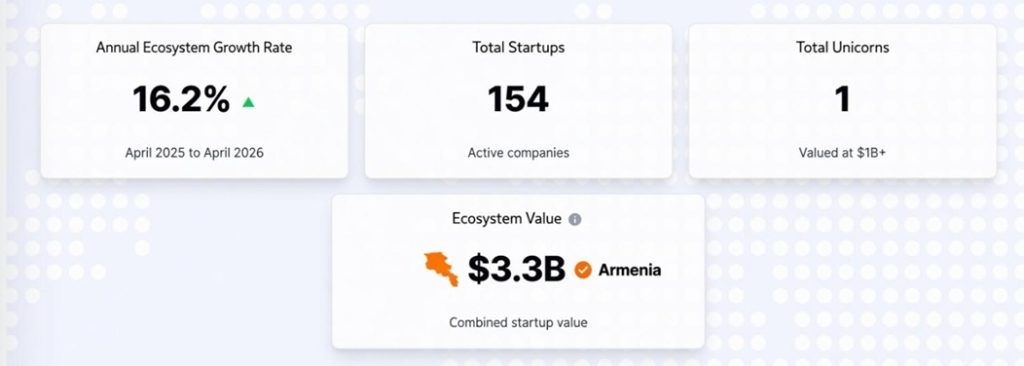
Those indicators align with Armenia’s strong showing in the StartupBlink Global Startup Ecosystem Index. StartupBlink’s latest snapshot, published this July, counts 154 startups in the ecosystem and records 16.2% growth year-on-year (YoY). According to Global Startup Ecosystem Index 2026, Armenia now ranks 55th globally, down one spot from its prior position, and 13th in Eastern Europe, holding the same regional standing as in 2025, behind Croatia and ahead of Slovenia.
That growth is not abstract. A small group of payment companies, banks and sandbox participants is carrying much of it.
Idram, TelCell and Sandbox Players Drive Armenia’s Fintech Activity
Idram dominates Armenia’s digital payments with over 90% QR market share, more than 25,000 payment points, and over 1.5 million users. It handles e-wallets, bill payments, and transfers, and has expanded via Alipay+ for cross-border QR and Bybit Pay for crypto-linked transactions.
Local competitors TelCell and EasyPay, alongside digital offerings from IDBank and Ameriabank, also drive card and contactless growth. Global fintechs such as Wise and Revolut are increasingly used by Armenians for international transfers, remittances, and multi-currency accounts, adding competitive pressure especially in diaspora-linked flows.
Several fintechs and banks are testing open banking, blockchain, and digital identity solutions in the CBA’s regulatory sandbox, with CBDC pilot testing expected within the next one to two years. Lending and insurtech activity is emerging through players like Cognaize and other startups focused on alternative credit and embedded insurance.
Despite this progress, most innovation and usage remains concentrated in Yerevan, leaving cash dominant for everyday transactions in the regions and underscoring the gap between fintech infrastructure and broad population adoption.
A $3.3B Startup Ecosystem Still Leaves 39% Without Digital Payments
The Armenian ecosystem is anchored by one unicorn, Picsart, and remains heavily concentrated in Yerevan, where most of the country’s startups are based per the StartupBlink’s report. The platform estimates the combined value of Armenia’s startup ecosystem at $3.3 billion. For a relatively small market, that is a meaningful regional footprint. The inclusion data show slower growth.
ServiceTitan shows why Armenia’s startup numbers require careful reading. Founded by Armenian-American entrepreneurs Ara Mahdessian and Vahe Kuzoyan, the Nasdaq-listed trades-software company calls itself the first Armenian-founded tech unicorn. However, its SEC filings identify ServiceTitan as a Delaware-incorporated, California-headquartered company whose Yerevan subsidiary mainly provides research, development and support. Its payment-processing tools make it fintech-adjacent, but it is stronger evidence of Armenia’s diaspora-linked engineering base than of domestic fintech adoption.
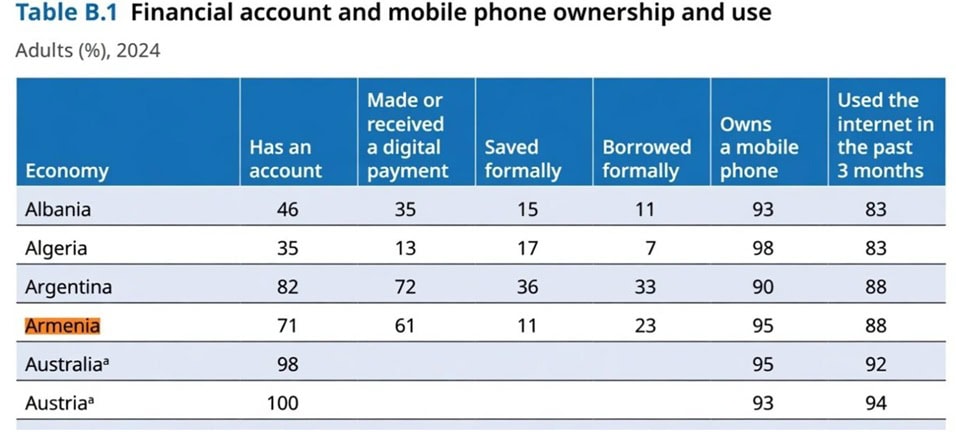
Figures from the World Bank Global Findex Database 2025 (based on 2024 survey data) show that 60.58% of adults made or received a digital payment, up from 47.47% in 2021. Account ownership reached 71.37%, while 43.71% reported using a debit card.
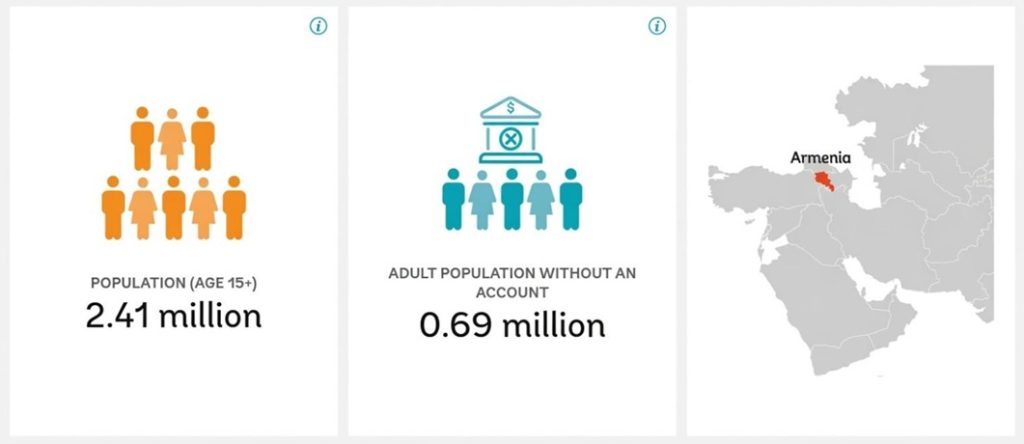
The same data shows that 690,000 adults, out of 2.41 million (aged 15+ years), still had no financial account at all. This leaves roughly 39% of adults without a recorded digital payment in the reference period. Armenia may have built a valuable fintech ecosystem, but a large part of its population still operates outside its regular use.
The national average also conceals a sharper divide between Yerevan and the rest of the country.
Cash Still Dominates Outside Yerevan Despite Armenia’s Digital Push
The adoption gap is most visible outside the capital. A Central Bank of Armenia (CBA) survey found that 59% of rural residents and 53% of people in secondary cities relied exclusively on cash, compared with 33% in Yerevan. While 52% owned a cashless payment instrument, more than 74% still used cash every day. For everyday purchases, 46% of Yerevan residents used at least one cashless payment method, versus just 21% elsewhere.
Among cash-only users, 77% blamed habit or limited knowledge rather than missing infrastructure. The challenge is no longer access. It is changing behaviour. That pattern is reflected in newer data. The CBA’s 2025 Financial Capability Survey found that 89.2% of adults knew at least one digital finance tool, yet only 52.4% actively used Armenian digital payment platforms. Even the central bank’s pensioner cashback programme delivered only temporary gains. As the CBA concluded, while incentives increased card payments, “their ability to generate lasting shifts remains limited.”
Armenia has largely built the payment rails. Getting people to use them consistently remains the harder task. That makes access to credit and targeted development finance more immediate than another payment application.
EBRD’s €50 Million Risk-Sharing Deal Targets SME Credit Gap in Armenia
Development banks have directed attention to the credit constraints that keep many firms outside formal finance in Armenia. The more immediate inclusion tool is credit risk-sharing. In May, the European Bank for Reconstruction and Development (EBRD) signed a €50 million unfunded portfolio risk-sharing agreement with Acba Bank, absorbing up to half the credit risk on newly issued business loans. Inside it sits a €4.5 million EU-backed guarantee under the European Fund for Sustainable Development Plus (EFSD+) programme, aimed at SME lending risk.
The logic is simple: when a development bank agrees to take half the losses, a local bank can say yes to borrowers it would normally refuse, like a smaller manufacturer, regional retailer or first-time formal borrower. Acba is expected to mobilise up to twice the facility’s value.
“We remain firmly committed to fostering the growth and sustainability of private businesses by improving access to finance for small and medium-sized enterprises – an essential driver of Armenia’s economic development,” said Francis Malige, the EBRD’s managing director for financial institutions.
The EBRD invested a record €426 million in Armenia across 26 projects in 2025, a second straight record after €396 million in 2024. “The year 2025 marked the beginning of a new strategic chapter in our partnership with Armenia,” George Akhalkatsi, the bank’s head of Armenia, added.
The agreement is much larger than a startup grant or pilot programme. Yet even €50 million remains modest beside a national adoption gap affecting hundreds of thousands of adults.
Two-Speed Fintech, or a Country Catching Up?
None of Armenia’s fintech growth is fake, and none of the inclusion gap is exaggerated. Both are true at once because they describe two different markets: one built for regional investors, diaspora capital, and companies that can operate from anywhere. The other is built for a population that still mostly pays in cash. Right now, the first market has the upper hand.
Whether that changes depends less on the next funding round than on whether programmes like the Acba guarantee and She’s Next scale up instead of staying boutique. A sandbox and a good ranking can make a country look like a fintech hub. Getting most of a population to actually use one is slower, far less photogenic, and it’s the part Armenia hasn’t finished yet.
Author: Richardson Chinonyerem
The editorial team at #DisruptionBanking has taken all precautions to ensure that no persons or organisations have been adversely affected or offered any sort of financial advice in this article. This article is most definitely not financial advice.
See Also:
Why Does Armenia Pay 3.4% to the IMF but 5% to the World Bank | Disruption Banking