
Citi’s third-quarter results on October 13 showed investment banking revenue up 9% to $1.35bn. Equity capital markets drove the gain with 77% growth, while advisory revenue slipped 4% to $406m and debt capital markets fell 3%. Goldman Sachs, by contrast, posted record advisory revenue of $1.65bn, up 18%. The same day the shares fell about 3.5% despite the earnings beat.
The contrast is useful just over a year after Vis Raghavan brought in two senior JPMorgan M&A bankers as co-heads. Activity in equity and debt markets has improved, while advisory has not matched that progress.
This is the sixth piece in a series on the bankers who run Wall Street’s largest M&A teams. Previous pieces covered Tom Miles at Morgan Stanley, Stephan Feldgoise at Goldman Sachs, Anu Aiyengar at JP Morgan, Andrew Woeber at Barclays and Robert Leitão at Rothschild & Co. This one looks at Vis Raghavan and the rebuild of Citi’s advisory franchise.
Capital markets carry the results
Citi held its fifth-place ranking in investment banking fees for the first nine months of the year. Equity underwriting rose 77% on follow-on offerings and convertibles. On the earnings call, management said the bank was on 17 of the top 25 investment-grade deals and led the dollar portion of SoftBank’s record high-yield bond.
That SoftBank transaction was one of the largest high-yield corporate bond sales on record. In September SoftBank raised the equivalent of $11.1bn across dollar and euro notes to help fund its OpenAI commitment, with coupons reaching 9.75% on the longest dollar tranche. Demand was strong enough that the company could price at or below the bottom of initial guidance ranges in several tranches.
The banking division produced $378m of net income in the quarter, for a return on tangible common equity of 19.2%. Year to date the figure is 17.7%. In the first half of 2026, investment banking revenue was up 31% and advisory up 7%, so the third-quarter advisory dip followed a stronger first half. Jane Fraser, answering a question on the pipeline, said: “Look, I think you should feel pretty good about the pipeline. It’s a solid pipeline, to say the least. US is the center of the action for both advisory and capital markets.” She added that private equity sponsors remain quieter as they sit on aged assets, though engagement for M&A and IPOs continues.
The JPMorgan hires
In June 2025 Citi hired Drago Rajkovic, JPMorgan’s global chairman of M&A focused on technology, as global co-head of M&A, reporting to Raghavan. In August it added Guillermo Baygual, also from JPMorgan, as the other co-head. Baygual spent more than 25 years at JPMorgan, most recently as global co-head of its infrastructure and strategic investors group. Both started in September 2025, with Baygual in London and Rajkovic splitting time between New York and San Francisco. Kevin Cox moved to global chair of M&A.
The hires are part of a broader effort under Raghavan to lift Citi’s market share in the advisory business. The bank has advised on Charter Communications’ acquisition of Cox Communications and Sycamore Partners’ deal to take Walgreens Boots Alliance private.
Regional activity has also been stronger. Citi’s ASEAN investment banking revenue is up 35% year-on-year, the bank has been involved in nearly $20bn of regional M&A, and it has helped clients raise nearly $25bn from global capital markets, according to figures the bank shared citing Dealogic.
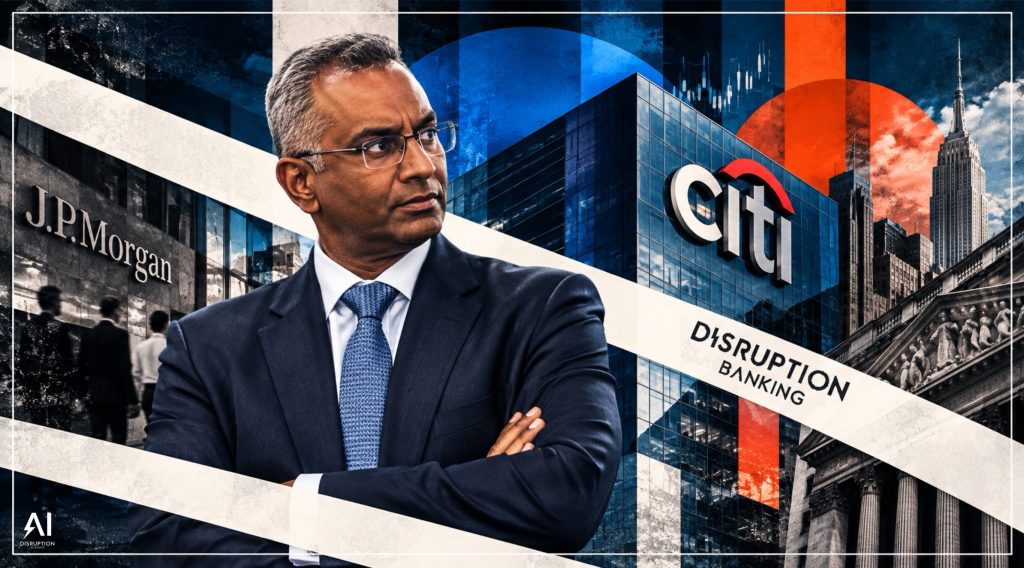
Raghavan himself is head of banking, overseeing corporate, commercial and investment banking across nearly 100 markets. Margo Pilic, Citi’s head of strategy, M&A and investor relations, handles the bank’s own corporate development and investor communications. That is an internal role, separate from the client-facing M&A advisory business run by the co-heads.
The package and the background
Raghavan joined Citi in 2024 from JPMorgan, where he had been global co-head of investment banking since 2020, with a background in equity and debt capital markets. In 2024 his compensation was $22.6m. He also received a make-whole package of roughly $52m, of which about $39.4m was deferred equity, to replace awards forfeited on leaving JPMorgan. Those awards continue to vest through 2031. His 2025 total compensation was $25m. The board noted a significant increase in revenues and investment banking fees while expenses stayed controlled.
The capital markets background is relevant this quarter. The results grew fastest in the business Raghavan knows best. At an investor day earlier this year he pointed to share gains across products and geographies, including M&A, and described the pipeline as strong, though those comments pre-dated the third-quarter advisory results.
What the quarter still shows
Investment banking fees fell 13% from the second quarter, the largest quarter-on-quarter decline among the banks reporting this quarter. Several analysts lowered price targets. Most of Citi’s banking growth came from equity markets, not from the M&A franchise the JPMorgan hires were brought in to build.
There are two questions that remain unanswered. Whether advisory catches up with capital markets in 2027 as the co-heads complete their first full year of mandates. And whether Citi can move up from fifth in investment banking against Goldman and JPMorgan. The SoftBank role and the first-half advisory gain show the franchise can execute large capital-markets and selective M&A work. However, the third-quarter advisory result shows the rebuild is still incomplete.
Author: Tejas Bansal
See Also:
Who Holds CoreWeave’s Secured Debt, and Who Holds the Notes | Disruption Banking
Who Is Anu Aiyengar? The First Woman to Run M&A on Wall Street | Disruption Banking
The 7 Biggest Capital Markets Disruptors of 2026 (So Far) | Disruption Banking