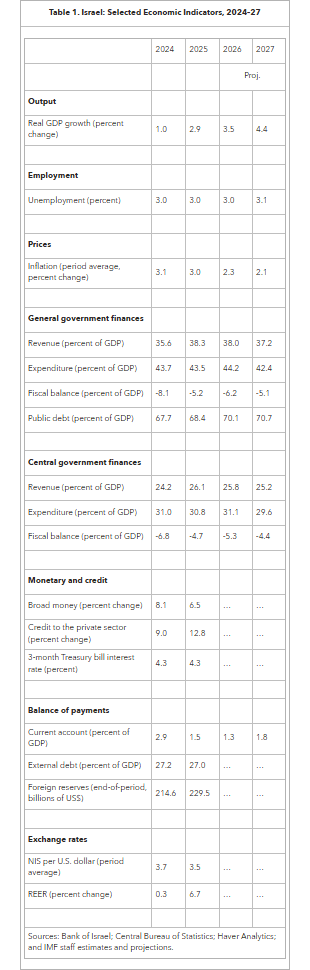
- The elevated regional tensions are casting a shadow on Israel’s economy. Growth forecasts for 2026 have been revised down to 3.5 percent from 4.8 percent before the war in the Middle East, while inflation is expected to rise temporarily due to higher energy prices and supply constraints despite shekel appreciation.
- The conflicts’ economic repercussions and longstanding labor market challenges weigh on the medium-term outlook.
- With medium-term growth challenges looming, key priorities include rebuilding fiscal buffers, raising labor supply and productivity, and ensuring price and financial stability
Washington, DC – July 1, 2026: The Executive Board of the International Monetary Fund (IMF) completed the Article IV Consultation for Israel on June 24, 2026.[1]
The elevated regional tensions are casting a shadow on Israel’s economy. Growth forecasts for 2026 have been revised down to 3.5 percent from 4.8 percent before the war in the Middle East, reflecting a sharp contraction in the first quarter followed by a modest rebound over the remainder of the year. Inflation is expected to rise temporarily in the near term, due to higher energy prices and supply constraints despite shekel appreciation. Risks to the growth outlook are tilted to the downside and the inflation outlook to the upside, with deeper and more prolonged regional conflicts remaining the key concern.
Amid ongoing hostilities in the Middle East, defense expenditure is expected to remain high, and labor supply constrained by military mobilization and reduced availability of non-Israeli workers. These pressures would compound longstanding structural challenges—such as persistently low labor-market participation among certain groups—and weigh on Israel’s medium-term economic outlook.
Executive Board Assessment[2]
The Executive Directors welcomed that the economy has shown resilience, despite repeated shocks. Directors, however, noted that elevated regional geopolitical uncertainty and long-standing structural impediments are expected to weigh on the outlook. Furthermore, renewed intensification of regional tensions remains a key downside risk. Accordingly, Directors emphasized the need to implement prudent policies to safeguard macroeconomic stability and advance structural reforms to boost growth potential.
Directors welcomed the authorities’ commitment to fiscal discipline and emphasized that gradual, credible fiscal consolidation is important to rebuild buffers and stabilize public debt. Noting the elevated defense spending and already low levels of civil spending, Directors considered that fiscal adjustment should rely primarily on revenue measures and efforts to enhance spending efficiency. They highlighted that a comprehensive review of the tax system, including tax expenditures, would help improve its simplicity, efficiency, and equity.
Directors welcomed the authorities’ efforts to bring inflation back to the target range. They agreed that a moderately tight, data-dependent monetary policy stance remains appropriate to safeguard price stability, given inflationary pressures arising from higher energy prices and supply shocks. Directors highlighted that financial sector systemic risks appear contained and that banks remain well-capitalized, liquid, and profitable. Nonetheless, they emphasized the need for continued vigilance, particularly with respect to banks’ real estate exposures. Directors recommended continued strengthening of stress testing frameworks, extending borrower-based measures to nonbank financial institutions, and careful implementation of Basel III requirements. While welcoming recent reforms to strengthen the BOI’s resolution powers, they advised further progress on enhancing the crisis management framework. Directors also encouraged continued efforts to strengthen the AML/CFT framework.
Directors stressed that advancing structural reforms is critical to boost potential growth and support fiscal sustainability. While welcoming recent progress, they underscored the need to address persistent gaps in labor force participation and skills, particularly among fast-growing population groups. Directors welcomed progress in trade reforms and called for further efforts to improve product markets and infrastructure. They emphasized the importance of ensuring an adequate and sufficiently skilled labor supply to maintain the competitive edge in high-tech, including AI. Strengthening active labor market policies to facilitate reskilling and labor mobility is also important.
[1] Under Article IV of the IMF’s Articles of Agreement, the IMF holds bilateral discussions with members, usually every year. A staff team visits the country, collects economic and financial information, and discusses with officials the country’s economic developments and policies. On return to headquarters, the staff prepares a report, which forms the basis for discussion by the Executive Board.
[2] At the conclusion of the discussion, the Managing Director, as Chair of the Board, summarizes the views of Executive Directors, and this summary is transmitted to the country’s authorities. An explanation of any qualifiers used in summings up can be found here: http://www.IMF.org/external/np/sec/misc/qualifiers.htm.
See also:
IMF Executive Board Concludes 2026 Article IV Consultation with Luxembourg | Disruption Banking
IMF Executive Board Concludes 2026 Article IV Consultation with Ireland | Disruption Banking