

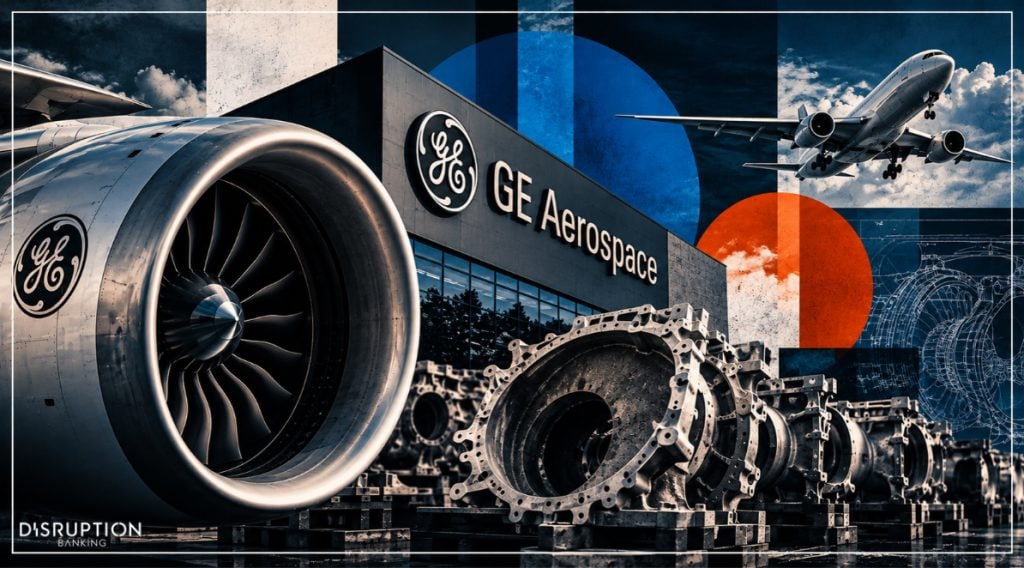
GE Aerospace used its third-quarter results call on October 20 to address the vertical-integration question raised by its largest deal since the 2024 breakup of General Electric. Chief executive Larry Culp said the planned $11.75bn acquisition of castings maker Consolidated Precision Products (CPP) was intended to build capacity “for ourselves and for others”, adding: “We have no intention of being a captive provider.”
CPP supplies not only GE but also Pratt & Whitney, Honeywell and Lockheed Martin. An engine maker buying a supplier on which its rivals depend is the sort of transaction competition authorities examine closely. Culp’s remark is the company’s first direct public response to that concern.
The $11.75bn acquisition
GE Aerospace agreed on September 8 to buy Cleveland-based CPP from private-equity firms Warburg Pincus and Berkshire Partners. Berkshire Partners is a Boston buyout firm and is not connected to Berkshire Hathaway, owner of Precision Castparts, one of CPP’s main competitors.
CPP employs about 6,600 people across more than 20 facilities and has supplied GE for over fifteen years. Roughly 60% of its revenue comes from commercial aerospace, with the balance from defence, power and other markets. Closing is expected in the second half of 2027, subject to regulatory approval. It is GE Aerospace’s largest acquisition since the 2024 split of the former General Electric into three separately listed companies.
How the deal is structured
Evercore and PJT Partners are GE’s lead financial advisers, with Paul, Weiss, Rifkind, Wharton & Garrison LLP as legal counsel. Morgan Stanley and Guggenheim Securities advise CPP, with Cleary Gottlieb as counsel.
The price values CPP at about 18 times expected 2027 EBITDA including synergies, or about 26 times without them. GE is paying $7bn in cash and funding the remainder with new debt. It held $9.35bn of cash and equivalents on June 30, so the cash portion uses most of that balance and leaves limited dry powder for other large outlays in the near term.
Why castings capacity is worth $11.75bn
Castings have been one of the tightest bottlenecks in aerospace since air travel recovered after the pandemic. Complex, high-temperature components for engines cannot be scaled quickly; lead times have stretched and quality issues have constrained output across the industry. GE’s order book illustrates the pressure: third-quarter orders rose 49% to $19.0bn. Commercial services backlog now exceeds $170bn. Culp described the CPP agreement as part of “continuing to invest in our customers’ needs.”
Defence is the smaller but growing portion of the business. Orders in GE’s defence and propulsion unit rose 18% in the quarter. The company’s quarterly filing cites governments’ focus on modernising and scaling their forces as a driver of demand. CPP’s European operations include sites in Poland, Belgium and Slovakia, giving the combined group a broader footprint for both commercial and defence programmes.
What Culp has said
On the results call Culp said: “We have no intention of being a captive provider.”
In the results release he added: “We’re continuing to invest in our customers’ needs with our agreement to acquire CPP to expand capacity, and over $3 billion in annual R&D to advance current and future technologies.”
At the deal announcement he stated: “Investing in mission-critical casting capacity is needed to support the strong simultaneous demand across commercial engines, aftermarket and defense.”
Strong results, weaker cash
The quarter itself beat expectations. Adjusted EPS rose 36% to $2.25, operating profit rose 30% to $3.0bn, and GE raised full-year adjusted EPS guidance to $8.00–$8.10 from $7.65–$7.85. The shares nevertheless fell almost 4% on the day.
Free cash flow declined 14% to $2.0bn, which management attributed to working-capital timing. GE9X programme losses are expected to total about $300m as production of the engine ramps through 2027. Higher oil prices linked to the conflict in Iran added to concern about airline demand. Commercial services, GE’s most profitable line, grew 17% in the quarter, against 32% in the first half.
GE is committing $7bn of cash to CPP in a quarter when its own cash generation moved backwards, leaving less flexibility if engine-programme costs or working-capital needs continue to absorb cash into 2027.
What happens next
Two questions remain. Whether regulators accept Culp’s assurance or require binding supply commitments to rival engine makers before the deal closes in 2027. And whether paying roughly 26 times earnings for supply security proves cheaper than waiting for capacity GE does not own. The first of those questions will determine whether the deal can close on the terms GE has described.
Author: Tejas Bansal
See Also:
AI or Defence? $13.1B Battle Redefines ETFs | Disruption Banking