
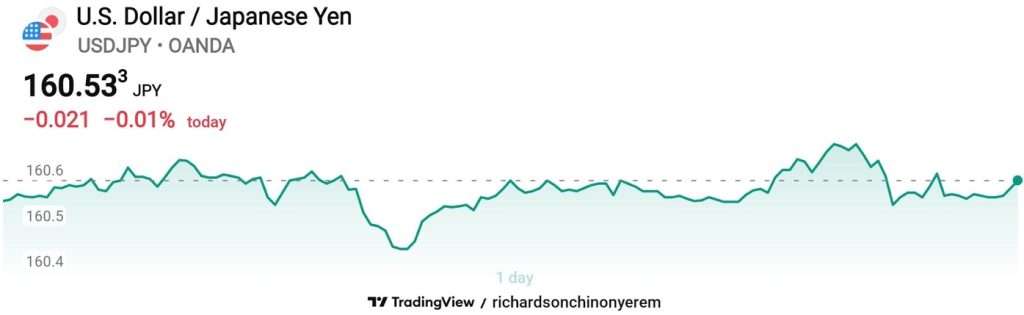
The Japanese yen (JPY) is often cited as one of the world’s most reliable safe-haven currencies, a port in a storm that investors flock to when markets fall apart. Yet, as of the time of writing, USD/JPY is trading around 160 (TradingView), close to its weakest levels in decades, even as geopolitical risk from the U.S.–Iran conflict remains high. Tokyo has been forced into billion-dollar FX interventions to prevent the yen from sliding further. Something has changed. The question is how much.
What Makes a Currency a Safe Haven?
The ECB says safe-haven currencies “offer refuge to investors during periods of market stress.” The research it cites, and earlier ECB work, points to the same building blocks: market liquidity, institutional stability, strong external balance sheets, and, for some currencies, a role in global funding markets. Japan historically ticked those boxes.
The Ministry of Finance says Japan’s net international investment position reached 561.75 trillion yen at end-2025, while Reuters reported a record current-account surplus in 2024. For years, large overseas assets, deep domestic savings, and ultra-low rates gave the yen structural haven support.
Why the Yen Became a Safe Haven: Net Foreign Assets, Repatriation Flows, and the Carry Trade
Japan’s credentials are layered. The country holds the world’s largest net foreign asset position, the product of decades of current-account surpluses and outward investment by Japanese corporations and households. When global stress hits, those overseas assets are often sold and the proceeds repatriated, generating automatic yen demand.
As DisruptionBanking has previously examined, Japan’s massive domestic savings base and low interest rates have made the yen a preferred funding currency for the carry trade, where investors borrow cheaply in yen to buy higher-yielding assets elsewhere. In a crisis, those positions unwind rapidly, forcing investors to buy yen back and driving the currency sharply higher.
BCA Research analysts described the yen carry trade as “a ticking time bomb”, warning that the strategy is vulnerable to a massive unwind akin to those seen in 2008, 2015, and 2020. Similarly, as one of our analyses of the carry trade unwind illustrated, the carry trade has grown into “financial dark matter”: invisible until it moves, and then capable of shaking every asset class simultaneously. In other words, the yen’s safe-haven logic is partly about Japan’s strength and partly about global investors’ exposed leverage.
Why USD/JPY At 160 Is Forcing Investors to Rethink the Yen
Three forces have eroded the yen’s haven credentials, planting doubts in investors.
First, Japan’s interest rates remain far below those of the United States. The Bank of Japan (BOJ) held its policy rate at 0.75% through April 2026, while Bloomberg reports that officials are now considering a hike to 1% at the June 15-16 meeting. Even at 1%, the rate gap with U.S. borrowing costs leaves the yen an attractive funding currency, not a yield destination. That differential keeps structural yen-selling alive.
Second, Japan imports more than 95% of its oil from the Middle East, with almost all of it passing through the Strait of Hormuz. The conflict in Iran and the de facto closure of the strait have kept energy prices elevated, widening Japan’s trade deficit. Koya Miyamae, a senior economist at SMBC Nikko Securities Inc., warned that a protracted closure of the Strait of Hormuz could balloon Japan’s trade deficit to around 15 trillion yen ($93.6B) in fiscal 2026. This potential shortfall is largely driven by soaring crude oil prices and a weakened yen, which makes essential energy imports significantly more expensive.
Third, the scale of foreign exchange (FX) intervention has exposed the limits of a defence without rate support. Japan’s Ministry of Finance deployed a record 11.7 trillion yen ($73B+) in FX operations in the April–May 2026 period alone, following an earlier effort estimated at over $64 billion. DisruptionBanking’s earlier coverage in May noted that despite the 10-week yen spike those operations produced, the currency repeatedly failed to hold gains below the 155 level against the dollar.
Swiss Franc vs Yen vs Dollar: Which Safe Haven is Working in 2026?
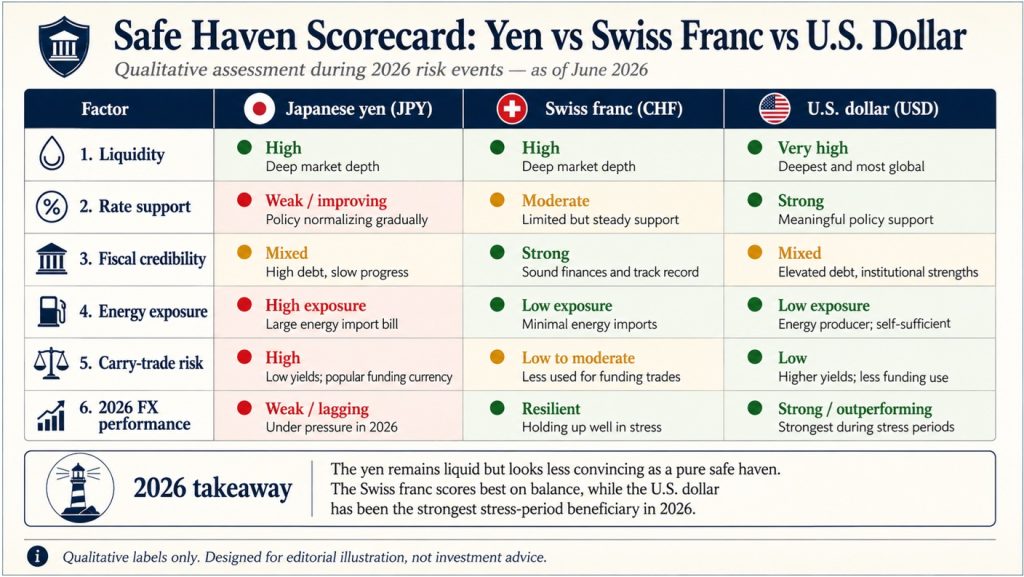
The yen now competes in a three-way haven contest, but it is not winning. Lee Hardman, currency analyst at Japanese bank, MUFG, said the safe-haven appeal of both the yen and the dollar had been “undermined” by recent turbulence, adding that “Over the long-term the Swiss franc has proven to be the best store of value among other G10 currencies including the JPY and USD.”
Head of FX and Commodity Research at Commerzbank, Thu Lan Nguyen, was more direct, calling the franc “the ultimate safe haven among currencies at present”, citing the erosion of the dollar’s status from White House policy unpredictability and of the yen’s status from “growing fiscal concerns.” Over 2025, the franc gained almost 13% against the dollar and has continued strengthening into 2026.
Crucially, performance is shock-specific. As an analysis in 2026 summarised, the franc tends to outperform during European or Middle Eastern stress, while the yen is more responsive to global deleveraging events like a U.S. recession or a broad equity collapse. The current Iran-driven energy shock, which directly damages Japan’s import bill, favours the franc over the yen as a tactical refuge.
What Could Rescue the Japanese Yen Before the End of 2026? What Investors Should Watch Next
The key variables are:
- The outcome of the June 15-16 BOJ meeting;
- The pace of U.S.–Japan rate spread compression;
- Oil prices and any Strait of Hormuz developments;
- Japanese government bond yields, which have risen sharply and reflect both inflation and fiscal unease;
- CFTC speculative positioning data for yen shorts;
- Japan’s monthly current-account releases;
- The Ministry of Finance’s FX intervention data.
Consensus targets for USD/JPY by year-end 2026 cluster around 146–150, implying meaningful yen appreciation from the current 160 level, but that view depends heavily on the BOJ delivering further hikes, U.S. yields declining, and energy prices stabilising.
Citi analysts have said the yen is unlikely to weaken far beyond 160, a level that prompted intervention in May, while ING observed: “The yen will approach the 160 level once more, but there will likely be a struggle between the market and the authorities near the 159 mark.”
At this point, investors should stop asking “Is the yen a safe haven?” and start asking “safe haven against what?” Watch USD/JPY around 160, the BOJ decision on June 15-16, 10-year JGB yields near 2.7%, U.S.-Japan rate spreads, Brent crude around $93, and CFTC positioning. The answer in 2026 depends less on history and more on the type of shock hitting markets next.
Author: Richardson Chinonyerem
The editorial team at #DisruptionBanking has taken all precautions to ensure that no persons or organisations have been adversely affected or offered any sort of financial advice in this article. This article is most definitely not financial advice.
See Also:
How Strong Will The Japanese Yen (JPY) Be In 2025? | Disruption Banking
How Strong Will the Japanese Yen (JPY) Be In 2026? | Disruption Banking
Japan Yen Carry Trade Unwind: Could It Trigger the Next Market Crash? | Disruption Banking