

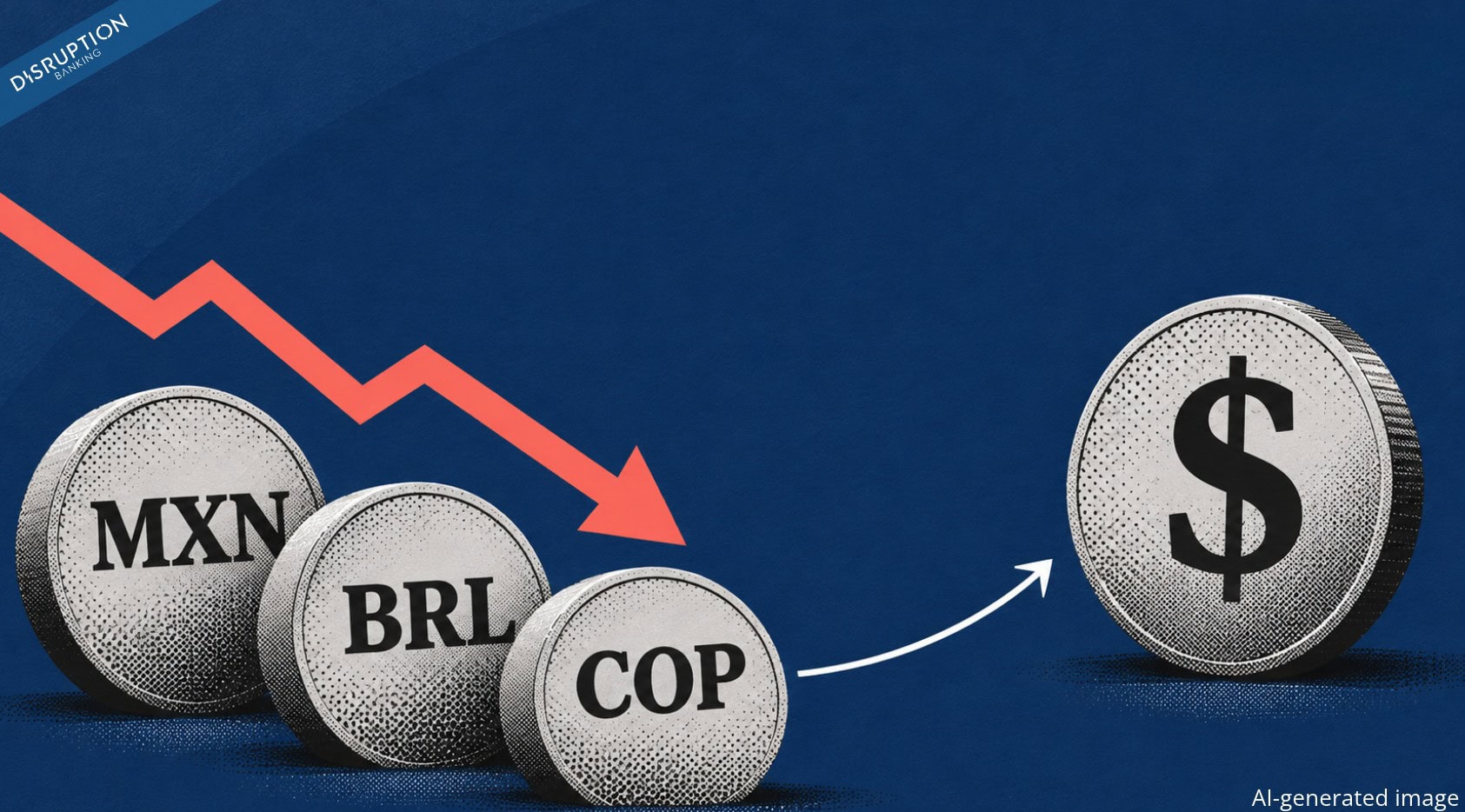
ING said in its November 25 FX Daily note that lingering uncertainty over the US tech rout, Federal Reserve tightening and fresh tariff risks are driving a full unwind of risk-seeking trades, with emerging-market currencies particularly exposed.
“The investment environment remains hostile,” wrote Chris Turner, ING’s global head of markets. The bank expects EM currencies to remain on the back foot, with further pressure possible if today’s core US PCE inflation print comes in hot.
The damage is already visible in the performance tables. Latin American currencies have occupied four of the five worst-performing spots since November 10. The Colombian peso, previously one of the market’s favored high-yielding carry trades, has fallen close to 10% over that period, reversing earlier gains supported by oil and fiscal consolidation.
What Pressures are Acting on EM Currencies?
The pressure on EM currencies stems from a classic risk-off combination that simultaneously lifts the dollar and reduces appetite for higher-yielding or growth-sensitive assets.
When US rates are expected to rise and global growth risks increase, investors typically cut positions in currencies that depend on carry, commodity exports or external financing. Higher US yields make dollar assets more attractive on a relative basis while tariff and growth concerns weigh on export earnings and terms of trade for many emerging economies. The result is both a stronger dollar and direct selling in EMFX.
Several forces are driving the current unwind. First, Fed Governor Chris Waller floated the possibility of a 50 basis point rate hike on November 10, helping trigger a broader correction in risk assets. Ongoing uncertainty around the US tech and AI story has encouraged a further retreat from risk assets, amplifying the move out of EMFX.
Sticky and broadening inflation has kept the market focused on further tightening rather than cuts, supporting the dollar and compressing the interest-rate advantage that many EM currencies had previously enjoyed.
According to reports, the US administration is preparing new tariffs following Section 301 investigations into excess manufacturing capacity. ING expects duties of around 5–10% on manufactured exports from China, the EU and 14 other partners.
Fresh tariff risks add to global growth headwinds and hurt industrial commodities. Copper, the standout, has fallen below $12,000 per metric tonne. Lower commodity prices directly pressure the currencies of metals and energy exporters while reinforcing the broader risk-off tone.
Which Currencies Have Been Most Affected?
Latin American currencies have borne the brunt because they combine high yields, commodity exposure and, in some cases, domestic vulnerabilities.
The Colombian peso’s sharp reversal reflects the unwind of a crowded carry trade once global risk appetite faded.
Brazil’s real has been undermined by fiscal concerns surrounding re-elected President Lula; a brief rally on news of extra fiscal consolidation on November 24 quickly faded because the proposed spending cuts were modest and the global EMFX sell-off dominated.
Chile’s peso has been hit by the copper rout, while Mexico’s peso is left exposed by Banxico’s rate cuts, which have narrowed its yield advantage at a time when the dollar is firm.
ING remains reasonably constructive on the Brazilian and Chilean currencies into next year but cautious on the Mexican peso, noting that Banxico may implicitly welcome a weaker currency and that recovery could be slow.
European emerging-market currencies have not escaped the broader backdrop. In central Europe, the Polish zloty and Hungarian forint are likely to wait for an improvement in the global environment before staging a sustained recovery.
Local rate differentials offer only limited support in the absence of clearer hawkish signals from their central banks; ING expects Poland’s National Bank of Poland to hold rates steady until the first quarter of next year.
For the Czech koruna, the bank sees EUR/CZK capped near 24.450 in the near term, with any rebound dependent on the Czech National Bank maintaining a hawkish tone amid rising inflation.
What Does ING Expect Going Forward?
Looking ahead, ING expects a continued preference for a defensive basket of dollars, yen and Swiss francs. The dollar may not turn lower until the second quarter of next year.
It said that near-term resistance in the dollar index around 104.60 can be tested unless US inflation surprises on the downside; the index closed at 103.81 on November 24
Today’s October core PCE print is in focus, with ING looking for a 0.3% month-on-month reading that would confirm inflation is still heading the wrong way.
Separately, S&P is due to announce its decision on France’s sovereign rating on the evening of November 27. The current A+ rating with a stable outlook is at risk of a shift to negative, adding a modest risk premium to the euro.
A hot PCE reading would reinforce the case for further Fed tightening and keep the defensive bias intact, while any downside surprise could offer only temporary relief to EMFX given the still-elevated tariff uncertainty.
Author: Scott Danaher
See Also:
How Strong Will The Mexican Peso (MXN) Be in 2027? | Disruption Banking
Why Japan’s Monetary Policy is Failing to Lift the Yen | Disruption Banking