

Argentine sovereign bonds sold off sharply on November 20, driving the country’s risk premium above 1,000 basis points for the first time in more than a year.
The move has opened a clear hole in Economy Minister Luis Caputo’s plan to cover large 2027 dollar debt payments without returning to international capital markets.
Global bonds issued under New York law fell more than 3% in places, while local-law Bonares dropped by as much as 2.8%. Over-the-counter sovereign bonds declined an average of roughly 5.6%, according to reports, with selling hitting both dollar- and peso-denominated paper.
The JPMorgan EMBI spread (which tracks the yield that investors demand for holding U.S. dollar-denominated emerging-market bonds) jumped as much as 135 basis points to around 1,070 bp, its highest level since October 2025. Dollar-denominated debt prices have fallen about 18% so far in 2026.
Markets are pricing in political risk ahead of the October 2027 election, and that pricing is now feeding on itself.
Markets Price Higher Political Risk Ahead of the 2027 Election
Country risk traded near 400 bp in July, when Caputo presented his financing programme. It has since more than doubled.
Investors are assigning a higher probability to a competitive 2027 presidential race in which a government less committed to the current fiscal path and debt-repayment strategy could take office. Longer-dated bonds have been hit hardest.
President Javier Milei’s approval has fallen from above 40% in January to the mid-30s. Most analysts say Argentina entered a technical recession in the third quarter of 2026 after activity contracted and real incomes remained under pressure from earlier austerity. The stalled recovery has reinforced the political premium already visible in bond prices.
Friday’s drop also occurred against a broader global risk-off backdrop. Wall Street weakness and a weaker Brazilian real weighed on emerging-market assets, and Argentine bonds underperformed most peers.
Domestically, investors exited local-currency positions for dollar coverage. The wholesale dollar reached a new nominal high near 1,580 pesos and the blue-chip swap gap widened.
Caputo’s July Financing Programme
Luis Caputo, a former Wall Street banker who served as finance minister and central bank president under Mauricio Macri, has been the public face of the administration’s market-oriented strategy.
He has repeatedly argued that Argentina can meet its obligations without returning to global capital markets at punitive rates. His July programme was presented as evidence that sufficient sources had already been lined up ahead of the election year.
The Treasury’s hard-currency needs for 2027 were estimated at roughly $24.9 billion: about $15.7 billion in principal and $9.2 billion in interest.
The plan avoids new international bond issuance. It instead draws on three main groups of resources to cover the 2027 wall. Fiscal and reserve sources include a carry-over surplus of about $3.7 billion from 2026 and roughly $4.9 billion in dollar purchases from the central bank. Domestic market measures add about $5 billion in new local-law dollar bond issuance in 2027 plus privatizations of roughly $1.5 billion. Official and public-sector channels supply the rest through multilateral disbursements from the IMF and other lenders, bilateral loans and public-sector rollovers.
Interest payments were expected to be covered by the fiscal surplus. At the time, with spreads near their lows, the local-issuance component looked realistic.
Higher Borrowing Rates Stall the Plan and Open a Financing Hole
As spreads widened, investors demanded yields as high as 17% on local-law dollar bonds.
The government halted fresh issuance of those instruments in August, removing a key planned source of dollars. That has opened a financing gap that private estimates put at roughly $10 billion against the private-bondholder portion of 2027 payments. Some consultancies project shortfalls of $16–20 billion under more cautious assumptions.
The subsequent rise in yields has made Caputo’s original local-issuance assumption untenable at rates the government is willing to accept. Greater reliance may now fall on central bank reserves or additional multilateral support at a moment when political uncertainty is rising.
Bonds Enter a Vicious Cycle
The widening gap has fed further selling. The higher the cost of refinancing, the less confident investors become that the plan can be executed, which pushes bond prices lower still.
Markets are now testing whether the austerity programme has created enough credibility and dollar resources to navigate the 2027 debt wall without a further sharp increase in borrowing costs.
Milei’s platform centred on rapid fiscal adjustment. The administration has cut public spending sharply, eliminated subsidies and maintained primary surpluses even as the economy slowed. Caputo’s financing plan sat within that framework.
By avoiding new external borrowing at high rates and relying on the fiscal surplus, local issuance and multilateral support, the government sought to show that austerity had restored access to cheaper financing and reduced rollover risk. The recent sell-off challenges that narrative.
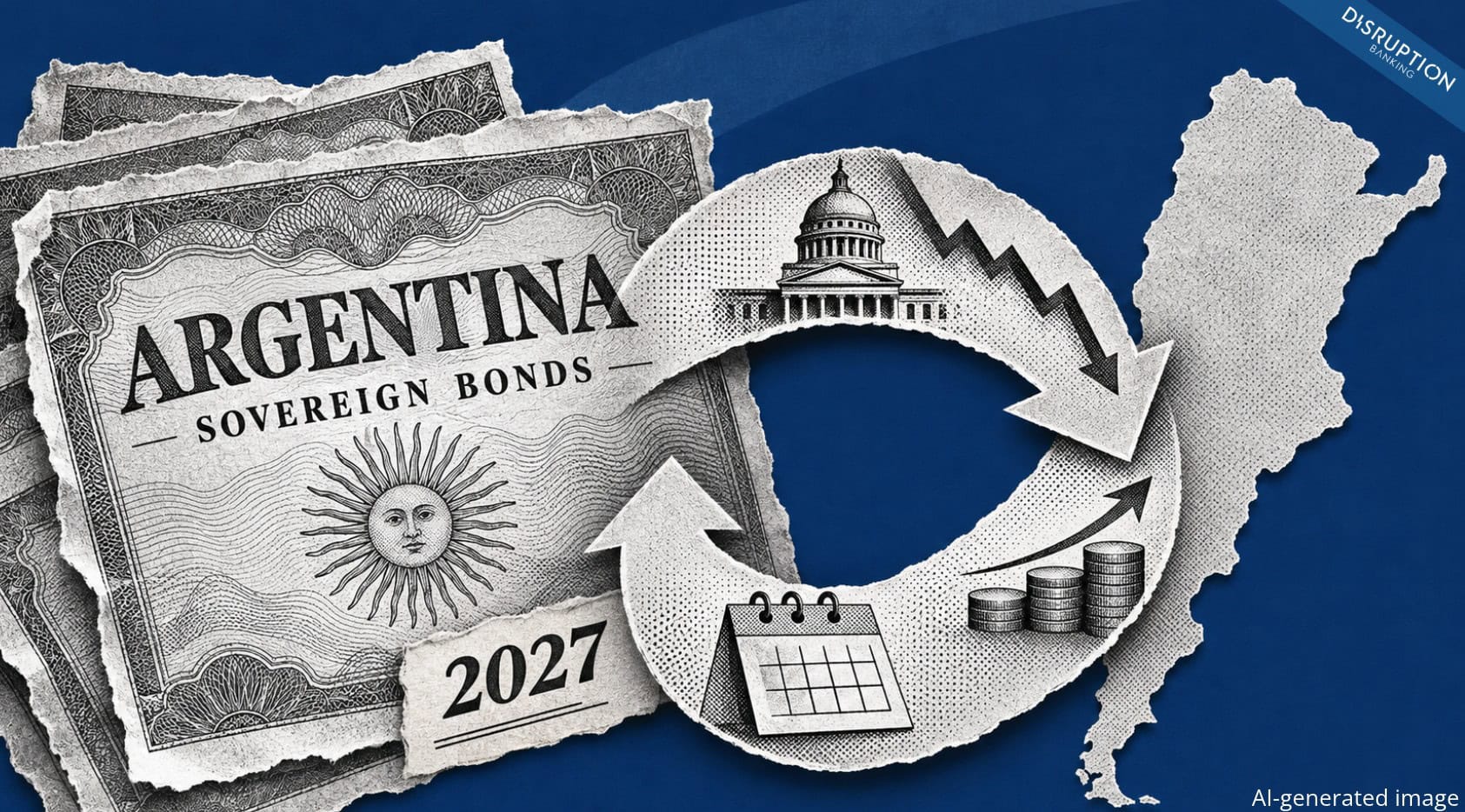
The pressure leaves Caputo’s programme under growing strain. With local dollar issuance paused and the financing gap widening, Argentine government bonds are caught in a feedback loop: political risk raises borrowing costs, the higher costs undermine the financing plan, and doubts about the plan weigh further on bond prices.
Author: Scott Danaher
See Also:
Javier Milei’s Battle to Revive Argentina’s Economy Against All Odds | Disruption Banking
How Strong Will The Mexican Peso (MXN) Be in 2027? | Disruption Banking