
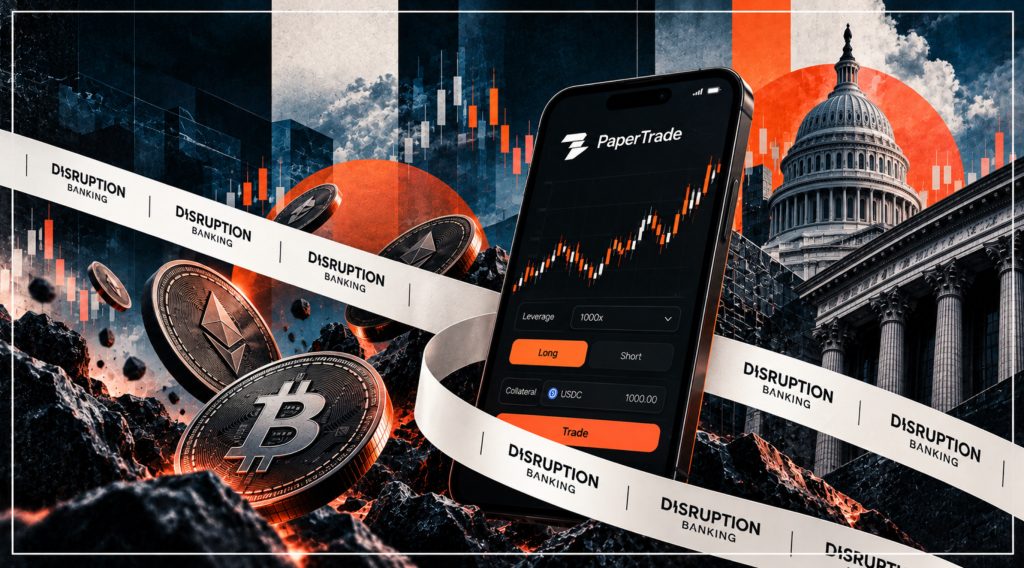
On October 10, the decentralized exchange PaperTrade launched without an order book, external market makers or any conventional liquidity provider. The exchange, which specializes in synthetic perpetual futures contracts, is itself the counterparty to every trade.
It takes the other side through a shared USDC pool called Martingaler LP, which started at zero dollars and is funded entirely by traders’ realized losses.
The opening numbers were enormous. PaperTrade recorded $564 billion in notional volume on launch day alone, and by the end of its second day the figure had reached $804 billion, enough to pass Nasdaq’s daily notional. Maximum open interest hit $10.1 billion.
Those volume figures trace back to Blockworks Research by way of a single post on X, and nobody has audited them.
Leverage Upon Leverage
Perpetual futures in crypto are routinely leveraged to a degree that would be illegal almost anywhere else in finance. Binance runs to 125x on bitcoin. Kraken Pro doubled its bitcoin and ether perpetual leverage to 100x. Hyperliquid, the exchange and blockchain Papertrade is built on, caps out at 40x on bitcoin and 25x on ether.
PaperTrade offers 1,000x on both.
The pool pays out winning traders and mints PAPER tokens to losing ones. Below a $2 million pool size, a trader can earn up to 100 PAPER for every dollar of eligible loss, with the rate falling as the pool grows. Stakers collect a share of trading fees in USDC, and once the pool clears $5 million, the excess gets distributed to them too.
The design has an obvious failure mode, and Papertrade documented it: when the pool cannot cover what it owes, payouts go into a queue and get settled first come, first served.
Bait & Switch
On October 1, Papertrade told prospective depositors that PAPER would eventually become transferable, “after a sufficient period of time has passed.” Somewhere between $85 million and $138 million flowed in as pre-deposits on that understanding. Roughly 99% of the token supply was staked within the first week.
Then on October 19, the team reversed itself. “At this juncture we do not have plans to allow off-contract token transferability,” it said. PAPER can still be staked and unstaked. It cannot be sent anywhere or sold.
A lot of traders had spent the intervening days losing money deliberately to farm tokens they expected to flip. They cannot. According to Lookonchain, 21 of the 25 largest losers were still underwater even after their staking rewards were counted.
One user did come out ahead, claiming $1.73 million in rewards against $979,000 in losses, which tells you how good the farming looked before the rules changed.
The Risk Was in the Document
Jason Pagoulatos, head of markets at Delphi Digital, put it plainly on an October 22 podcast. He said the episode was “not exactly a rug” but that the team was “kind of bait-and-switching you” on the terms people had signed up for, and he called the reversal a bad look.
“You sell a bunch of people on a rule set beforehand, a bunch of money comes in, and now you change everything after the fact.”
Pagoulatos also granted the other side of it. He agrees the manipulation risk is real, saying an attack “will 100% happen if the token is made transferable,” and he notes the team “literally put the risk in the doc ahead of time.”
His read is that there is some blame to go around for everybody. Papertrade co-founder Jez has argued that PAPER is better understood as a revenue share in the exchange than as a traditional crypto token, which is a reasonable description of what it now is and a poor description of what people thought they were buying.
Reliance on Hyperliquid
Papertrade uses no order books and no external oracles. It reads prices straight off Hyperliquid’s midpoint, the halfway mark between the best bid and the best ask. That minimalism got stress-tested within eight hours of launch.
A trader opened a long position at 1,000x, then bought roughly 6,060 Ethereum (ETH), about $20 million worth, on Hyperliquid’s spot market. The purchase moved the price up around $3, or 0.12%, which at 1,000x was enough to double the margin.
About an hour later, the trader opened a 30 ETH short at 660x, a notional position of $297 million, and sold roughly 6,590 ETH to push the price back down. The round trip drained $1.28 million out of the pool and cost about $52,000 in Hyperliquid fees.
Papertrade’s response was that the “initial position limit was set too loosely, and it is currently being tightened.” The team maintains this is not a flaw in the mechanism.
Perps Are Taking Over
Unlike traditional futures, perpetual futures never expire and trade around the clock. BitMEX introduced them in 2016, and they now dominate crypto, accounting for more than 70% of total volume on centralized exchanges. CryptoQuant put 2025 perp volume at roughly $61.7 trillion.
CoinGecko’s April 2026 reading of the eleven largest centralized perp venues came to $4.4 trillion for the month.
Until this year, perps were effectively off limits in the United States.
Washington Opens the Door
That changed on May 29, when CFTC staff issued an advisory and no-action relief rather than a formal rule, which cleared the way for regulated venues. Kalshi got the green light for a bitcoin perpetual contract. Coinbase received a no-action position covering its own planned derivatives.
CFTC Chair Michael Selig called it historic action. Coinbase CEO Brian Armstrong framed the old regime bluntly, saying US users had been locked out of around 80% of global crypto markets.
US exchanges had spent months gearing up for the change. Kalshi’s perps crossed $1 billion in volume inside a week. Its prediction markets took forty months to reach the same milestone.
The Incumbent Objects
The reception was not universally warm. CME Group chairman and CEO Terry Duffy called the approved contracts “a disaster waiting to happen” at a June conference, said the funding rate mechanism “incites bad behavior,” and pointed at 50-to-1 leverage as a systemic concern.
CME describes itself as the world’s largest regulated derivatives marketplace, and perps encroach on its territory, so the warning is not disinterested. Duffy addressed that directly, arguing CME is insulated because 85% to 90% of its volume comes from institutions. Whether that holds as retail perp venues scale is the open question.
On August 19, President Trump said the CFTC was working to bring Hyperliquid into the US “in a fully compliant fashion.” Hyperliquid is the largest decentralized perpetual futures exchange in the world, and it also runs HyperEVM, the Ethereum-compatible execution layer Papertrade sits on.
The HYPE token jumped on the news. A wider reckoning is underway across Wall Street over what a 24/7 contract with no expiry does to the rest of the market.
A Different Approach to Risk
PaperTrade’s bootstrap liquidity and four-figure leverage mark a real shift in the derivatives market. Futures and options were built as hedges, instruments for laying off risk onto someone willing to carry it. Perps, in the form PaperTrade has taken them, manufacture risk and sell it as entertainment.
The exchange needs losses the way a casino needs a house edge, except the house here is a smart contract with no balance sheet of its own.
Critics have called the arrangement a Ponzi scheme, which is imprecise. A Ponzi scheme conceals the fact that new money pays old claims. PaperTrade published it.
Twelve Days Is All It Took
The question the critics asked was what happens when volume dries up. The answer arrived faster than anyone expected.
PaperTrade’s daily revenue peaked near $25 million around October 10 and 11. By 05:28 UTC on October 22, it was $178,830, a collapse of more than 99% in twelve days. Volume followed the same curve, falling from $564 billion on launch day to $54.23 billion on October 17, about 90% off the peak, with trade counts down from 226,541 to 135,227 in a single day and new account signups down from 1,322 to 622.
Total value locked peaked around $102 million on October 11 and sat at $40.29 million on October 22. After the transferability reversal, bitcoin open interest fell roughly 40%, and ether open interest fell roughly 55%. Over thirty days, $69.71 million in collateral was liquidated.
October revenue came to $61.96 million in all, with $57.89 million of it paid out to PAPER stakers, which means the people who got paid were largely the people who got in first.
The Pool is Only So Deep
None of this required a hack or a bank run. The incentive to lose money on purpose evaporated the moment the token stopped being sellable, and the volume that incentive generated evaporated with it. The pool was always going to be only as deep as the appetite for feeding it.
PaperTrade said so in its own documentation, and 1,000x leverage on a pool that thin means a small move in the wrong direction can still empty what is left.
What makes the experiment worth watching is not whether PaperTrade survives. It is that regulators in Washington have just opened the door to this product class, CME’s chief executive thinks it is a disaster in waiting, and the most aggressive version of it ran its entire boom-and-bust cycle inside two weeks while everyone was still arguing about whether to allow it.
Author: Tim Tolka, Senior Reporter
#Crypto #Blockchain #DigitalAssets #DeFi
The editorial team at #DisruptionBanking has taken all precautions to ensure that no persons or organizations have been adversely affected or offered any sort of financial advice in this article. This article is most definitely not financial advice.
See Also:
KCEX Asked Crypto Scam Investigator to Push Crypto Scam | Disruption Banking

Tim Tolka
Tim Tolka, Senior Reporter at Disruption Banking, covers digital assets, monetary policy and the politics of global finance. Based in Mexico City, he brings an investigative edge to his reporting, informed by a Master's in International Affairs and his work as an author and screenwriter.