

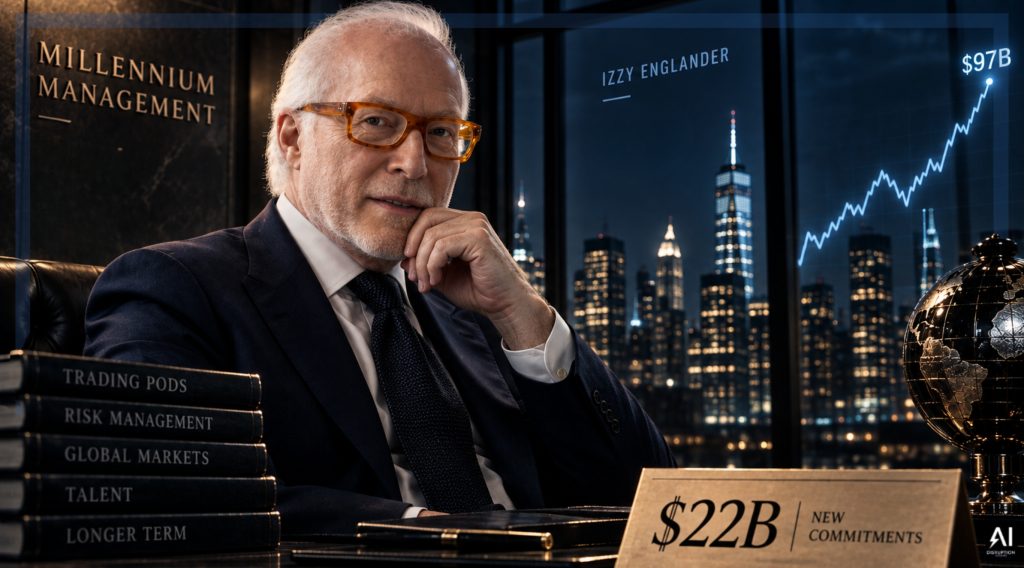
Izzy Englander keeps pushing. At 77, the founder of Millennium Management has driven assets to $97 billion, more than double the total from six years earlier, and is set to close on $22 billion in fresh commitments next month, Bloomberg reported on Monday. Millennium is calling $2 billion on October 1 and will call the balance over the following four years. Talk of another $3 billion for a credit vehicle continues. Bloomberg said the firm has typically returned at least 10 percent a year. At that pace, assets could exceed $130 billion over the next few years as the $22 billion is called and returns compound on the growing base. The new commitments alone would take the platform to about $119 billion.
Englander rarely speaks publicly. The results speak for him.
From Brooklyn Trading Desk to Wall Street Scale
Englander was born September 30, 1948, in Brooklyn and raised in Crown Heights by Polish-Jewish parents sent to a Soviet labor camp after the war; his father’s family was killed in the Holocaust, and his two older sisters were born in the camp before they immigrated to the US in 1947. He attended yeshiva, traded stocks while still in high school, and earned a finance degree from New York University in 1970. He left the NYU MBA program unfinished once the trading floor proved more useful than further classes.
He started as a floor broker and specialist on the American Stock Exchange, focusing on convertibles and options. Later he co-founded Jamie Securities with John Mulheren. Jamie Securities closed in 1988 amid Mulheren’s legal troubles; Englander was never charged, and a federal appeals court overturned Mulheren’s securities-fraud and conspiracy convictions in 1991. In 1989, he launched Millennium with $35 million, $5 million of it his own, alongside Ronald Shear, who left within a year.
The Pod System That Refused to Hit a Ceiling
Englander rejected the single-star model that collapsed larger funds in earlier cycles. He built independent trading pods, each running under strict risk limits and capital that expands or contracts with performance. The firm now runs hundreds of teams, more than 6,800 employees across 18 offices, and executes millions of trades each day. In March, Disruption Banking reported that Millennium was prepared to expand its Jersey presence for Dubai staff who did not want to return during the U.S.-Israel war with Iran, while retaining a smaller operation in Dubai. Bloomberg reported an annualized return of about 14 percent since inception and only one losing year in roughly 35; Reuters reported a 10.5 percent gain in 2025.
The approach absorbs capital without forcing every dollar into the same crowded positions. External seeding and selective spin-outs add further capacity while retaining exclusive relationships in many cases. That structure is why Millennium has outgrown most rivals even as the entire multi-strategy segment has swollen.
Institutional Moves That Reduce Founder Risk
In November 2025, Englander sold a 15 percent stake that valued the management company at roughly $14 billion. The transaction brought long-term institutional capital into ownership for the first time.
He has also spread investment oversight across an Office of the CIO staffed largely by former Goldman Sachs partners and elevated Ajay Nagpal as president and chief operating officer. Englander has told investors the firm is now “far too large and intricate for a single individual to manage.” Key-person clauses that once allowed investors to exit on his departure have been removed.
Under the 2005 mutual-fund market-timing settlement, the fund entities paid $148 million in disgorgement: $121.4 million from Millennium Partners and $26.6 million jointly from two affiliated management companies. Englander paid a $30 million civil penalty, plus $1 in disgorgement. Three other individuals paid smaller penalties: Terence Feeney $2 million, Fred Stone $25,000 and Kovan Pillai $150,000. The combined total ran above $180 million. The settlement did not alter the long-term trajectory of the firm.
Capacity Still Matters More Than Star Power
Englander continues to seed external managers and expand internal teams rather than rely on personal trading edge. Bloomberg’s accompanying chart defines its yardstick as hedge-fund AUM rather than firm-wide assets. On that basis, it puts Millennium’s $97 billion beside AQR at more than $140 billion, D.E. Shaw near $90 billion, and Bridgewater, Two Sigma, Elliott Management, Man Group, TCI Fund Management, and Ken Griffin‘s Citadel above $75 billion. Concentration at the top is real, and some allocators flag the systemic risk when large platforms move in parallel.
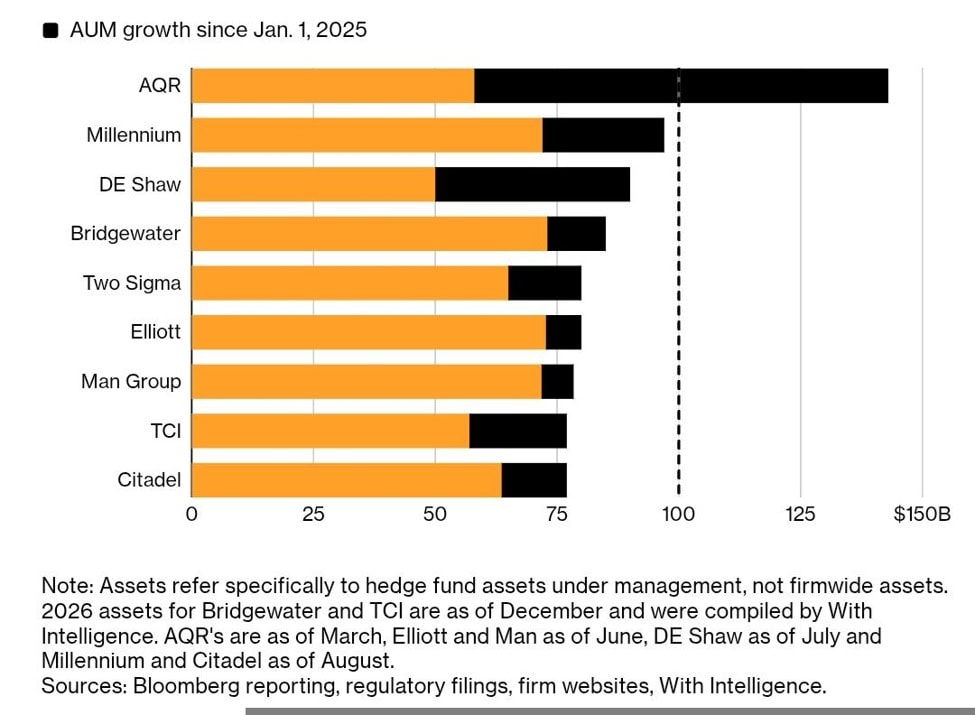
Englander’s response remains structural: more pods, tighter risk controls, longer capital, and deliberate ownership changes. He still controls the majority of the firm. He still sets the culture. At an age when many founders step back, he is accelerating fundraising and capacity. The $100 billion mark is no longer distant. It is the next checkpoint on a path he has controlled for 37 years.
Author: Richardson Chinonyerem
The editorial team at #DisruptionBanking has taken all precautions to ensure that no persons or organisations have been adversely affected or offered any sort of financial advice in this article. This article is most definitely not financial advice.
See Also:
Millennium Ditching Dubai for Jersey as Iran War Hits Too Close | Disruption Banking
Can the Situational Awareness Hedge Fund Raise Capital After its 439% H1 Gain? | Disruption Banking

Richardson Chinonyerem
Contributing author at Disruption Banking, covering capital markets.