
Most stablecoins keep their value by holding reserves. A dollar in a bank account backs a token on-chain, and you trust the issuer to honor the swap. Quai Network built Qi to work differently. There is no reserve and no promise to redeem. Qi is mined into existence, and its supply is meant to track the energy used to produce it.
That design raises a fair question for anyone watching digital money mature: Does an energy-linked token actually behave like money, or is it a clever idea still waiting for proof? The supply numbers offer the clearest early read, so that is where this piece looks, using Quai’s public tracker figures as of July 20, 2026.
How Qi Enters Circulation Without a Reserve
Qi launched in April 2025 with zero pre-mine. No tokens were set aside for founders or investors, which sets it apart from tokens that ship with a large allocation already minted. Qi enters circulation in two ways: it is mined by people running hardware, or it is created when holders convert QUAI into Qi.
Roughly 100 megahashes per second of mining work over a day produces 1 Qi, which works out to about 8 trillion hashes per coin. That ratio is the point. Qi rewards scale with difficulty, so as the network grows and difficulty climbs, miners earn more Qi, not less. Each unit is meant to represent a roughly constant amount of energy, no matter how large the network gets. Quai’s claim is that this pins Qi’s value to a real-world input rather than sentiment.
So what limits how much Qi is floating around? Not the mining math, which happily produces more as the network expands. Two other levers do the work. First, miners choose whether to take their block rewards in QUAI or Qi, so Qi issuance depends on what miners want to hold. Second, Qi shares a ledger with QUAI, the network’s other token, and holders can convert between the two. QUAI works like programmable money for smart contracts, while Qi runs on a separate UTXO system built for payments and cash-style privacy. That conversion is the pressure valve meant to keep Qi’s supply and price in balance. Conversions carry a two-week lockup, so the adjustment is deliberate rather than instant.
The Supply Numbers as of Mid-2026
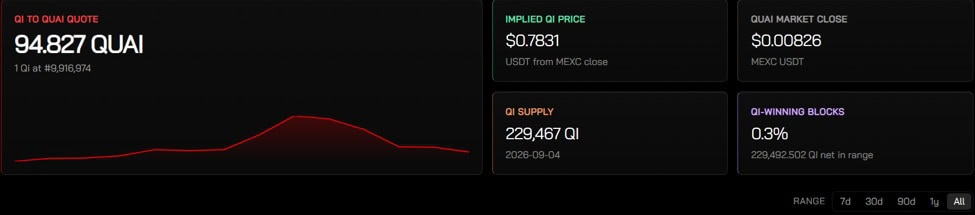
Here is where theory meets the ledger. As of July 20, 2026, Quai’s public Supply Tracker reported roughly 248,912 Qi in circulation against about 1.041 billion QUAI, all verifiable on-chain, according to Disruption Banking’s earlier reporting.
QUAI is measured in billions. Qi sits in the low hundreds of thousands. More than a year after launch, Qi remains a small float. For a token pitched as an everyday medium of exchange, thin supply is the headline fact, and it shapes everything that follows.
Small supply cuts both ways. It signals that mining incentives have not yet driven large volumes of Qi into the market, thereby keeping scarcity intact. It also means the stability mechanism has not been put to a real test. A token that only a handful of participants hold and move has not proven it can hold a steady value once serious volume arrives.
A Fork That Reshaped the Wider Supply Picture
Qi does not sit alone. The same protocol governs QUAI, and a major change in 2026 rewired the supply math for both.
On March 19, 2026, Quai’s foundation, investors, and core team permanently canceled 1.67 billion QUAI of future genesis unlocks in what the network calls the Singularity Fork. Those tokens were never minted and never will be. The move cut future genesis unlocks by 81.1 percent and lowered the vested genesis baseline from 3 billion QUAI to about 1.33 billion (Quai’s docs put the post-fork figure at 1,332,840,016 QUAI).
That 1.33 billion figure is the genesis schedule after the fork. It’s not a hard cap written into consensus. Quai still issues QUAI through mining, and SOAP can burn tokens bought in the open market. The protocol equation is:
total supply = genesis unlocks + mining emissions − SOAP burns
If buybacks fully offset new mining over time, net issuance trends toward zero and supply gravitates toward that post-fork genesis baseline. Quai’s tracker projects a path of about 1.4 billion QUAI by February 2029. That 1.4 billion mark is a soft cap from the genesis schedule, plus the remaining unlocks and the assumed net-emissions path. Not a fixed ceiling. Quai itself has described the post-fork setup as a soft supply cap of roughly 1.4 billion tokens.
Disruption Banking covered the mechanics of that change in detail in its look at how the Singularity Fork reframed Proof-of-Work tokenomics. The point for Qi is context. A protocol willing to strike most of its unminted genesis supply is signaling that scarcity is a design goal, not an afterthought. Qi was given the same treatment: no founder allocation, no pre-minted float.
SOAP and the Buyback Engine Behind the Tokens
The second lever is SOAP (Subsidized Open-market Acquisition Protocol), which has been live since December 2025. It routes mining rewards from partner chains into open-market QUAI purchases. The purchased QUAI is either burned outright or streamed back as time-locked locker rewards. Burns take it out of supply; locker rewards take it off the market until the lock expires.
The idea flips a familiar problem. Merge-mining rewards usually create selling pressure as miners cash out. SOAP turns that flow into steady buying instead. Quai reported a $6.177 million chain-revenue snapshot from that activity in August 2026. SOAP acts on QUAI rather than Qi directly, but it matters for the pair, because a healthier QUAI market gives the conversion mechanism firmer ground to stand on.
Unlocks Still Landing Through January 2029
Scarcity has a counterweight. QUAI genesis tokens keep unlocking on a monthly schedule, and those releases add supply that markets have to absorb.
The tracker lists steady monthly unlocks, each in the range of 12.5–13.1 million QUAI. September 21, 2026, brings about 13.1 million. October adds 12.6 million. The schedule does not taper off next year, either: roughly 352.5 million QUAI remains locked, with releases running monthly through January 2029. Those remaining genesis unlocks sit inside the post-fork baseline; they are how the soft cap is reached, not tokens on top of a hard 1.4 billion limit.
Against a market cap near $9 million as of September 4, 2026, and trading in the low-double-digit millions around the July snapshot, per CoinGecko data, those unlocks are worth watching. Fresh supply meeting thin demand is how price pressure builds.
Why This Belongs on a Capital Markets Radar
Strip away the mechanics, and Qi is an experiment in what backs money. Fiat rests on central bank policy. Most stablecoins rest on bank reserves and an issuer’s word. Qi rests on energy and computation, with no reserve to hold and no issuer promising to redeem it.
That framing has regulatory weight. Disruption Banking recently examined how Quai’s dual-token model aligns with the proposed U.S. CLARITY Act, which draws a line between digital securities and digital commodities and favors tokens issued through decentralized methods such as Proof-of-Work. A token with no issuer and no pre-mine fits that commodity description more cleanly than most. As the bill moves through the Senate, that distinction could matter for how energy-based tokens are treated in the United States.
For now, the honest read is that Qi is a working design with yet to be proven economics. The supply is real, the issuance is transparent, and the mechanism is coherent on paper. What it has not shown is stability under load. The number to watch is Qi’s circulating supply against its implied price as volume grows. If the two hold a steady relationship as the float expands, the energy-dollar thesis gains real evidence. If supply climbs while price drifts, the model needs more work.
Either way, the data is public and updated in real time on Quai’s Supply Tracker. Anyone can check the claim against the ledger, which, for a monetary experiment, is the right place to start.
Author: Ayanfe Fakunle
The editorial team at #DisruptionBanking has taken all precautions to ensure that no persons or organizations have been adversely affected or offered any sort of financial advice in this article. This article is most definitely not financial advice.
See Also:
How Quai’s Singularity Fork Reframed Proof-of-Work Tokenomics | Disruption Banking
Kaspa vs Quai in 2026: Too Early to Call Despite Kaspa’s Head Start | Disruption Banking