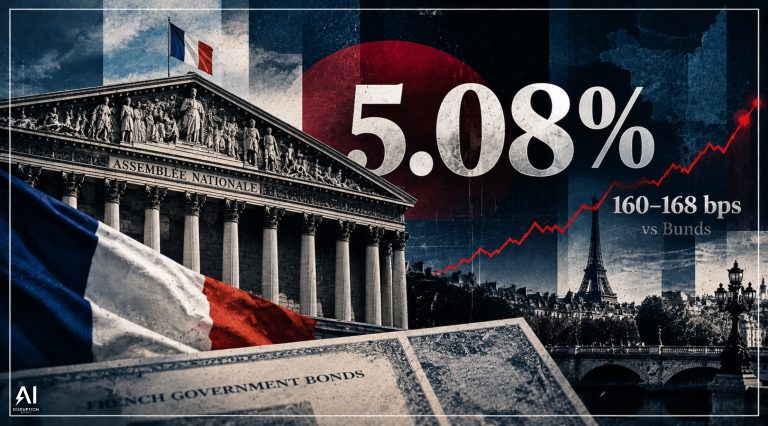


Global government bond yields have climbed to their highest level since the 2008 financial crisis. The Bloomberg Global Treasury Index yield recently reached around 3.68 percent after a sharp rise driven by Middle East tensions and a brief surge in oil prices. Brent crude topped $100 a barrel earlier last week before retreating; it is trading in the mid-to-high $80s today. Even with the pullback in oil, markets continue to price a higher-for-longer rate path as central banks prepare for key decisions.
The yield move has brought renewed attention to the structural position of major central banks. Former World Bank President David Malpass has for several years described the Federal Reserve’s large balance sheet as functioning like a giant hedge fund. The Fed continues to carry a deferred asset of roughly $236 billion that reflects cumulative operating losses. Those losses arose because the central bank bought large quantities of longer-duration bonds during quantitative easing and later paid much higher rates on bank reserves after the 2022 tightening cycle. Similar pressures exist at other central banks that expanded their balance sheets aggressively in recent years. Critics argue this structure continues to absorb interest-rate risk that would otherwise sit with the private sector or the Treasury, while reducing future remittances to governments.
Gulf Nations Borrow to Build Beyond Hormuz
The same higher-yield environment is eliciting a different response from energy-exporting sovereigns. Gulf Cooperation Council countries, including Saudi Arabia, Kuwait, the United Arab Emirates and Qatar, have issued a record $112 billion in bonds and sukuk so far this year, the highest volume for this point in any year and more than triple the 2022 pace. A large share of the proceeds is directed toward infrastructure that reduces dependence on the Strait of Hormuz: new ports on the Red Sea and Gulf of Oman, upgraded pipelines, and improved road networks. Investor demand has stayed firm; Kuwait’s recent $6 billion deal was more than twice oversubscribed.
The contrast is clear. Developed-market central banks are still managing the consequences of earlier large-scale asset purchases, carrying duration risk and accounting losses on their books. Gulf sovereigns, by contrast, are using access to the bond market to finance physical assets that strengthen energy-export resilience. One set of institutions is absorbing the residual costs of past policy; the other is converting capital-market funding into concrete geopolitical insurance.
For banks and capital markets the divergence carries practical weight. Higher global yields tighten financial conditions and raise funding costs. Persistent central-bank losses keep the question of balance-sheet normalization and fiscal transfers in view. At the same time, the Gulf issuance wave shows that investor appetite for well-backed sovereign credit remains intact even after the recent rate volatility. Capital is flowing toward strategic infrastructure rather than purely financial engineering, one of the clearer signals that the post-2008 low-rate era continues to recede.
Whether the pattern endures will depend on the path of inflation, oil prices, and the pace at which central banks shrink their footprints. For the moment the bond market is displaying two faces of the same higher-yield reality: institutions still working through the legacy of earlier interventions, and sovereigns treating the market as a construction tool.
Author: Andy Samu
See Also:
Why Did Kevin Warsh Shock Markets on Rate Cuts? | Disruption Banking

Andrew Samu
Andrew Samu, Editor-at-Large at Disruption Banking, shapes the publication’s global coverage of banking, capital markets and digital assets. Based at London’s Level39, he combines market analysis with a strong commercial perspective, informed in part by his role as Commercial Director at Verita HR.